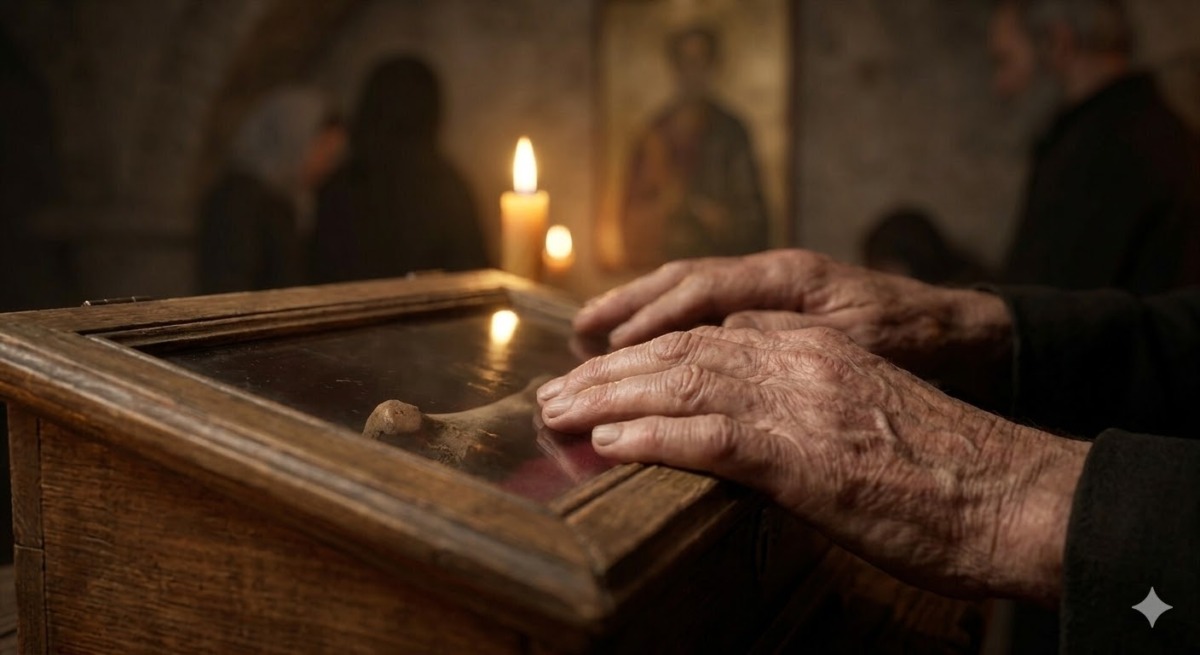
“The manner in which they are wrought is worthy of laughter and tears. They have in an ark full of human bones and intact skulls, which they silver, and they call them, one of St. Charalambus and another of St. Gregory. Wherefore, they shall not baptize a saint without having part of his bones. Most of these bone-eaters come out of the mountain of Athos, which they call Mount Athos, where the source of these bones is located.”
In 1806, long before Greece gained its freedom, a small book was published in Italy that was destined to leave a great imprint, the «Greek Prefecture». Its anonymous author, with a courage rare for the time, spoke not only of political slavery, but also of spiritual slavery. Between his pages, he described a reality that many knew but few dared to confess: the existence of relics presented as sacred, without anyone being able to prove their origin. Bones placed in elaborate reliquaries, adorned with silver and gold, became objects of veneration and veneration.
For the people of that time, however, the issue was not proof. It was the need. They lived in a world of hardship, deprivation and fear. Death was a daily companion. So a relic was not just a bone. It was a promise. A silent assurance that maybe there is something that doesn't end.
Later, great writers dared to touch on the same subject. Emmanuel Roidis, through the famous Pope Joan, ironically revealed that the trading of relics was a widespread practice throughout Europe. He was not only interested in the fraud, but above all in the human willingness to believe. Nikos Kazantzakis, in The Sisters, presented with bitter humour the existence of more than one relic for the same saint, showing that faith does not always depend on reason, but on the need of the heart.
If one considers that the «scavenging» of the time was transferred from the 19th to the 21st century as a normality, the relics of Saint Lazarus were doomed from the beginning to be relegated to the background. What if any serious historian, who doesn't want to have a heart attack from laughing, can tell you that Lazarus not only didn't rise from the dead, but didn't even exist? But this is small print for a flock that swallows what is served to them without chewing.
And so, no one would be offended if they learned (even if the information ever reached their ears) that the «authenticity» of the relics is claimed by France, in addition to Cyprus. A saint with two heads, four arms and four legs is but an almost plausible monster in the face of the Hydra we have mentioned.
As if that were not enough, it is said that the Archimafioso of Crete once asked Archimafioso Melchizedek if the fragment of the relic was «genuine» or if it came from an animal. The archimandrite's answer was a poem: «Don't bullshit me, asshole.» You see, in a country that still lives in 1806 terms, what counts above all is a decent use of language... and a good pepper in the mouth!
And as if the story of Lazarus was not enough, it is enough to look at other saints to understand how... multiple versions of the relics can be. For each saint there were relics in dozens of monasteries, in different cities and countries. Each reliquary claimed to hold the «original» bone, the «real» part of the saint's body. And if you looked at it logically, you'd say something didn't add up: one saint, dozens of heads, arms and legs. And yet, for the faithful, truth was not measured by numbers, but by faith and the need to touch something sacred.
This is the case of Lazarus of Bethany. His remains are honoured in different places, and for thousands of people they are a source of consolation. Perhaps for the historian there is doubt. For the believer, however, there is hope. And sometimes, hope is stronger than proof.
There are times when a person does not approach a relic out of certainty, but out of necessity. He slowly bends down, makes the sign of the cross and stands for a while in silence. He does not necessarily expect a miracle. He waits for an answer within himself. Like looking at an old object that belonged to a loved one who has passed away. There is no value in the object. It's what it reminds you of that has value.
Because, in fact, the relic does not speak of the saint. It speaks of the man. It speaks of the fear of death, of the difficulty of separation, of the need to believe that something continues. Man cannot easily bear the idea of final silence. And so he creates symbols. Symbols of hope.
One need not see the relics only as a fraud or only as a miracle. They are, above all, part of human history. It is man's attempt to come to terms with his end. To make sense of what he cannot understand.
And so, the real question is not whether the remains are real.
The real question is why we need them.
We need them because we are afraid of getting lost.
We need them because we want to believe that something of us will remain.
Because, in the end, the greatest truth is not in the reliquary.
It is in the man who stands before it.
In his need to hope.
In his need to believe.
And in his irresistible desire to never become just a relic in the memory of others.