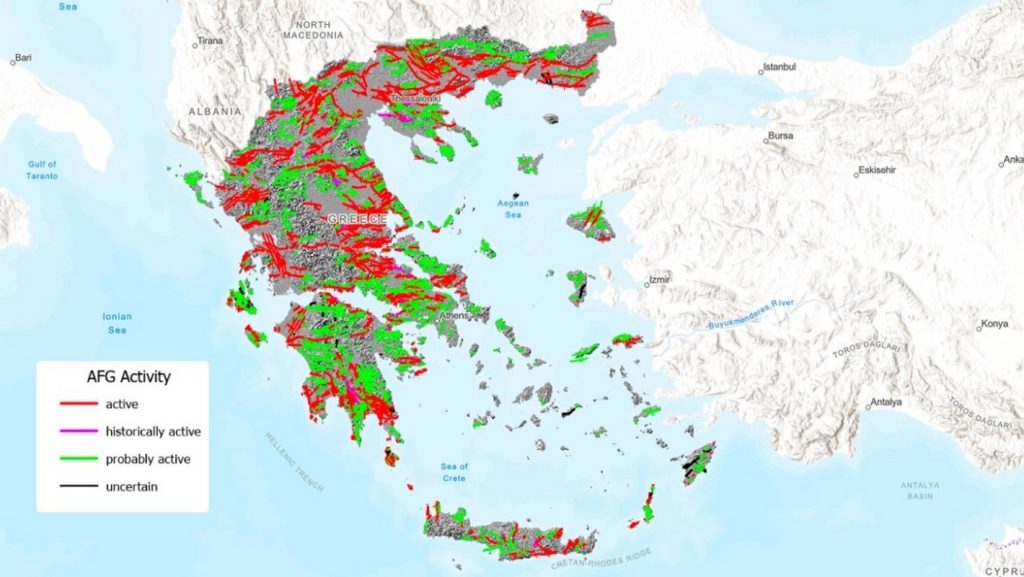
Scientists from the National Observatory of Athens (NASA) and New Zealand have systematically mapped the entire Greek mainland, using detailed Digital Earth Models (DEMs) from the Hellenic Cadastre, in order to record and classify the country's active seismic faults.
The research team identified hundreds of new faults and mapped more accurately those already known, creating AFG (Active Faults Greece), the first comprehensive database of active faults based solely on their footprint on the relief, published in the scientific journal Nature.
As the international team of Dr John Begg, Dr Vassiliki Mouslopoulou, Dr Dave Heron and Prof. Andy Nicol reports to the Athens-Macedonian News Agency, the Greek landscape, with its strong morphological contrasts, reflects a continuous geological process.
«Greece, wedged between two continents, is deformed by the persistent movement of Africa northwards and Eurasia southwards. The country's topography continues to change today through the action of active seismic faults, many of which remain hidden beneath vegetation or urban environments,» they stress.
At the same time, they point out that, with the economy increasingly based on tourism and Greece's ambition to become an energy hub, «it is necessary to have a deeper understanding of the dispersion of seismic sources, which requires detailed mapping throughout the land and submarine territory».
The AFG is the first national map of active faults based exclusively on soil morphology, at a consistent scale of 1:25,000. A total of 3,815 fault traces are recorded, grouped into 892 individual faults, of which more than half are mapped for the first time.
At the same time, 35 surface ruptures linked to historical earthquakes are included. Each fault is classified as active, possibly active or uncertain, depending on how recently the relief has been deformed or whether the available data allow a safe characterisation.
More than 2,000 traces are classified as active and about 1,600 as potentially active. The analysis showed that more than half of the active faults directly affect river flow, sediment deposition and the boundaries between mountain ranges and valleys. However, according to the researchers, some active faults remain undetectable, «buried» beneath younger geological deposits.
In terms of methodology, the scientists point out that modern DEMs allow the Earth's surface to be visualised with unprecedented accuracy. «A DEM is not just a map; it is a three-dimensional representation of the Earth's surface, allowing structures invisible to the naked eye to be revealed,» they say.
Through special imaging of lighting and gradients, geomorphological clues - such as the changing course of a river or a triangular front on a mountain slope - can be clear signs of earlier earthquakes.
Active fault mapping has direct practical applications. As Dr Vasiliki Mouslopoulou, Principal Researcher at the Geodynamic Institute of the National Academy of Sciences, tells RES-MPA, «knowledge of the location and characteristics of active seismic sources is critical for the design of roads, bridges, dams and energy infrastructure. AFG information, combined with seismic and ground deformation data, can significantly enhance the country's seismic hazard models.».
At the same time, Dr John Begg makes it clear that «technology alone is not enough», pointing out that interpreting DEMs requires geological expertise to separate a tectonic trace from an erosion surface. «AFG's strength lies in combining modern tools with decades of geological knowledge,» he says.
The AFG database is freely accessible to the public. Through an interactive map, engineers, researchers and citizens can locate active faults in their area of interest and learn about their characteristics.
The scientific team believes that the initiative will make a significant contribution to national mapping efforts and will serve as a model for other seismically active countries that want to use digital landscapes for fault detection.
You can read the publication in English here: https://www.nature.com/articles/s41597-025-06283-z , while the interactive map can be found here: https://experience.arcgis.com/experience/a6c85b1edf9d4d17a3f01a70cef6d2b2
The Active Faults of Kythera
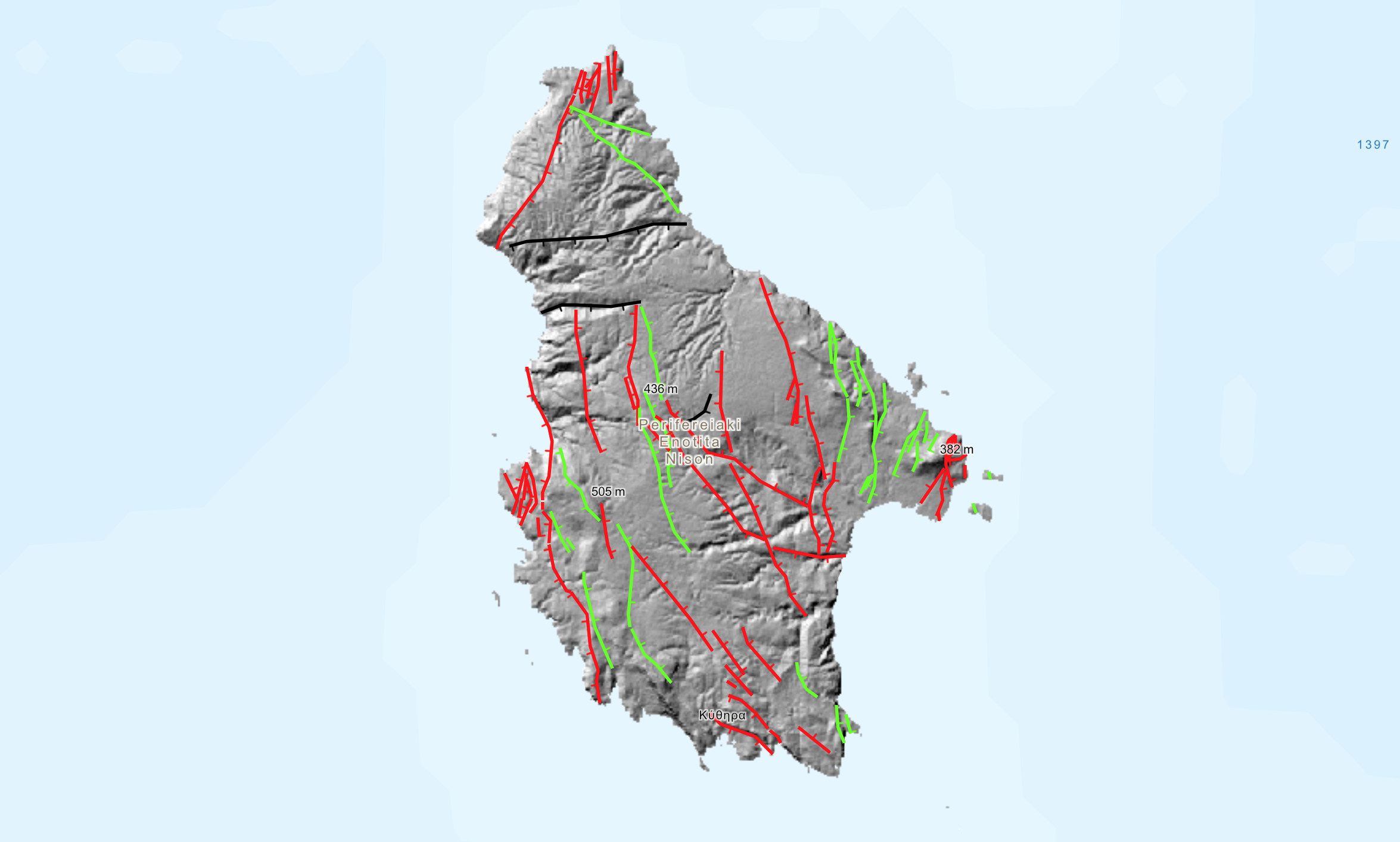
Kythira is not a non-seismic island. They are located on a belt with a dense network of active and potentially active faults, as captured now with much greater accuracy thanks to AFG. The new mapping does not mean that “an earthquake is coming tomorrow”, but:
- dramatically increases the update on the sources of earthquakes on the island
- Sitting inevitable to take account of fractures in every major project, study and development strategy.
What the map shows for Kythera
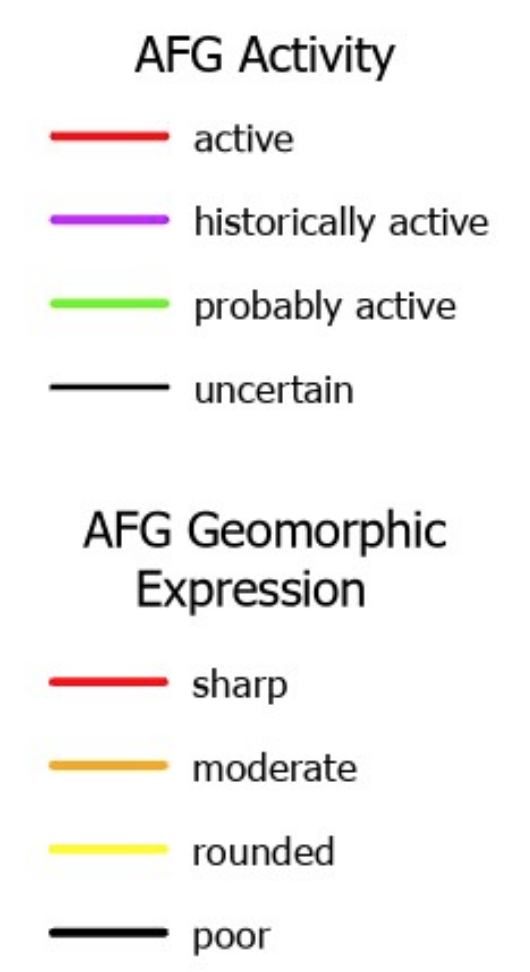
Colours - Fracture Activity (AFG Activity):
- Red: active fracture
- Green: potentially active
- Black: uncertain (more data needed)
There is a dense network of red faults that run almost all over the island, mainly in a N-S/NE-SW direction.
The green (probably active) are mainly concentrated in the east side and in some parts of the central island.
The black (uncertain) are few, mainly in 1-2 lines in the north-central part.