The Athens University Students' Cultural Club issued a press release regarding the abolition of the independent legal personality of the University Club of the University of Athens and the new law - framework of the Ministry of Education in general. Read below:
Press release of the Cultural Club of Students of the University of Athens
The students of the Cultural Club of the Students of the University of Athens protest against the new law - framework of the Ministry of Education and article 296
This article stipulates the abolition of the independent legal personality of the University Club of the University of Athens. This change abolishes the Club's autonomy and, consequently, the independent management of its financial reserves, its budget and its building infrastructure. The Club of the UCLF houses various student services (two student reading rooms, a student welfare fund, food and accommodation, medical and mental health services). At the same time, it houses and supports the Cultural Club of Students of the University of Athens (P.O.F.P.A.), which has been active for almost 100 years in the buildings of 15 Ippokratous Street, on the ground floor of which the historic «Iris» cinema theatre is located, and in the «Kostis Palamas» building on the corner of Akademias and Massalias Streets.
The P.O.F.F.P.A., as it exists today, was founded in the mid-1980s with three Sectors: the Theatre, Film and Dance, with the fourth, Photography, being added a little later. Its operation is based on the selfless and voluntary contribution of its members, old and young, while its organization and continuation over time are ensured by the efforts, personal time and enthusiasm of the students.
The Theatre Department, with two theatre groups, stages annual theatre performances open to the public, with free admission.
The Film Department has a daily programme of educational seminars - screenings and supports the production of films and their participation in domestic and international festivals.
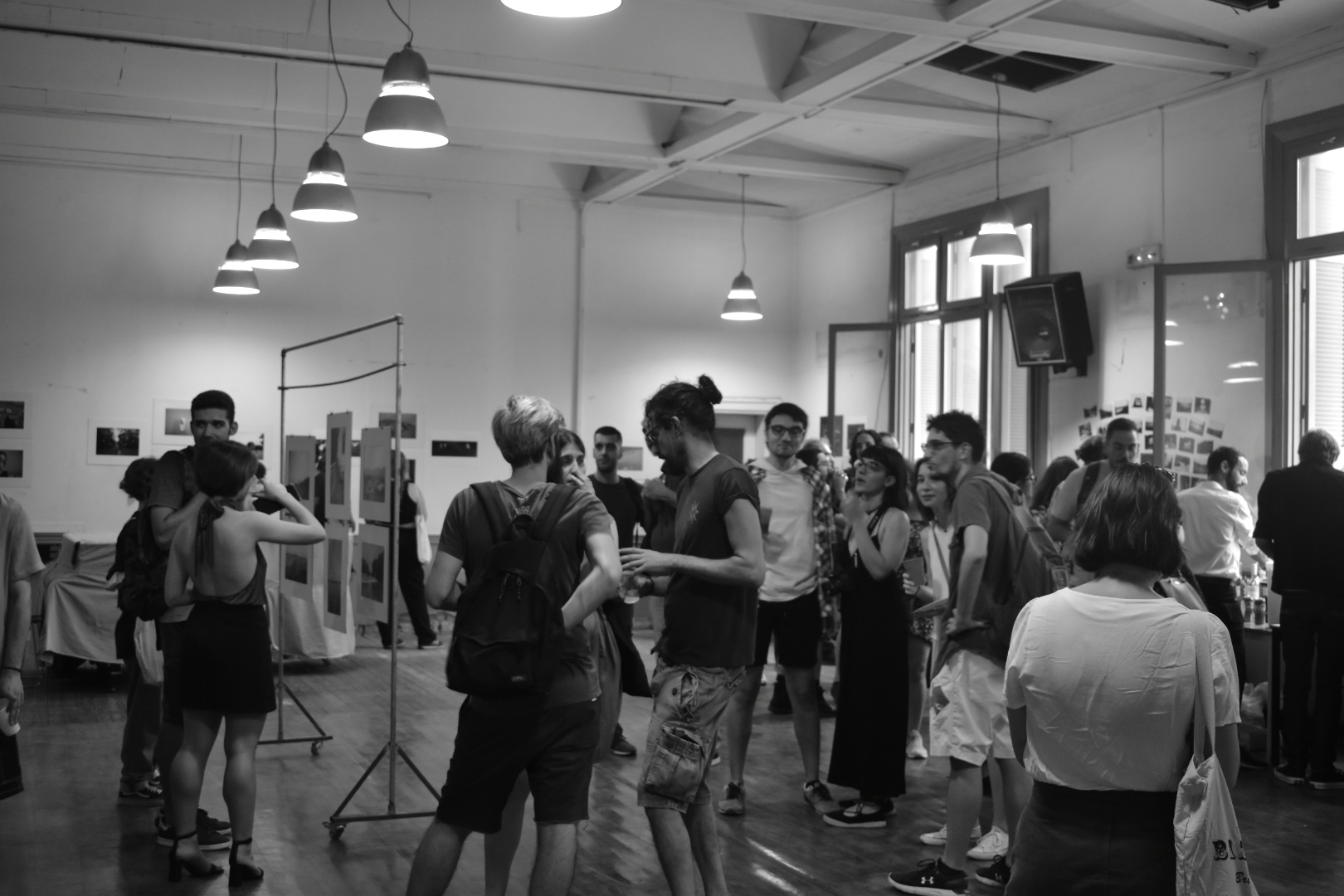
The Photography Section provides daily theoretical and practical photography courses and organizes the annual photography exhibition of its members.
The Dance Department delivers traditional dance classes and at the end of each academic year organizes a central dance performance and participates in events of other institutions throughout Greece and abroad.
With the passing of the law - framework, which affects the student care services, the future of the P.O.F.P.A. is directly affected, since all of its activities are housed within the premises of the Club and supported by it. For this reason, as the P.O.F.P.A. we demand the withdrawal of the framework law and Article 296.
The P.O.F.F.P.A. has managed to become a cradle of culture for the student community, but also for the general population of the city of Athens. Participation and access to the group's activities are open and free of charge within the framework of the public university, far from the logic of exclusion from culture and its commercialization.
Below is the written protest of the Cultural Group of Students of the University of Athens, as it was transferred to the Rectorate of the University of Athens.
Written Protest of the Cultural Group of Students of the University of Athens for the new bill for the universities and article 296
The student community is facing the filing and imminent passage of the Framework Law: “New Horizons in Higher Education Institutions: Strengthening the quality, functionality and connection of higher education institutions with society and other provisions”, which is expected to place an additional burden on the operation of universities.
As students of departments of the University of Athens and other University Institutions of Athens, who choose to devote our free time to the cultural activities offered by the Cultural Club of Students of the University of Athens (hereinafter referred to as P.O.F.P.A..), which are housed and financed by the University Club of the University of Athens, we express our opposition to the specific law - framework and in particular to article 296.
This article stipulates the abolition of the Club's independent legal personality and the subordination of its debts and rights in rem to the legal entity of the University of Athens. This change abolishes the Club's autonomy and, consequently, the independent management of its financial reserves, its budget and its building infrastructure. As a result, the future of the PAFPA is directly affected since all its activities are housed within the Club's premises and supported by it.
The Club of the University of Athens, initially as the main institution of student welfare for the university, housed, apart from the PofPA, the student reading rooms, the Club's library, medical clinics with all the specialities of doctors providing free medical care to students, a language learning centre with teaching of more than 33 languages, for a long time it also housed the E.In addition, to this day it has been responsible for feeding the students of the university and the student relief fund. Over the years, at different times, parts of the above services, such as the language learning centre, have been detached from the responsibility of the club and a decline in the quality of their services has followed as a result of underfunding. A similar experience has been made with the clinics run by the club, which are now limited to basic medical specialities. In the above logic, the transfer of responsibility for the various Student Services from the Club leads to a reduction in their funding and, in perpetuity, their deterioration.
The Club's buildings are not owned by the Club, but are granted for use by EKPA to the Club for the purpose of student welfare. At the moment the activities of the club are limited to the building at 15 Ippokratous and the basement of the building “Kostis Palamas”, 48 Akademias and 2 Massalias. In the past, the Club also used the historic building of the University of Athens at 5, Tholou Street in the Plaka area, but today, after the withdrawal of its concession by the University of Athens, the building has been leased to a private company and its use for student activities is by reservation and for a fee by the Club or the University. The University's event space on the Academy, where the graduation ceremonies of a number of graduates of the University of Athens are traditionally held, is similarly managed, with the result that the space is leased so frequently on a calendar basis for events unrelated to student activities that the faculties cannot find availability for holding the ceremonies.
It is easy to conclude that the abolition of the Club of the University of Athens can lead the above historical buildings, which have been inextricably linked for more than 100 years with the daily life and well-being of students, to similar management, paving the way for the intensification of business activity within the University. At the same time, it is worth noting that the building at 15 Ippokratous has been erected on land which is part of the Antonis Papadakis bequest and has been bequeathed for the purpose of student care. The general tendency of the university for its legacies is to lease them on a long-term basis and to provide scholarships from the rental income. The current use of the building at 15 Ippokratous 15 is the most beneficial for the University's student body due to the services housed within it, while at the same time it has been a long-standing centre of student creativity, expression and study, thus contributing to the provision of a comprehensive and multifaceted education for the students of the University.
Over the last decades, the general trend of education ministries has been the devaluation of universities and the activities within them through the continuous reduction of their funding, and the pressure to self-fund the institutions through business agreements with third parties. The parallel structural and organisational alteration of universities (mergers of departments, abolition of asylum, introduction of university police, introduction of tuition fees for postgraduate programmes, etc.) leads to the weakening of universities as places of free participation, circulation of ideas and therefore of culture.
The Cultural Club
As early as the 1970s, the University of Athens Theatrical Department (T.T.P.A.) was operating in the University Club - which is not related to the academic Department of Theatrical Studies of the University of Athens, whose operation began in 1990-91. Within the framework of the T.T.P.A., activities related to theatre, cinema and dance were developed. The P.O.F.P.A., as it exists today, was founded in the mid-1980s with three Sectors: the Theatre, Film and Dance, with the fourth, Photography, being added in 1987. Its operation is based on the selfless and voluntary contribution of its members, old and new, while its organization and continuation in time, are ensured by the efforts, personal time and the passion of the students.
In this way, the P.O.F.P.A. has managed to become a cradle of culture for the student community and the general population of the city of Athens. Participation and access to the group's activities are open and free of charge in the context of the public university, far from the logic of exclusion from culture and its commercialisation. Engaging with culture is not a marginal activity in a student's daily life, but enriches it, while benefiting the wider community, thus making the university a an outward-looking organisation with a substantial connection to society. In short, the result of the actions of the P.O.F.P.A. is the upgrading the image of the external relations of the UCA.
Specifically:
Theatre Department
The Theatre Department of the National and Kapodistrian University of Athens was founded in 1923. Its nucleus was the «Union of Refugee Students» with N. Matthaios as its animator. From time to time, important people of the theatre, such as Manos Katrakis, Andreas Filippidis, Christos Tsaganeas, Stavros Xenidis, Pellos Katselis, Lydia Koniordou etc. were its members.
During the period of the dictatorship, it was reconstituted after a short period of inactivity and since then it has followed a continuous course of experimental artistic intervention in the cultural events of the country.
All these 100 years of existence of the Theatre Department of the University of Athens, the teams take part in national and international festivals, in which they have often been distinguished.
Today, the Theatre Department consists of two active groups: Unseen - Theatrodine - other groups have operated in the past, indicative reference is made to the operation of the active ones today.
The theatrical group Theatrodini was founded in the 80’s by students of the University of Athens. The theatrical group Afantoi was founded in 1996 and has staged a total of 25 performances. The groups' annual operation starts with the registration of new members in October. During the first months, rehearsals are coordinated by older members who want to pass on their knowledge and skills to the younger members. With a combination of improvisations, theatre games and kinesiology exercises, the group activates the imagination, discovers boundaries and opens new horizons by passing on theatrical tools and knowledge. Around the middle of the year, once a decision has been made to stage a performance, a group member is selected from the members of the groups to external partner, who is involved in directing in order to pass on his knowledge and guide the team in the process of preparing the performance. The group organises regular rehearsal meetings three times a week with content defined either by the members themselves or by people specialised in specific theatrical techniques, who are invited to present and pass on their knowledge to the members of the group in the form of seminars.
In addition, both groups are active members of the Panhellenic Coordination of Amateur Student Theatre and in recent years they have been present with their performance at the annual festival organized by the coordinating committee, thus communicating it to various cities of the country. The rehearsals of the groups as well as their main performances are held in the basement of the building at 48 Akademias Street and 2 Massalias Street, “Kostis Palamas” and on the fourth floor of the Club's main building, at 15 Hippokratous Street.
Cinema Sector
The Film Department has a full weekly programme of seminars (script - technical - analysis - directing) and educational screenings on video and film. It operates on the ground floor of the University Club, in the Iris Cinema, for which it bears the main responsibility and obligation of operation. The seminars are conducted on a voluntary basis by former and newer members of the Film Department, as well as by external collaborators.
Within the framework of the practical/technical seminars, film exercises are carried out in order to familiarize the members of the Department with the cinematographic subject and the equipment available. At a later stage, the members have acquired the the knowledge and experience to realise productions of their own design. For this purpose, the Section provides logistical film equipment for the production of films - either digital or analogue, since, apart from filming equipment, it also has digital editing and 8mm film developing laboratories, thus enabling its members to make their own short film at no cost, with several of them being distinguished at domestic film festivals. It also organizes events, such as festivals and tributes, with invited directors and technicians with many years of experience and presence in the field, in order to talk about their work and cinema. At the same time, it provides the opportunity for young artists to share their creations. Finally, it publishes the film magazine “Bobina”, available either in print or online.
Photography Department
The Photography Section has been operating since 1987 as a place of acquaintance with the world of Photography.
Registration starts in September and the seminars are held daily at the ”Iris” cinema theatre of the University Club of the University of Athens (15 Akadimias and Hippokratous 15). It includes the technical part, as well as a theoretical part, where the history of photography is reviewed through the presentation of the work of well-known and not only photographers.
The free courses, as well as the broader operation of the Photography Department, are addressed to all interested parties, students and non-students, regardless of their studies or previous experience, while, in parallel, activities are organized, such as:
- Dark chambers : Members have the opportunity to develop and print film in the fully equipped darkrooms of the POPFPA
- Library : The Section has one of the most complete photographic libraries, where members have access to photographic albums
- Photographic excursions : Within the framework of the seminars, photographic excursions are organized, inside and outside Attica, so that the members become familiar with the process of photographic shooting.
- Exhibitions : The annual exhibitions of the members of the Photography Department, at the end of each academic year, give the opportunity to showcase their works and their development in the field of photography.
- Album : Publication of a Photo Album with photos of the members
- Invited photographers : Introduction and promotion of the work of Greek photographers in the context of the courses
- Workshops : seminars on lightroom editing, lighting, studio photography etc.
Dance Sector
The Dance Department organizes daily classes in Greek traditional dances throughout the academic year. The classes take place in the hall of the 1st basement of the University Club. The aim of the Dance Department is to raising awareness of students on issues of our popular culture. Students record and process all those elements that make up Greek culture, thus experiencing our traditional heritage. The departments are overcrowded and the Department works many hours a week to meet the needs of the students. At the same time, screenings are held in order to approach the style of each region through this avenue as well. In addition, seminars are held by experienced dancers where they show the authentic dance identity of different provinces. At the same time, it participates in events organized by other institutions throughout Greece and abroad. At the end of each academic year, it organizes a dance performance with traditional costumes and live music.
With this text we demand:
- The Retraction of this bill against which the overwhelming majority of the academic community has positioned itself
- The maintaining the financial and operational independence of the Club as a distinct NPO, no thought of abolishing it
- The constant funding of the Club
- The continuation of the activities of the P.O.F.P.A. in the areas where it has been active for decades
- No thought of shifting the base of the P.O.F.P.A.
- No thought of changing the use of the Club's premises
- No degradation of the Student Affairs of the University to students but its reinforcement
- Interpretation of the will of Antonios Papadakis, whose the bequest was for the sole purpose of student welfare, in a manner that is sufficiently and to the maximum extent consistent with the will of the testator (such as the direct use of the buildings on the heritage land by the students)
- Preservation of the reserves of the Club's funds and dividends from the shares held in the Bank of Greece, amounting to more than 12 million euros, and using them only for purposes directly related to student welfare
- No alteration of the listed character of historic buildings and their simultaneous maintenance, without distracting the operation of the P.O.F.P.A. (renovations and repairs during the summer months, coordination with the Group's sectors that operate in the areas)
The Cultural Club of Students of the University of Athens
Vote here: