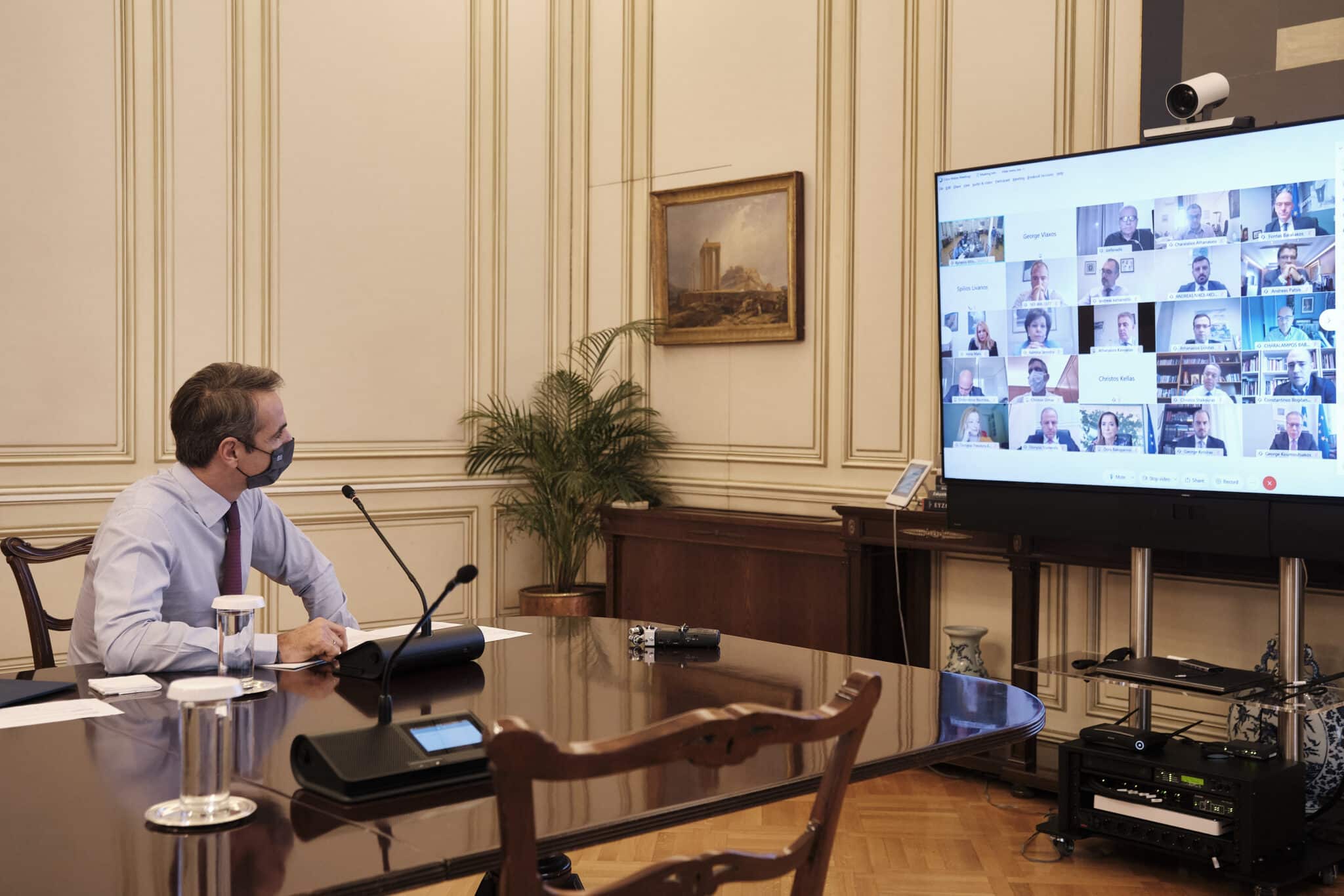
«I wouldn’t trade my school years for anything.» This could serve as the closing remark of Prime Minister Kyriakos Mitsotakis’s digital participation in an online class for the 6th-grade students at the 8th Elementary School of Chania.
During the event, Mr. Mitsotakis, who joined virtually from the Maximos Mansion, had the opportunity to speak with the students and their teacher, to hear their questions, to listen to the concerns they expressed regarding the course of the pandemic and how it is affecting them, their families, and the education system, and to commit to maintaining closer personal contact with them once the lockdown is lifted and beyond.
The prime minister congratulated the children for diligently following the safety measures, emphasized the importance of social distancing to protect vulnerable groups, and highlighted the opportunity to strengthen the bonds that have developed within the family unit due to family members spending more time together.
When asked to respond to a question about the upcoming vaccine, Mr. Mitsotakis stated that it would initially be intended for healthcare workers and vulnerable social groups, while emphasizing that the scientific community does not yet know the duration of immunity it will and, consequently, whether it will need to be repeated every year.
The Class as a Group
Responding to questions from Kyriakos Mitsotakis about distance learning, the class teacher, Evangelos Pagonidis, noted that the experience of distance learning has «brought the class closer together» as a group. He emphasized that the curriculum is being covered as planned and that the transition to distance learning went smoothly and more quickly than he had expected, especially given the experience from the previous school year.
For his part, the prime minister pointed out that there is no substitute for being physically present in the classroom but, given the circumstances caused by the pandemic, technology offers many tools to address these challenges. He also urged students to make the most of their experience with distance learning and the use of the necessary technological tools. «In this changing world, we will have more and more opportunities to learn through computers, so this entire process is also a lesson for you, the younger generation,» she said.
This online meeting with students from the 8th Elementary School of Chania was also attended by Minister of Education and Religious Affairs Niki Kerameos from the Maximos Mansion and Deputy Minister Sofia Zaharaki from the Ministry of Education. The Minister of Education noted that while the videoconference was underway, 54,000 classes were in session, while a total of 1.6 million teachers and students throughout Greece are participating in the distance learning process.
At the summit, Katerina's idea was...
Katerina asked Kyriakos Mitsotakis whether elementary school students, such as those in the sixth grade at the 8th Elementary School of Chania, could participate in online classes for 2 or 3 hours with children from another European country (e.g., England) who are in the same difficult situation due to the restrictions caused by the pandemic.
The prime minister gave the following response: «I really like your idea, Katerina. We’ll discuss it with the minister and the deputy minister. I imagine it won’t be difficult to set up a platform. I’ll bring up what you told me at the next European Council as a good example of how children who share the same experiences, the same life experiences—are currently unable to attend school—can connect with other children from other European countries so they can exchange ideas and experiences. Through the minister and the deputy minister—Sophia, we’ll come back to this—I will personally ensure, since you made the suggestion, that your department be put in touch with a school in England with children of the same age so that you can have an online discussion and exchange suggestions and ideas. I promise we’ll do this right away.».
Back to School
In response to Polyvios’s question about what else students can do to limit the spread of the virus, as well as when they will be able to return to school, the prime minister replied:
«I imagine this is the question that all students, all teachers, and all professors would like to ask me. The answer, Polivie, is that we’ll reopen schools whenever the experts and scientists who are monitoring the course of the pandemic give us the go-ahead. And they’ll let us reopen schools whenever they feel it’s safe for us to do so. As children—you know this—you’re at lower risk of getting sick from COVID-19. However, you might get sick without even realizing it and unwittingly bring the virus back home, thereby infecting your dad, your mom, your grandpa, and your grandma. And that’s why, what you can do during the pandemic is, first and foremost, to follow all the precautions that I think you’re all well aware of by now. All children know them, Mr. Pagonidis, I imagine, and when school was in session, you always wore your masks, washed your hands, and used hand sanitizer. You should do the same at home or when you go out.
And of course, the first thing you need to do is not lose your enthusiasm or your smile, and view this experience with distance learning as a temporary situation. It will only last for a little while; you’ll be back in school soon—I’d like to believe—but make sure to make the most of this new experience. Because as you grow up, you’ll realize that there’s no substitute—as you well know—for being in the classroom. And you know this, and your teachers know it too. But in a changing world, we’ll have more and more opportunities to learn things through computers. Therefore, this entire process is also a lesson for you, for the younger generation, on how you can acquire knowledge as you grow up—not only through your physical presence in the classroom—but also through digital processes, such as this one, which the ministry has fortunately launched.’.
«Our young children put our glasses on twice.»
In response to Celia’s question about the different ways each country is handling the education sector under the new circumstances of the coronavirus (including whether or not to close schools), both the prime minister and the minister of education responded:
Prime Minister: «My answer to you, Celia, is that different approaches are being taken. There are countries that kept schools open, there are quite a few countries that closed schools, and there are countries that did what we did during the first wave of the pandemic: they kept small classes open and closed large ones. So, there’s no single answer as to what countries did; in the U.S., a great many schools were closed. Consequently, each country, depending on the problem it was facing, did what its experts recommended. I want to emphasize—and I want to explain this to you in as simple terms as possible—that the reason we’re closing schools isn’t because we’re so afraid that you might get sick. It has to do with what we call the movement of people. When schools are open, elementary schools are open, someone might take you to school—if you don’t go yourselves, since you’re older kids, some of you might even go on your own—but especially for the younger grades, someone will take the child to school, someone will pick them up from school, moms will be out and about, sometimes dads too, grandfathers, grandmothers—there will be a lot of people out and about. The more people are out and about, the greater the chances of the virus spreading.
So the reason we closed the schools has to do with our decision to reduce—as much as possible—the movement of people. But because, I believe, we’re now starting to see some positive signs—the measures we’ve taken have worked; in Chania, I must say, we’re doing well, we’re doing better than in other parts of the country. This, however, does not mean we should let our guard down. And my request to you is this: When, God willing, the schools reopen—and I believe it won’t be long before we reopen them—please be extra careful. We now know, first and foremost, that we will have a vaccine that works. Children will not be the first to be vaccinated. The first to be vaccinated will mainly be our doctors and our grandparents—that is, those who are most at risk from the virus—but in any case, you must be careful. I want to say something, Mr. Pagonidis: our children have been wearing masks. And our young children have worn masks twice. We were the only country in Europe to make masks mandatory even for preschoolers, and I must tell you that the response has been exemplary. And I want to say a big thank you to all the children for what you’ve done, for following the guidelines, for being careful, and for the way you’re participating in distance learning. You know, this wasn’t an easy undertaking. And despite the fact that there were some minor technical issues—which I believe the Ministry resolved relatively quickly—the fact that we have today, every day, tens of thousands—how many classes are there exactly?;
Minister of Education: 55,000 elementary and preschool classes and approximately 38,000 and 39,000 middle and high school classes. A total of 1.6 million people—all of the country’s students and all of the country’s teachers—are participating in distance learning.
Prime Minister: »It's a very difficult task to carry out, and yet we're managing to do it; we're correcting our weaknesses and, wherever we can, we're getting better.".
Two Questions About the Vaccine
Konstantina, referring to the plan in place for the rapid distribution of the vaccine, asked, first, whether children would also be vaccinated, and, second, whether the vaccine would need to be administered annually, like the flu shot. In response, the prime minister stated:
«Two excellent questions. The answer to the first is that we want as many people as possible to get vaccinated. However, since we’ll have a limited supply of vaccines at first—and the supply will gradually increase—we’ll need to vaccinate first those who are at the highest risk of contracting the virus. Who are they? They are our doctors, our nurses, those who work in hospitals, and our elderly fellow citizens, who are at greater risk if they contract COVID-19. So, we have a very complex vaccination plan. We will set up around 1,000 vaccination centers across the country.
The vaccine will be free for everyone, and ultimately it will be the experts who will advise us on whether or not children should be vaccinated. I believe that ultimately, provided we have enough vaccines, as many people as possible should be vaccinated, and children should be vaccinated as well, if necessary. You, however, know this well: you’re not the first ones at risk of getting sick, but you do run the risk of transmitting the virus even if you aren’t sick. In other words, you could be carriers of the virus and pass it on. What we don’t know yet, Konstantina, is whether we’ll need to get the vaccine every year. What is the vaccine? It’s an immune response. The vaccine teaches our bodies to fight the virus on our own—whether it’s the flu virus or the COVID-19 virus. We still don’t know how long the protection from the vaccine will last. That is, how long the immunity will last. Just as we don’t know whether someone who gets sick will contract COVID-19 again, because they’ve developed immunity. Nor do we know if this immunity lasts six months, 12 months, one year, or two years. So I think no scientist can answer that question. There’s a possibility—just as we get vaccinated against the flu every year—that we’ll have to get vaccinated against COVID-19 every year as well. But that’s something we simply don’t know yet.».
Question about time with the family
Manolis asked the prime minister a personal question: Given his heavy schedule, does he have any time left for his family? Kyriakos Mitsotakis’s response was as follows:
«The answer is yes. I always try to find a little time for my family. I have to tell you, right now, because we’re not traveling—we travel very little because we’re not allowed to travel—and, of course, we’re fully complying with the restrictions. So we don’t go out—the only reason I go out is to go to work, to return home, or possibly to go out for some exercise, always within the scope of permitted sports activities—so I make sure to be home every night and have dinner with my wife and daughter. And that’s something I have to tell you brings me great joy. In fact, during the first lockdown, both of my older children were home—my son has since joined the army, we haven’t really seen him at all in the last two months because he’s doing his military service in Alexandroupoli, and my older daughter is in London—but during the first lockdown, all five of us were together. The five of us and our two dogs. So we spent a lot of time together as a family, and that’s something I really enjoyed. So yes, I make time for my family, even if it’s just a little, and every night we make sure to eat together, even if it’s late.».
The class president asked about the economy and unemployment
Michalis, the class president, asked the prime minister about the economy and the problem of unemployment. Kyriakos Mitsotakis gave the following answer:
«Michalis, I understand why you’re class president. You’re absolutely right that we’re facing two major problems right now. One problem is public health; we want to keep Greeks healthy, and that’s why we’ve taken these drastic measures to limit the spread of the virus. However, as you quite rightly point out, this has economic consequences. Businesses have suspended operations; they have been closed for some time.
So, as a government, what are we obligated to do? When we order a business to suspend operations, we must step in to support it. How do we do that? In two ways: First, we pay the business’s employees, who are not working. We give them less money than they would earn if they were working, but we provide them with a basic wage. At the same time, we provide some funds to the business itself so it can cover its expenses. This way, when the lockdown finally ends, businesses won’t have to close permanently, and we will have protected people from losing their jobs.
So, just as important as tackling the pandemic from a health perspective is supporting the economy, businesses, and workers through the measures I’ve described to you. And I have to tell you that I’ve been devoting a great deal of time—I’ve practically become an expert—to issues related to infectious diseases. But I’m devoting just as much time to making sure that what you mentioned doesn’t happen. In other words, when—God willing—this ordeal is over, when the lockdown ends, when you go out again to a store to buy a pair of shoes, the store will still be there, the employees will be there, and hopefully we’ll be able to get back to our normal routines.».
The proposal for an online detox program and the Chania swimming pool
Nicole proposed establishing a «digital detox» day at a time when we’re spending more and more hours in front of screens. She spoke to the prime minister about the benefits of sports, such as cycling and swimming, and asked Kyriakos Mitsotakis to immediately begin work on the Chania swimming pool. The Prime Minister responded as follows:
«My dear Nicole, thank you so much. I’m happy to accept your suggestion that we go biking together in Chania sometime, and of course, it is, in fact, my commitment that we will build the swimming pool. What you may not know is that I learned to swim at that very first swimming pool in Chania. So I have a strong personal connection to this place, and I feel an even greater obligation to help get it rebuilt.
I like the idea of digital detox, but I would recommend that you try it yourselves in your free time. We’re trying it at home, too. My youngest daughter is 17 years old; she’s in her junior year of high school, but I’ve noticed that all of us—you and us—spend more time than we should in front of screens, whether on cell phones or computers. So, we all need to consider—if we recognize that this is a problem—to consciously limit the time we spend in front of screens, and if we can’t do that at school, because we’re required to attend classes, we may need to do so in our free time. And instead of spending so much time on Facebook or TikTok, we should go outside, take a walk, do more sports, or perhaps agree—we’re trying to do this at home—that for two hours, no one will look at their cell phone, no computers, and no tablets.
So we set them aside. We always do that—whenever we eat—and pick them up again sometime later. So you’re absolutely right about the idea of digital detox and, of course, about the school issue —I know it’s tiring—it’s not easy to stay focused in front of a screen for several hours. But again, what I want to tell you is that this is temporary. And I want you to know that the first thing we’ll reopen—once our experts give us the green light—will be schools, and the first schools to reopen will be elementary schools. So please be patient a little longer, and I believe that next week we’ll have better news to share with you.».
For team sports
Dimitris pointed out to Kyriakos Mitsotakis that students are currently in quarantine and cannot exercise much, and asked whether, once the quarantine is over—hopefully soon—there will be new measures in place or whether things will go back to the way they were before. A discussion ensued:*
Prime Minister: Dimitris, what sports do you play?;
Student: I skateboard and play basketball.
Prime Minister: I know that the hardest thing for someone who loves sports is not being able to play. And the truth is that it will take us a little while to get back to team sports. So, my advice is to find ways to stay active within the limits of what experts say we can do. It could be a workout program—there are plenty of online options you can do at home. There are also some great workout programs for boys, girls, and kids your age that you can do at home.
Maybe tomorrow you’ll go for a run to at least get in shape. So it’s important to stay active even during the lockdown. The activities that experts allow us to do—and they do allow us to do certain things—and I hope that soon we’ll be able to allow all amateur clubs and youth teams to resume operations so that you can get back to your practices and games.
A Promise of a Tour of the Parliament
Ioanna asked if her class would ultimately be able to visit the Parliament. The prime minister replied:
«I hope so; it all depends on how quickly we can get vaccinated and how strictly we follow the measures. But because not all of us can follow the guidelines—or find it difficult to do so—that’s why we’re having problems. When I say ’guidelines,’ I don’t mean we have to stay cooped up inside. I mean that we should all wear our masks, maintain social distancing, and avoid gatherings, get-togethers in homes without masks, loud talking, dancing, and parties—which I know we Cretans love to have, to drink a little extra tsikoudia, and to sing—because when we do those things, we’re obviously not wearing masks.
So if we’re careful, this ordeal will be over soon. As long as we’re not careful, we’ll be forced to take measures like the ones we’ve already taken. So it depends on all of us—and I think on you, too; you bear a lot of responsibility. I’ll say it again: more often than not, children are more responsible than their parents. So I believe you’ll be able to go on your field trip. And if you manage to bring your class to Parliament, I promise to come and meet you and personally give you a tour.‘.
There is no substitute for the natural order
In closing the discussion, the prime minister noted: «The truth is that there is no substitute for the natural order. On the other hand, technology provides us with very powerful tools. And that is why the future will be one in which, obviously, the natural order will always play a primary—but not an exclusive—role. And what you’re saying is true—that we can connect much more easily; we don’t need to travel. We, too, hold teleconferences with people from all corners of the world. It’s easier. But the natural order is the natural order.
Human contact cannot be replaced, but technology also offers us tremendous opportunities to tackle an unprecedented crisis, and I’m glad to see you doing so with such joy and enthusiasm. I’d like to thank you once again for giving me the opportunity to participate in your class, and I’d really appreciate it if, should you be able to come to the Parliament, my colleague Kyra is here; please contact the Prime Minister’s Office, and I will personally give you a tour.».
The 8th Elementary School of Chania, which was founded in the 1920s, has 242 students in 12 classes, and its teaching staff consists of 25 teachers. It operates without any vacancies, offers a full-day program, and supports distance learning via a 100 Mbps fiber-optic connection. The school has a reception class to support foreign students who are behind in their Greek language skills, which is attended by refugee children through synchronous and asynchronous instruction. It also offers parallel support or private parallel support to a total of six children who face mild learning difficulties.