From autonomy to absolute dependence. From the absolute balance of anthropogeography-ecosystem, to the degeneration of a harmonious coexistence that has nourished the land and its people for centuries. Our islands are in danger. The end of the period of model autonomy, based on a sensitive understanding of the territory and aesthetic intervention in its footprint, has given way to the subsidised castration of green development, the deadlock of tourist monoculture and the alteration of the cultural portrait of local communities, in favour of a good testimony from outside called development. But it is expressed as a contraction and a legalistic cessation of the DNA of the area and its components.
Read the article-intervention of Thodoris Tsymbidis, Honorary Researcher of Marine Conservation and Director of Archipelagos, as published in the “Journal of the Editors”. https://www.efsyn.gr/nisides/246495_i-apaxiosi-ton-ellinikon-nision
The story of a disaster - From autonomy to total dependence
Have we ever wondered how our islands have been transformed in a few years from models of management and self-sufficiency to totally dependent places, without primary production, but also without drinking water in most of them? It is noteworthy that back then, many times ships might not even approach the islands for several weeks, which did not affect the sufficiency of goods and the daily life of the islanders.
Those of us who lived on the islands in the 1960s-1970s or earlier, even at an early age, were able to experience the end of the period of model autonomy that for thousands of years characterized the Aegean.
In my village, in Raches on Ikaria, I remember that in all the houses they made sure that every season they stored what they produced so that people could make a living in the following months, thus having a form of sufficiency and autonomy.
The few things that the islanders did not produce, such as sugar, rice, coffee and the necessary kerosene for the lamps, were obtained from the few shops that existed with the little money they had or through the exchange of products. The ship from Piraeus came to the island sporadically, whenever the weather conditions allowed it, and as it had few passengers, the products unloaded on the island were correspondingly few, because the needs of the locals for consumer products were correspondingly small.
Conversely, when the ship was travelling to Piraeus, it was common for many different products to be sent either for sale or to relatives living in Athens and Piraeus.
For centuries, all the islands have made a living from the production of products, not only for local consumption but also for export. The larger islands, such as Lesvos, Chios and Samos, were for centuries important production and export sites for all kinds of agricultural and livestock products, with important small industrial units (e.g. tanning, soap making).
Ikaria exported raisins, the famous kaisi (apricot variety), almonds and many other agricultural products. Until the late 1970s Kythnos produced the also famous Thermionic barley, which covered the entire production of FIX beer, employing the majority of the island's inhabitants through contract farming. Paros exported large quantities of cereals and Naxos potatoes, fruit and vegetables. Many islands also exported raw materials (e.g. coal, lime or the mineral kaolinite - the main ingredient of porcelain).
Primary production and exports of different products were similar on all the inhabited islands, while small merchant boats travelled between the islands throughout the year, either for trade or for the exchange of products. The last remaining merchant boats in the Aegean stopped sailing some 15 years ago.
In previous decades even small islands had a full water supply. They made use of springs and the water table, and there was systematic collection of rainwater.
It is noteworthy that at that time, many times the ships, either due to weather conditions or for other reasons, might not approach the islands even for several weeks, which did not affect the supply of goods and the daily life of the islanders.

Today, when ships do not call at the islands due to prolonged bad weather or strikes, it takes only 3 days to empty the shelves of all the shops, starting of course with those of the multinational supermarket chains that have set up on almost all the islands.
After 5-6 days things become very difficult, as there is a complete lack of vegetables, fruits and almost all kinds of food, and there is no drinking water either, as in most islands the inhabitants consume almost exclusively water in disposable plastic bottles, with all that this implies for their health and the environment. But that is another long discussion.
So in the 10-12 days when the ships do not call, survival on the islands becomes very difficult. The islanders are even deprived of salt, which we used to bring home with our little buckets.
From self-sufficiency to dependence

So the question is: How in 40-50 years have we managed to go from total self-sufficiency to total dependence, discrediting a wise management system that should be the subject of teaching in all environmental schools on the planet? How did we go from the time when we exchanged products and culture in the Aegean to the present day, when the islands have ended up exchanging only waste from open landfills?;
We often look for the causes in interests, but I am afraid that in this case the cause of this devaluation is not only interests. The state of the islands today reflects not only the policies of previous years but also the credibility of the political figures chosen to manage this unique place. And they have done so by discrediting this culture of management. All they had to propose and implement was to turn the islands into a tourist «monoculture», which dealt the final blow to the culture of self-sufficiency and wise management of natural resources.
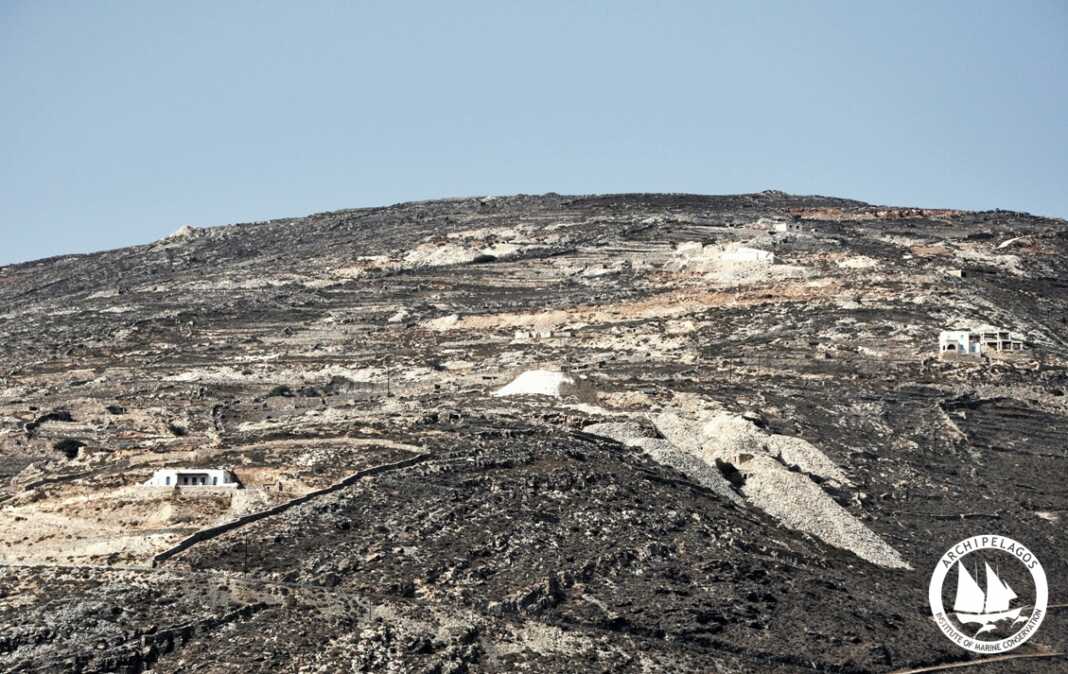
Most of the cultivations were deserted and small and large tourist units took their place. Island erosion prevention systems were abandoned, exacerbating the erosion phenomena on most islands. Thus, along with the fertile soil on the islands, the water table is being lost.
The traditional system of animal husbandry was also destroyed, which had built in empirical understanding and knowledge of how many livestock could be raised in an area, what seasons and when to move the animals elsewhere to avoid the negative effects of overgrazing.
These were not ecological practices, but were based on common sense, knowledge and experience of many years (which we now devalue) and of course the need to survive. They did not exhaust nature because they knew that they would be hurt in the end. We can still see the remnants of this traditional livestock farming system today on all the islands, with the dry stone walls and cobbled streets that were used to divide up the grazing areas.
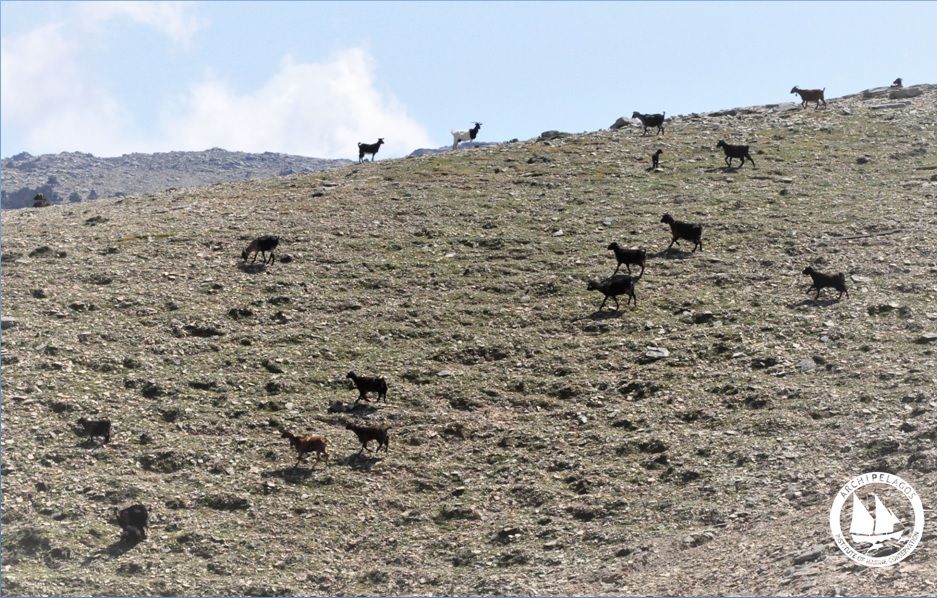
The reverse path to island self-sufficiency began in the 1980s, when the state authorities, following a European policy - which proved disastrous for the islands - devalued this ancient and proven management system and encouraged islanders - farmers and non-farmers alike - to receive an annual subsidy for as many sheep and goats as they decided to raise, without respecting carrying capacity, management care or a requirement for product production. The result was the destruction of the livestock sector. The few hundreds of animals became many thousands, for example 35,000 goats and sheep in Ikaria with 9,000 inhabitants, 3,000 goats and sheep in Arkii with 40 inhabitants and so on.
The number of livestock farmers increased dramatically, as anyone could now declare themselves to be a livestock farmer, with no provision for slaughterhouses or dairies. The islands were destroyed by overgrazing and subsequently by the resulting soil erosion, and the farmers were also destroyed, as there was no longer any pasture and they were forced to transport expensive imported feed (usually of dubious quality, e.g. cheap mutant maize) to the islands.
And what happened to the fishermen of the islands?;
The next inspired intervention was the devaluation and destruction of the fishing industry. In Greece, no substantial fish stock management practice has been implemented since the 1970s, with fish stocks declining alarmingly year after year. Instead of managing fisheries, the state, following another European policy adopted as a national policy, decided to limit overfishing by destroying (i.e. breaking into pieces) more than 13,500 fishing vessels, 90% of which were wooden, traditional masterpieces of shipbuilding, which we are now unable to build.
Along with this unique cultural heritage, many thousands of jobs have disappeared, considering that even the smallest boat employed directly or indirectly 3-4 people, in areas where the state is unable to create even a few stable jobs for local communities.
With the 30,000 to 50,000 euros that was the average compensation for the destruction of each boat, each fisherman usually built a few rooms to let or some equivalent seasonal tourist activity, which obviously cannot survive all year round.
At the same time, in the same areas where fishermen used to use soft fishing gear (nets and longlines), now mainly large fishing boats are fishing - starting from Piraeus or Michaniona or even from Italy, as we see more and more often in the southern Aegean, depleting fish stocks and often destroying productive ecosystems.
Now we are bathing in the results of our actions
It took another crisis and a pandemic to make us realise that tourism, however important it is today, when it is a «monoculture», is an absolutely futile profession that can in no way ensure the permanent and stable survival of island societies.
But as if all the above were not enough, now our politicians have started to implement another brilliant idea, which may well be the coup de grace for the islands. After all the devaluation and destruction of the islands on land and sea, having de-industrialized most of Greece, they have thought of setting up a new industrial production zone (see, energy) on the islands and islets.
On islands where for centuries the inhabitants were even careful how to move a stone, so as not to affect the aesthetic landscape and not to cause erosion, i.e. loss of fertile soil.
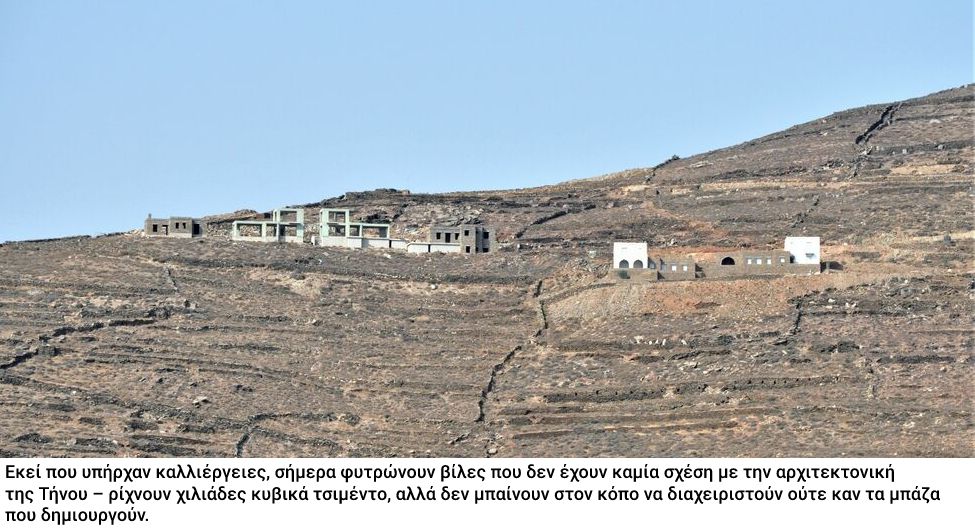
The inhabitants of the islands had formed an aesthetic landscape that is an important example of their culture, which we all, Greeks and foreigners alike, like to admire on our holidays. All the buildings are intertwined with the environment and the landscape (with the exception of some villas that have sprung up in recent years), with an excellent balance of coexistence, as no building has offended the landscape or hidden the view of its neighbours.
This balance was, after all, a prerequisite for the functioning of the geographically isolated society, in which one really needed the other, despite any personal differences they may have had.
Part of this unique aesthetic is even the sound produced by the wind blowing through the narrow streets and much more.
So the last brilliant idea our politicians had was to install a new form of «development» in these unique landscapes and ecosystems, which they promote under the ironic title of «green(!) islands».
It took another crisis and a pandemic to make us realise that tourism, however important it is today, when it is a «monoculture», is an absolutely futile profession that can in no way ensure the permanent and stable survival of island societies.
But as if all the above were not enough, now our politicians have started to implement another brilliant idea, which may well be the coup de grace for the islands. After all the devaluation and destruction of the islands on land and sea, having de-industrialized most of Greece, they have thought of setting up a new industrial production zone (see, energy) on the islands and islets.
On islands where for centuries the inhabitants were even careful how to move a stone, so as not to affect the aesthetic landscape and not to cause erosion, i.e. loss of fertile soil.
The inhabitants of the islands had formed an aesthetic landscape that is an important example of their culture, which we all, Greeks and foreigners alike, like to admire on our holidays. All the buildings are intertwined with the environment and the landscape (with the exception of some villas that have sprung up in recent years), with an excellent balance of coexistence, as no building has offended the landscape or hidden the view of its neighbours.
This balance was, after all, a prerequisite for the functioning of the geographically isolated society, in which one really needed the other, despite any personal differences they may have had.
Part of this unique aesthetic is even the sound produced by the wind blowing through the narrow streets and much more.
So the last brilliant idea our politicians had was to install a new form of «development» in these unique landscapes and ecosystems, which they promote under the ironic title of «green(!) islands».
What do these investments require?;

A prerequisite of course for these large-scale projects is to level the ridges, open roads where vehicles >30 meters long can move and maneuver. For example, in just one of the projects already licensed, which involves 14 islands and islets of the Dodecanese and Cyclades, in Natura 2000 areas, they plan to install more than 100 wind turbines, each up to 198 metres high, on islands where the average altitude is no more than 300 metres. The power generated will be 2.5 MW per turbine, i.e. to give a benchmark, the same as the average consumption of an island of the size of Sifnos.
In order to make this facility possible, they have to construct 70 km of In order for this facility to be possible, 70 km of road network in difficult areas, extensive excavations have to be made, 14 ports (single-use) have to be constructed, disproportionate to the size of the islands, in remote areas, to serve the needs of unloading all these materials and vehicles, the mountains have to be cemented with hundreds of thousands of cubic metres of cement, excavation has to be made for the backfilling of 673 km of medium voltage cables and many other corresponding «development interventions».
All this at a time when small-scale, high-efficiency renewables are at their peak globally and we insist on implementing technologies that are a thing of the past, but still generate high profits for large investors and manufacturers.
Dramatic consequences for the microclimate
Of course, with all this destruction, few people want to reflect or understand the dramatic impact on the islands' very important avifauna. But what everyone can understand is the dramatic consequences of the transformation of the microclimate. As international experience confirms, the turbulence caused by the propellers of wind turbines creates a strong mixing of air masses, altering the temperature and humidity near the surface of the land.
On the islands, the water table is not enriched by the few rains of the year but almost all year round by the so-called "ayazi", i.e. water vapour from the evaporation of seawater during the night, which condenses and settles on the mountain tops and slopes of the islands. With the help of vegetation and rhizomes, this moisture finds its way to the water table.
The huge wind farms are going to wipe out the ayazi, thus causing a reduction in the supply of springs and further aggravating the water shortage problem that the islands are already facing. At the same time, as the temperature rises on the mountain tops, there will be a severe drought, thus causing total destruction.
So as we like to invoke the thousands of years of history of this place, of which we have found ourselves to be the current administrators, we must reflect on how we have managed in a few decades to inflict such a great cultural and environmental damage on our land.
But we also need to consider whether we want to be the ones to deliver the coup de grace: irreversible damage to local communities, tourism, the environment, quality of life and much more.