The myth of Aphrodite has never ceased to enchant. It gives birth to dreams that emerge from the foam of the surging waves of legends that have nourished generations. And they continue to stir the soul like an endless flood of hope for the very affirmation of the course that this region has charted through space and time. We need that affirmation—both in times when «the sea is rough» and in those when «we’re sailing off course.».
In response to an invitation from the Piraeus Bank Cultural Foundation to participate in a conference on the topic of «Once Upon a Time, the Sea: Marine Habitats in Greek Regions», Archaeologists Aris Tsaravopoulos and Geli Fragou launched a study that, as it progressed, allowed them to formulate some initial hypotheses about where the lost temple of the goddess of love might be «located.».
And we say «to lie,» because in this the changes indicate which receivedif country affected by the earthquake of 365 AD A phenomenon that influenced the spatial formation of an imaginary line connecting Kythira, Antikythira, and the coast of Falasarna in Western Crete.
Kythera.News contacted archaeologist Aris Tsaravopoulos and asked him to share his insights on the subject with our readers. After accepting the invitation, he discussed the dynamics of the site, as shaped over the centuries primarily by geophysical upheavals as a result theυ largeυ earthquakeού in the year 365 A.D.
This earthquake, focusing on inν the wider region of western Crete, as a result of the collision between the African and European tectonic plates, left its mark on the geomorphological landscape of the region. However, while in the case of Falasarna and Antikythera, this resulted in an elevation (Falasarna was raised by 6 meters and About 3 (Antikythera is a few meters away), on Kythira had otherwise results.
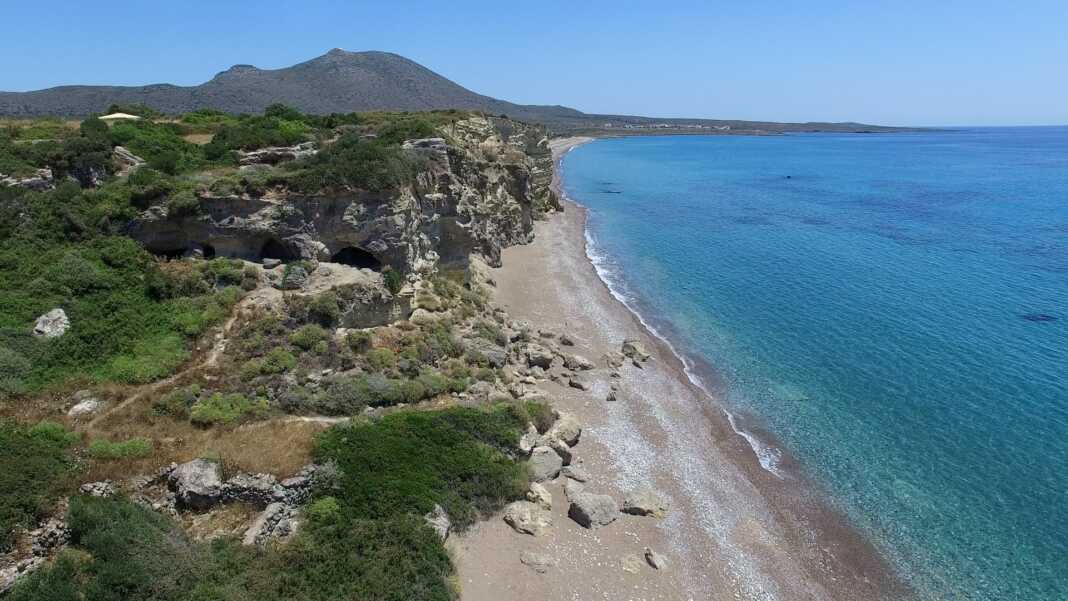
In Kythira, was caused by the precipitation large parts of the eastern coast and their submersion in the sea. The entire coastline from Paleopolis to Chalkos shows clear signs of landslides. In the sea, a few meters from the beach between Komponada and Fyri Ammos, below the church of St. John the Theologian, there are submerged monolithic columns dating to the Late Roman period, which indicate the existence of a significant structure (most likely an ancient sanctuary) on the section of the hill that collapsed.
But what is the connection between this phenomenon and the presumed existence of a temple to Aphrodite in the area? And where exactly do archaeologists place it?;
The hill of Asproga and the missing piece are the key
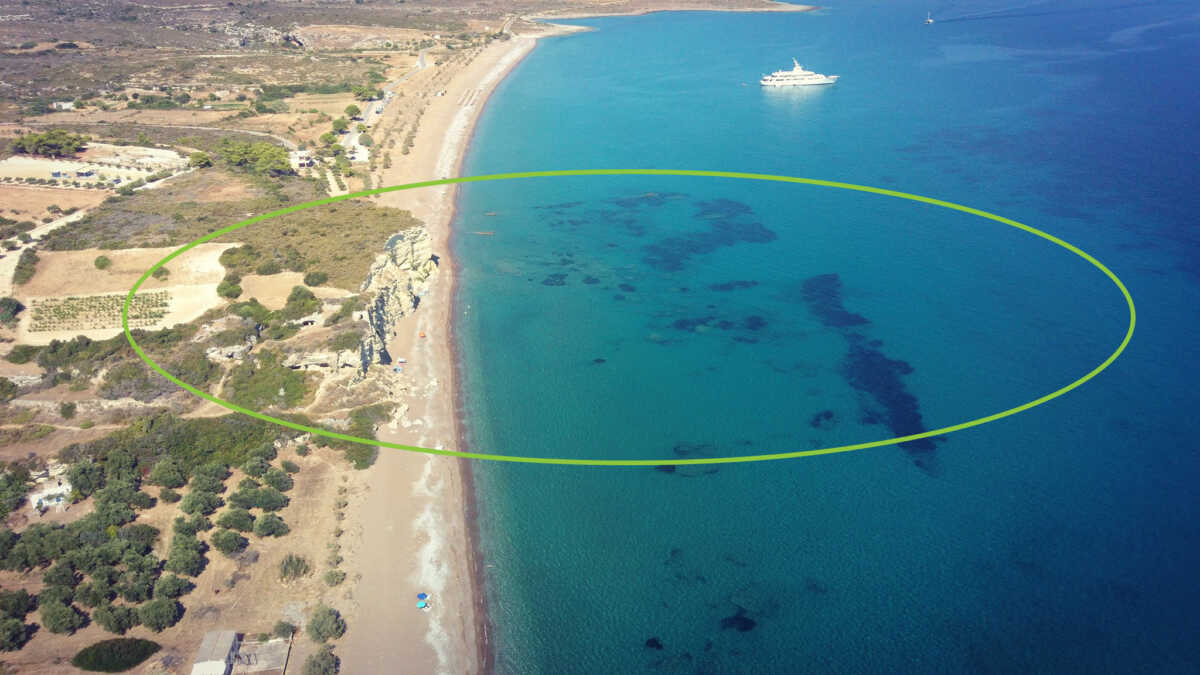
The hill of Asproga overlooks the beach at Paleopolis, where, according to legend, the goddess Aphrodite was born. Common sense would suggest that a place of worship in her honor might have been built in such a location. But one might ask: «Is it possible for myths to be governed by logic?» Or, more accurately, «How is it possible for the logic of myths to be interwoven with the works of living people?»;
Of course, this is a topic for another, extremely interesting discussion. Archaeology, however, is first and foremost a science of data. And according to Mr. Tsaravopoulos, in this specific case, the data «lie in plain sight» at the edge of the hill of Asproga. What do we see there?;
There, two very significant findings reinforce the theory that “x marks the spot of the treasure.” And the treasure—in this case, the lost temple of Aphrodite—is «buried» somewhere there.
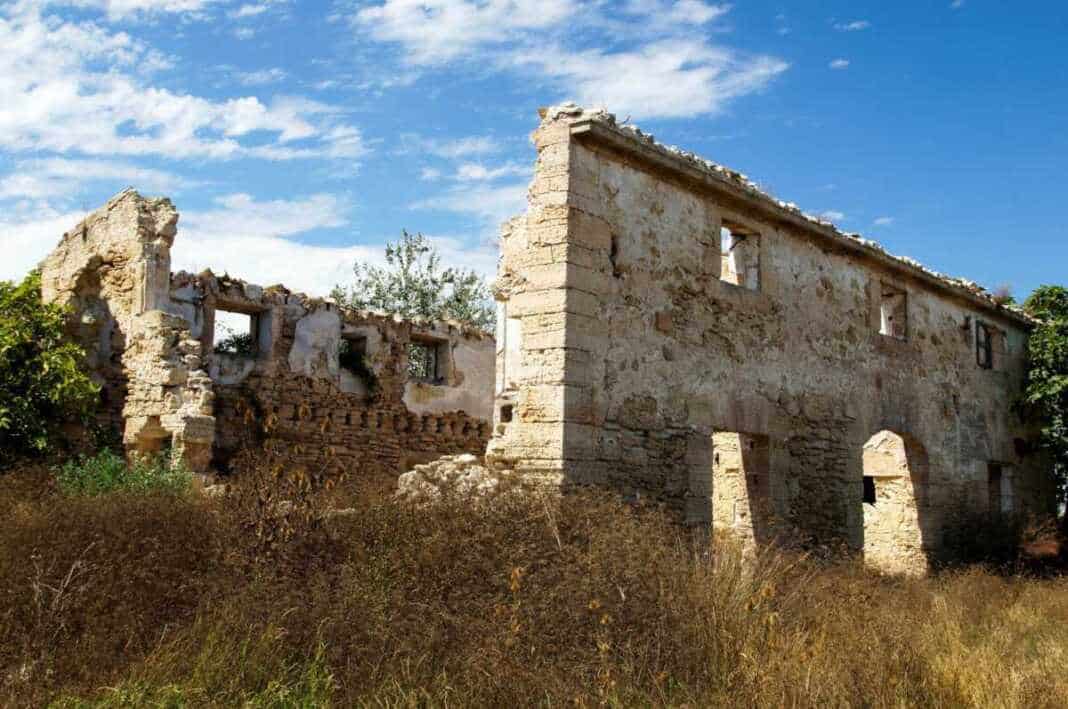
So, at the edge of the hill, we first see the ruins of two burial sites monuments, (and many others internally) of the Hellenistic period and the Late Roman period. What do these figures suggest? We know that the tombs in ancient times Located at along the streets· was passersby, to carry the memory of the deceased into the space where the passerby passes through.
Now pay attention. As we mentioned, these burial chambers were located along the roads, not on the edges of hills or cliffs. This is very important to understand, and it ties in with what we mentioned about the results of the major earthquake on the eastern coast of Kythira. We had reported that in Kythira resulted in the collapse of sections east of the island. So it was here, on the edge of Asproga, that this very event took place. Part of the the peninsula that protected the ancient port of Skandeia from the northeasterly winds, broke off and sank into the sea. And in this section, according to archaeologist Aris Tsaravopoulos, the theory that it was founded the temple of Aphrodite.
The end of the burial chambers and the second discovery
In the above scenario, two facts support this conclusion. First, we know that often σin ancient times, The tombs were placed along the streets that led to a spacethem worship (churches). The passerby brought the memory of the deceased to the sacred place. Therefore, it is very likely that there was a temple in the section that broke away as a result of the landslide caused (or contributed to) by the earthquake of 365 AD. This is further supported by the second find in the area.

On the beach at Paleopolis, almost right on the sand, it exists and is visible one a Doric column capital that was most likely part of a temple. In fact, it seems as if it had been placed there later. Could it be that a fisherman «caught» it in the stretch of sea that was once dry land and lies a few dozen meters ahead? In that very same sea, which myth refers to as the birthplace of the goddess Aphrodite? As we’ve said, myths have their own logic. But it’s a logic that springs from the emotions of living people. And it becomes tradition. Until the day comes when it evolves into a hypothesis for a future researcher.
Archaeologists Aris Tsaravopoulos and Geli Fragou have put forward such a hypothesis, which is fascinating in every respect. And the day will come when such hypotheses are transformed into established facts through research.
The following is the article published by Aris Tsaravopoulos in the Romanian magazine CAIETE ARA, in which he sets forth the above theory regarding the presumed existence of the Temple of Aphrodite in the coastal area of Palaiopolis, in connection with alles the geomorphological upheavals that occurred in the wider region, centered on the major earthquake of 365 AD.
Photos by P. Gianniotis, T. Tambaki, and from Facebook.