By their very nature, TV series are more susceptible to the passage of time. Entire decades of television history seem to have been almost completely erased today. Who watches dozens or hundreds of episodes of ‘80s police dramas anymore? Who watches hundreds of hours of ‘60s sitcoms?;
It is precisely what makes TV series more dominant upon their release (their reach, their scale, timeliness)—is also what sends them more quickly—compared to cinema, let’s say—into the dustbin of history. With very few, very specific exceptions, it’s much harder today to get into a TV series from 2003 than it is to get into a movie. There’s always a sense that «if you didn’t experience it when it was happening, then you simply missed out» when it comes to TV series.
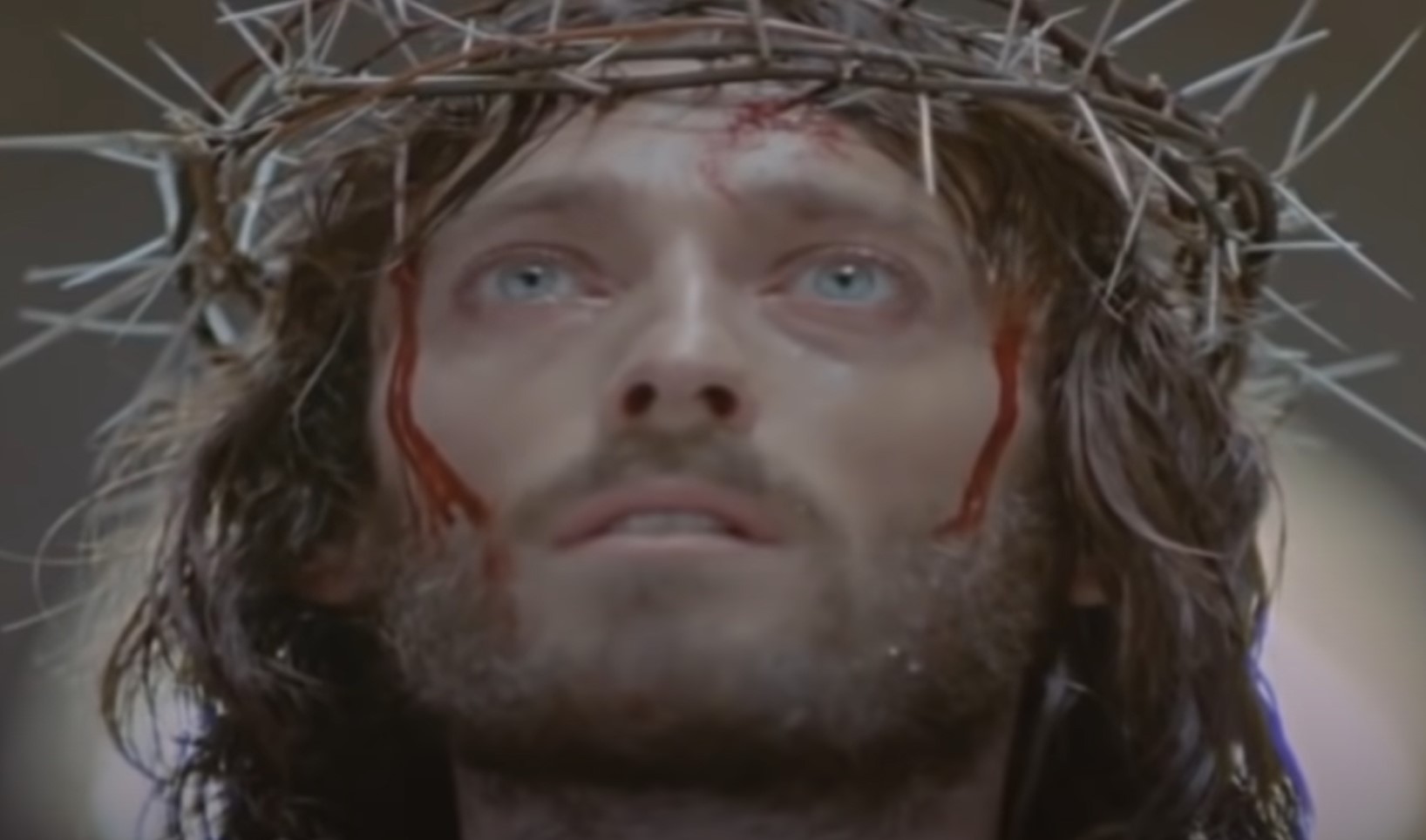
And then there's Jesus of Nazareth. His epic miniseries Franco Zeffirelli Filmed as a British-Italian co-production in 1977, it not only took the world by storm in its day but remains timeless and untouchable, just like the texts it adapts. As Easter comes and goes, in Greece (and in many other countries around the world) the one true constant is the rebroadcast of the series, over and over again.
Its influence on culture is such that, by common consent, it has essentially replaced the Gospels themselves in the collective consciousness as the primary text that comes to mind when one speaks of the New Testament. When we speak of Christ, the figure of Robert Powell. The 12 Apostles take on a deeper meaning in this metaphor.
«You really realize the power of something like this—it’s phenomenal,» Robert Powell said a few years ago on Sky History. «I always try not to make a big deal out of it, but I’ve been shocked over the years. People still stop me today in Greece, even with short hair, glasses, and no beard.».
It is by no means a given that any such religious spectacle would be successful, let alone one of this magnitude. Hundreds of TV series and movies have adapted stories from the Bible, but what did this one have that was so special that, 45 years later, it continues to be broadcast and watched by audiences?;
It certainly had to do with Zeffirelli himself, a director with an exceptional sense of epic grandeur in his visuals, to such an extent that it took decades for this to be taken for granted in television productions. Even some of the most famous, prestigious television productions of the era, such as *Roots*, cannot compare to Zeffirelli’s framing and color palette. The deep pockets backing the project certainly helped: The man himself Pope Paul VI He proposed the idea, which came about not only as a co-production between RAI and the British ITC, but also—obviously due to the subject matter—attracted sponsors of the caliber of General Motors (which contributed $3 million to the budget—the total remains unknown but is somewhere between 20 and 45 million).
The production was thus able to film in locations in the Morocco and Tunisia for months, which, combined with Zeffirelli’s visual style, gives the work a sense of place that is almost always missing from similar productions. In this miniseries, you feel the dust of the shantytowns filling your lungs, you feel the sweat of imperial decline, and you follow well-rounded characters as they move between real locations, giving the work a genuine sense of narrative and transition—what unfolds thus forms a story rather than a sequence of passages.
And then there’s the cast. A legendary cast featuring eight Oscar winners comes together—and the incredible part of it all? For most of them, even their brief appearances here are among their most iconic roles. Christopher Plummer; ? A legendary career, but Herod Antipas—blinded by lust—is forever unforgettable. Michael York? Frenzied and mesmerizingly devoted as John the Baptist. Olivia Hussey as the Virgin Mary—undoubtedly one of the greatest casting choices of all time. And as for the Ian McShane as Judas, here we have the true triumph: the series manages to portray this character as a compelling, misguided antihero.
Which brings us to the heart of the matter: The entire work was written not with the logic of a blind, sterile, mechanical adaptation, but with genuine choices made in the interest of the drama. Along with Zeffirelli, the screenplay was co-written by Anthony Burgess, four years after Wound-Up Orangei(!). Burgess approached the work with a much more down-to-earth version of Jesus in mind than any of the conventional portrayals we had seen before. In developing the story around him, he took some liberties with the source material so that the characters would be more fully realized and their motivations would make sense.
This approach of his may also have led to an event that, strangely enough, remains little known today: At its premiere, the Jesus of Nazareth It turned out to be an unexpectedly divisive work thanks to this more down-to-earth approach, sparking reactions from Christian groups (what an irony)—without, of course, having even seen it—which even led to General Motors pulling out as an advertiser—the company preferred to take a 3-million financial loss rather than be advertised in a TV production that stirred up so much controversy. Of course, we know how that turned out.
Even while writing the series, Burgess says (in a delightful piece he wrote for The Times on the series« U.S. premiere) that he wasn’t supposed to please—as is customary—only the director, the producer, and those footing the bill, but also the various theologians (»professionals and amateurs«) and to reconcile among themselves myriad different depictions of Christ. »I was hounded by RAI’s religious experts with pleas, orders, and ultimatums,« he recalls. “They hounded me from Rome to Siena to Bracciano to Rome, telling me what to write. ‘You write it, for the ”God!", I said to them respectfully. “No, no, you’re the writer. Now write this down.”.
In Burgess’s text, his own penchant for realism clashes with Zeffirelli’s more dreamlike sensibility, and it is this tension that creates this somewhat unique effect. Writing in The Times about the story’s source, Burgess says: «There is the romantic gospel of John, written much later than the historical events, which includes the wedding at Cana and the resurrection of Lazarus. The accounts of Matthew, Mark, and Luke, which are nothing like John’s, but are similar to one another. As a romantic, Zeffirelli was drawn to John, but I insisted on the more austere evangelists. The result, as you will see, was a compromise: the wedding at Cana is absent, but there is a spectacular resurrection of Lazarus.».
Not that the evangelists who fit into Burgess’s perspective provided him with a narratively satisfying story. «The more I read Matthew, Mark, and Luke, the more dissatisfied I became with the way they told the story. They’re good propagandists but bad historians, and they’d never make it into the screenwriters» guild,« he writes. “”And now Judas was a thief.» How foolishly inadequate. Whatever Judas was, he was not a thief.”.
Judas, one of the most compelling characters in the miniseries (played brilliantly by Ian McShane, who had some truly juicy material to work with), highlights the production’s approach: while it took the Bible as its source material, it played with the story in ways that were creatively tailored for television rather than strictly adhering to the text. Burgess wrote Judas from scratch, as a politically naive, inexperienced man who trusts the wrong people and makes the wrong choices, and this weighs heavily on his conscience when he comes to realize it—going through various stages in later drafts of the screenplay. (To this end, characters not found in the New Testament—such as Ian Holm’s Zera—were created to give Judas’s journey a more solid dramatic foundation.)
«My final portrayal of Judas is a palimpsest of Judas as a sweet, innocent man, as a Zealot, as an indiscreet chatterbox, and as a disillusioned man,» says Burgess, «but never as a one-dimensional, melodramatic villain.».
He took a similar approach with the other Apostles who, he says, «were not well developed as characters in the Gospels.» He had to create specific traits and values for each one that would make them easily recognizable—indeed, in the final version of the work, most of the Apostles have distinct personalities, even minor or major story arcs that culminate as we move toward the crucifixion.
The result of this overall approach was a series that immediately stood out in the television landscape. «The show is, despite its flaws, a truly impressive achievement, more for the pitfalls it avoids than for anything else, and moving thanks to an aura of spirituality that seems utterly heartfelt,» wrote the Washington Post upon the series« U.S. premiere. »Its true beauty is its true beauty,” the article concludes.
Today, it's his turn Zeffirelli has become the norm, so to speak. It’s like the basic textbook—a feeling that, by its very nature, makes everything else seem less interesting. No one thinks an encyclopedia or a physics book is cool. But maybe they should? For *Jesus of Nazareth* to become such a classic series—to the point of serving as something of an Easter staple— it means it managed to pull off an incredible feat of creative balance: combining romantic fidelity with a small, essential dose of sacrilege.