Aikaterini Statira, Physicist and Vice President of the Ioannina Mountaineering Association, debunks myths and reveals truths about the negative environmental and nature conservation consequences of installing wind farms in an article published in Ipirotikos Agonas.
Facts and figures
Renewable energy sources and information
After decades of climate change and concern for nature and the planet, we are now faced with the reality of renewable energy sources (RES) and, in particular, wind turbines. Most of us have in mind what we would like wind turbines to achieve in terms of the threat of anthropogenic climate change and what is promoted by the media, such as advertisements by electricity companies, advertisements by ELETAEN (Hellenic Wind Energy Association), programs dedicated to RES, and articles by employees of RES installation companies. The images are idyllic, with hills and fields dotted with wind turbines dubbed “wind farms” and sunsets in the background, and we are also informed that RES are installed in degraded areas with an emphasis on their environmental friendliness. Any information we have comes from the Green Fund's program to promote wind power at all costs and reverse the negative climate. The Green Fund also finances the initiative to promote renewable energy sources, "Synglis," chaired by Alexandra Mitsotaki.
It is time to ask ourselves whether renewable energy sources (RES) are environmentally friendly, at least here in Greece... There is much debate globally about whether this is the right way to tackle global warming and the associated destruction of nature. However, we can and must learn about domestic RES. Why do so many people not believe in this “green energy”?;
Why? What lies behind renewable energy sources?;
Let's focus on the situation in our country, where the theater of absurd destruction of nature is being played out behind people's backs.
Every European country has committed to gradually reducing emissions by replacing fossil fuels with renewable energy sources, with the aim of potentially using only renewable energy sources by 2050.
Greece and RES: The national target for installed capacity from renewable sources to meet domestic energy needs is to produce 7.05 GW by 2030.
How close are we to our goal?;
The Ministry of Environment funded research by the universities of Ioannina and Crete, led by Vasiliki Kati (Vasiliki Kati, Kathimerini). The database was obtained from the Regulatory Authority for Energy (RAE), which licenses renewable energy sources, in relation to installed, licensed, and submitted wind energy investments. Research date: March 2020. The data presented was valid for one year prior.
3/2020: The target was achieved by 44% with 260 in operation ASPIE (wind turbines - wind farms) with a total capacity of 3.12 GW. If we add the ASPHEs for which installation permits had been issued or were in the final stage of production permits, plus all the ASPHEs that were about to start operating in the near future, then the total capacity reached 8.83 GW, meaning that the national target was exceeded by 125%.
The picture was that “if all the investment plans on the RAE-3/2020 map for onshore ASPIE are implemented, the country's installed capacity will be 43,756 MW, exceeding the national target by six times.”
That was a year ago. At that time, companies had just caught wind of the subsidy bonanza. Since then, applications for ASPIE installations have been pouring into RAE. The corporate lobby is exerting constant pressure for wind turbine installations. Why?;
EU subsidies for investments in ASPIE are particularly attractive, and overpricing increases profits (we will explain why the EU subsidizes them later).
What is at stake is the very nature of Greece, both mountainous and insular.
The land for installation is free (mountains, islands, public land that does not belong to foreign and local entrepreneurs but to the Greek people).
With the increase in the price of electricity and the special levy for renewable energy sources, they are also significantly financed by our taxes (the recovery fund allocates 30% exclusively to renewable energy sources).
In December 2020 alone, there were 1,544 approved applications for wind power with a total capacity of 34.48 GW, five times higher than our national target for 2030 according to the Regulatory Authority for Energy (RAE). (energy press 3/6/21).
The March 2020 study continues that if all ASPIE applications are approved, there will be approximately 5,515 MW of wind turbines in Natura 2000 areas, with approximately 80% of mountains granted to companies (RAE geoinformation map). Since December 2021, there has been a battle between business groups over which mountain will be allocated for wind turbines, with some mountains receiving multiple applications, and our mountains and islands not being enough (energy press 3/6/21).
3/20: If only ASPIE outside the Natura network were approved, the target would be met three times over.
How ”clean” is this energy? Is an energy source green when it destroys forests?;
The 2020 environmental bill abolishes nature protection. What does this mean? Who benefits?;
No country has assigned mountains, places of natural beauty, environmentally sensitive areas, habitats, places of historical significance, archaeological sites, or the European Natura network to wind turbine, hydroelectric, or photovoltaic companies.
In no country are forests and areas suitable for reforestation sacrificed in the name of ’green development“ (yes, areas suitable for reforestation are no longer protected; they can be given over to renewable energy investments, according to a recent presidential decree). No state with conscious citizens would remove nature protection, bypass and nullify the democracy of the Constitution for the sake of ostensibly green energy. The company can point to a protected site, and no law, no right can prevent it from destroying nature, raping nature, under the cover of the Hatzidakis bill.
Companies have always managed energy, and historically, the practice of using renewable energy sources in mountains and environmentally protected areas was initiated by previous governments. but now they are recklessly managing the country from mountains to islands for the excessive profits that their renewable energy sources bring them. Furthermore, local communities are not informed and suddenly discover that wind turbines are being installed in the mountains of their youth and that the clear waters of their villages are being locked up in concrete hydroelectric dams and going to the companies. And when they react, they discover that the state turns a deaf ear (in Nymfaio and Aetos, they hid wind RES from the RAE website, in violation of Greek and European legislation). The residents ran when they heard the bulldozers levelling the forest. In the public consultation on the wind turbines at Cape Malea, which will extend over 25 km, they hid the comments of the public). Where do we live?;
Where should renewable energy sources be installed?;
If we assume that renewable energy sources are the necessary solution to climate change, then their location is a serious and sensitive issue for every country, and even more so for Greece. Scientific research (Kati) suggests that they should be installed in degraded areas close to road networks. In Europe, the trend is to install them on hills below 800 meters, with very few exceptions. In Europe, they do not destroy their mountains because they value them and hike in them. Nature is their quality of life. They advertise mountains and tourist areas as being free of wind turbines.
Our country is unique in terms of its mountains, islands, diverse nature, and biodiversity. And yet, we have even given our islands to companies for wind turbines.
What role do environmental impact assessments (EIAs) play? Are they scientifically sound? Are they drafted by objective individuals who are familiar with the specific characteristics of each location and take them into account? Quite the contrary. They are written by people (offices) who are paid by the investor.
It should be noted that the law on environmental impact studies was recently amended so as not to prevent or hinder the installation of wind turbines. The EIAs, which were ridiculous and full of holes because they ignored important environmental parameters and only talked about impacts, some of which were copy-pasted, were an easy target for objections from local communities, associations, environmental companies (not NGOs) and other bodies, when it was not too late, of course. The amendment to the law circumvents the obligation of companies to conduct EIAs by stipulating that they are not required for wind turbines under 10 MW, so companies “break them up” and are free to install as many as they want, e.g., 10 x 9.9 MW.
EIA: How to overcome this “obstacle” for RES
Environmental impact studies are not only unnecessary for wind projects divided into small wind farms of less than 10 MW, a loophole that gives the green light to every application to the Regulatory Authority for Energy (RAE) for wind turbines, but also for burned areas (which were protected as reforestation areas prior to the presidential decree). Indeed, what is there to study about burned areas? (However, if you leave burned areas alone, they regenerate beautifully).
So they divide projects worth tens of MW into smaller parts and get them approved by the Regulatory Authority for Energy (RAE), regardless of whether the area is of unique biodiversity.
One plus one equals two, and the second solution to the relevant obstacle of the EIA is incineration.
To build a wind farm, several kilometers of new roads (and widening of the existing road network), pylons, transmission cables, and huge concrete bases are usually required.
Wind turbines: green or gray?;
Environmentally friendly energy sources?;
Wind farms are industrial areas and are even considered heavy industry. RES are RES.
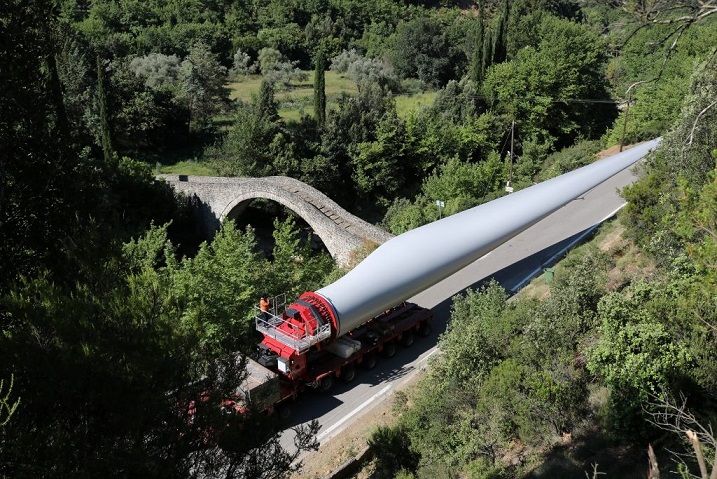
Why? Giant wind turbines with a total height, rotor, and blades of 150-220 meters are being installed. In order to install them, roads are being built that are wide enough to allow the passage of their components (>40 m) over many kilometers, and due to the slope of the mountains, the cross-sections are many meters wide. The slopes and ravines are eroded, losing their vegetation, their water sources, their relief, and filling up with excavation debris. Forests are uprooted. Ridges are levelled, huge fields are opened up for the bases of wind turbines, and hundreds of tons of concrete are poured. The mountain is cemented, nature and life are sealed.
The birdlife, bats, and essentially migratory birds and birds of prey, even the few that remain in the Special Protection Areas (SPAs), are being sacrificed on the altar of renewable energy sources.
A study by a Bank of Greece committee on climate change and its effects has come to a very serious conclusion. Wind turbines affect the water potential of an area from the onset of rainfall to the enrichment of the water table. The microclimate changes because the blades of wind turbines disperse moisture, reducing rainfall and snowfall (impact of wind turbines on the water table, chronos). Pindos, our own Amazon, will gradually cease to quench Greece's thirst. The islands, losing their moisture, will dry up.
The mountain will have lost its forest, its springs, its natural watercourses, its flowers and herbs, its seeds waiting to sprout, its birds, its wild animals.
Wind turbines have an average lifespan of 20 years. All the infrastructure projects, road construction, electrical interconnection projects, and land configurations will have cost a significant amount of money that no one gave us for free. They will remain there forever, silencing and polluting the land with now useless wind turbines and other technologies waiting to be implemented.
However, their impact on nature is irreversible. Until now, nature has been our God, from whom we have derived sustenance and life. Nature has resurrected and continues to resurrect man until now. It is the intangible legacy that each generation leaves to its children beyond human memory and the legacy left to us by our grandparents.
Will we destroy nature in order to save it?;
Climate change, global warming...
Climate change is largely due to carbon dioxide emissions. Plants, through transpiration, i.e. the production of oxygen during the day, absorb carbon dioxide and filter the atmosphere. They are weather stabilisers, climate change inhibitors and our only allies. Even the most barren mountain is full of vegetation and water, full of life, herbs, and flowers that will bloom in their own time. On the seemingly rocky slopes, sheets of flowers of all kinds and colors will spread out, and the earth will smell sweet. After all, isn't that where we get our herbs and medicines?;
Will we do evil and reap good? Is that what our era, the dawn of pandemics, teaches us? That we have the right to destroy nature for the sake of investors' profits? Would our ancient ancestors call this hubris?;
There are other important facts we need to know about the reality of the earth—nature—and the future generations we want to save.
Independence from hydrocarbons and lignite...
Greece is undergoing a rapid transition away from coal, with a target date for the transition to renewable energy sources set for 2030, while Germany's target date is 2038, Poland's is 2050, and the rest of Europe's is well after our own target date. This raises the first question. Are renewables capable of supporting the country's electricity needs?;
The actual power output is 0.3% of their nominal power. Wind turbines are an unstable and intermittent form of energy that cannot be stored (storage is extremely expensive and destructive to the environment). Thus, fossil fuel power stations are responsible for producing energy. The thousands of MW of wind energy planned to be introduced into the system must be supported by corresponding MW of energy from coal, lignite, and natural gas power plants.
In Great Britain, 14,000 wind turbines are needed to produce 4.4% of energy. Germany and Denmark have reduced subsidies for wind turbines, making them less attractive to companies looking for new territory with better conditions for installing renewable energy sources.
Germany accelerates the installation of the Nord Stream natural gas pipeline and inaugurates a new lignite-fired steam power plant. (Akis Tselentis)
The second question: why such haste when there is time for a gradual transition without hastiness, but with sincere studies that protect our country for the sake of all generations, nature as our planet gave it to us?;
The third question: Why is Europe, our partner, not intervening?;
Here's the answer: Europe is funding us, but not for free... they'll take almost 80% of the energy produced from RES, reducing their own footprint (pollutants)! RES have long been installed for energy outside Greece. Greece is being transformed from a country of unique beauty into the battery of Europe.
Fourth: Logically, hydrocarbon (oil and natural gas) extraction should be stopped. Is this happening? No. Repsol and Energean Oil and Gas are undertaking extraction activities in Epirus. Are we closing the lignite mines and continuing with the other fossil fuels?;
We are told that wind energy is inexhaustible, but the raw materials for wind turbines are beginning to run out, with China, the leading mining country, informing us that rare earths are becoming scarce.
We are told that we will achieve energy independence, but we will depend on the countries that produce the raw materials, the countries that manufacture them, and the countries that subsidize them. In addition, we will depend on natural gas from abroad.
Furthermore, the economy and citizens will depend on companies rather than state-owned lignite mines.
They tell us that they will remove them and recycle them and restore the damage. But removal is so costly that even America does not do it. As for restoring the land... from the cement, concrete, wind turbine components, above-ground and underground cables, the destruction of nature... ...let's laugh... in Greek... Those that are not destroyed by the weather will last twenty to twenty-five years, and then instead of mountains we will have wind turbine graveyards to remind us of our naivety and inaction.
In the meantime, new ways of exploiting energy will have been found, which we will be forced to implement, while wind turbines will be obsolete as inefficient, non-green, and uneconomical. But we will have irrevocably ruined our Greece. We will not leave our descendants islands and mountains, but a land covered in concrete.
We are told that jobs are created during the operation of RES, but RES do not need anyone during their operation. The largest RES in Denmark employs three people.
They tell us that it is cheap electricity, but why, apart from the high price of electricity, do we also pay the special fee for RES ETEMAR?;
The Minister of the Environment tells us that wind turbines will be installed on ridges that are bare of vegetation, but the Minister of the Environment does not know that, first of all, the subalpine zone begins at 1,500-1,700 meters on all mountains and, secondly, that the weather is formed in this treeless subalpine zone, that water is formed up there, infinite flora and fauna live there, the life of the mountain begins there, and inevitably our own. He tells us that they will be placed on peaks that are not visible. But the aesthetics of the issue come far behind reality: mountains and biodiversity are life itself, they are oxygen, water, they are the planet, they are what we want to save!
Human-made threats to our planet...
The central political goal of the European Union, the World Wildlife Fund, the International Union for Conservation of Nature, and the UN is to prevent the increase of ”artificial” land, the fragmentation of land by roads, artificial surfaces, human interventions, and changes in land use. Greece ranks among the top countries in terms of road construction and human erosion.
An equally valuable goal is the preservation of biodiversity. In terms of anthropogenic alienation and the protection of nature and biodiversity, the data for Greece paint a bleak picture for the future.
Is nature the only thing threatened by wind farms?;
Beyond nature, productive activities such as beekeeping, livestock farming, land cultivation, mushroom and herb gathering, tourism, alternative tourism, gentle mountain tourism, essential production, and exports are also affected.
What about the compensatory benefits?;
Judging by the fact that more and more municipalities, including those that have joined forces, are refusing to allow renewable energy sources to be installed in their mountains and on their islands, they have realized that the destruction cannot be offset.
How can we reconcile progress with saving the planet?;
Where will we get our energy from?;
I could suggest realistic solutions. Such as...
- Subsidized residential photovoltaic systems.
- Significant incentives for bioclimatic constructions.
- Renewable energy sources that will not destroy nature, in degraded areas after serious environmental damage
- New technologies for lignite plants that will significantly reduce pollutants and enable domestic energy production.
- Control of sources of air pollution at national and global level. Obligation on companies, e.g. shipping, transport, factories, to implement technologies to reduce pollutants.
- Encouragement by every government in developed countries to change consumption and dietary habits.
Wind farms, green energy, sustainable development, Ministry of the Environment... meaningless words, Trojan horses.
Environmental protection as a pretext and, behind it, the creation of new areas of investment activity for foreign and domestic business groups.
Let's stand up... let's demand...
Restoring constitutional protection of nature. Natura 2000, Ramsar, UNESCO, SPA, habitats, sensitive ecosystems, etc. Greenery, undisturbed nature, and biodiversity above renewable energy contractors and cedar trees.
And something that no one has any interest in saying... because it goes against profits and consumption...
One of the planet's laws is recycling and economy. Let's take our cue from our planet if we want to be part of it, otherwise the planet is our host, with all that that entails.
Globalization and neoliberalism lead to the exploitation of the weak, and the weakest of all, at our mercy, is nature.
Let's stand by her side! And by the side of our future children and grandchildren! They gave us the world so that we could give it back to them unharmed, as beautiful as we can make it.
Statira Aikaterini
Physicist, Vice President of the Ioannina Mountaineering Association