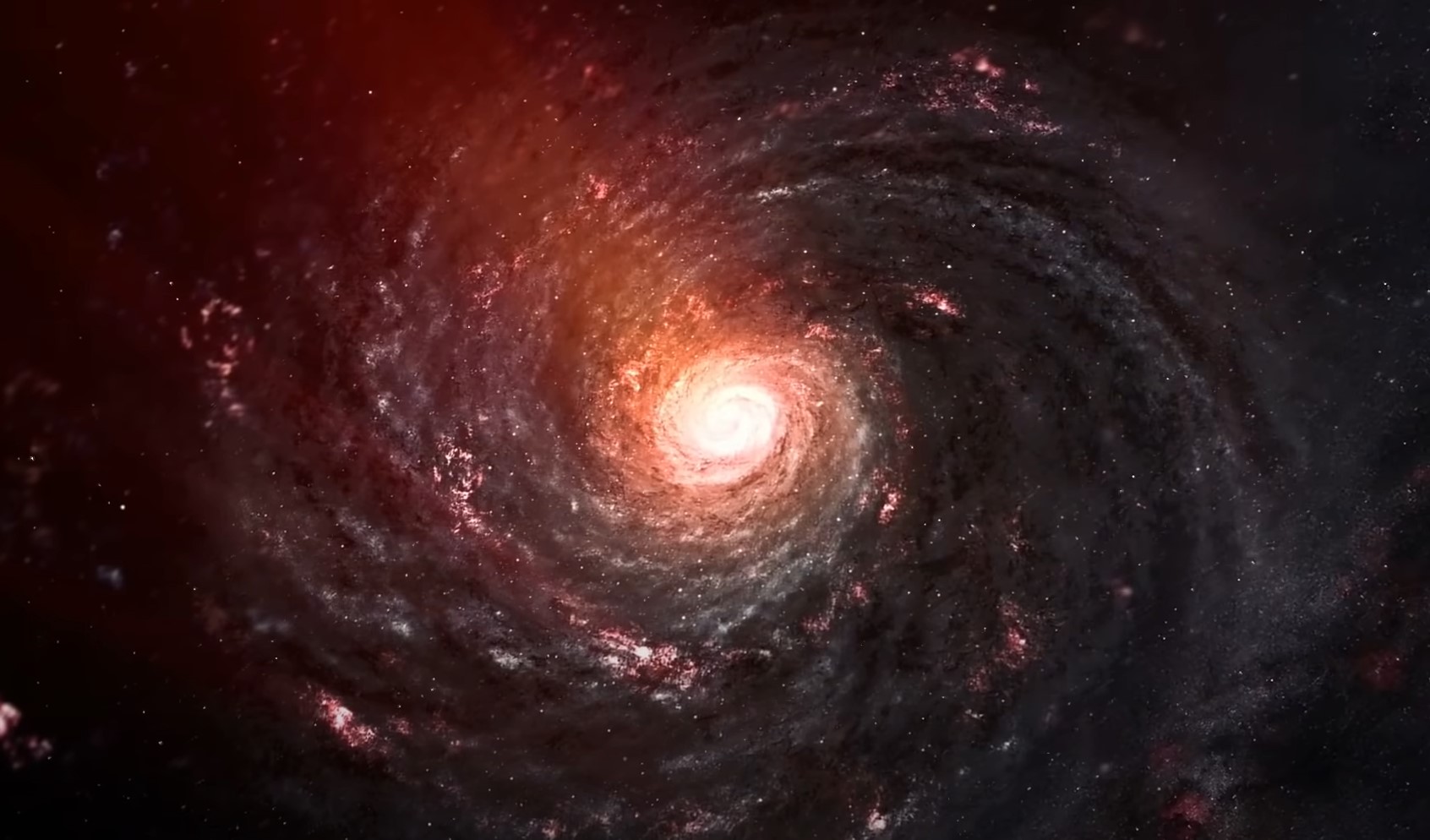
An unprecedented view of its bustling downtown Galaxy has revealed almost 1,000 mysterious «threads», which hang inexplicably in space.
Up to 150 light-years long, the «strings» occur in pairs and are often evenly spaced, like the strings on a harp. Using observations at radio wavelengths, Farhad Youssef Zadeh of Northwestern University discovered these highly organized, magnetic «strands» in the early 1980s. According to the findings, the mysterious «strings» consist of cosmic-ray electrons that spin the magnetic field at a speed close to the speed of light. But their origin has remained an unsolved mystery ever since.
Now, the new image has revealed 10 times more filaments than we had seen before, allowing Youssef and his team to conduct statistical studies on a broad population of filaments for the first time. This information could potentially help them finally unravel this long-standing mystery.
«We’ve been studying individual threads for a long time,» says Youssef, the study’s lead author. «Now, at last, we’re seeing the big picture—a panoramic view filled with countless filaments. Examining only a few filaments makes it difficult to draw any real conclusions about what they are and where they come from. This is a milestone for further understanding of these structures.».
Yousef is a professor of physics and astronomy at Northwestern’s Weinberg College of Arts and Sciences and a member of the Center for Interdisciplinary Exploration and Research in Astrophysics (CIERA).
Image Construction
To produce the image with unprecedented clarity and detail, astronomers spent three years surveying the sky and analyzing data at the South African Radio Astronomy Observatory (SARAO). After observing the filaments for 200 hours using SARAO’s MeerKAT telescope, the researchers pieced together a mosaic of 20 separate observations of different sections of the sky toward the center of the galaxy, 25,000 light-years from Earth.
The full report will be published in a supplementary document — led by Oxford University astrophysicist Ian Haywood and co-authored by Youssef Zadeh — in an upcoming issue of The Astrophysical Journal. Along with filaments, radio emissions have been recorded from numerous phenomena, including exploding stars, stellar events, and supernova remnants.
To view the filaments on a finer scale, Youssef’s team used a technique to remove the background from the main image in order to isolate the filaments from the surrounding structures. The resulting image surprised him.
«It’s like modern art,» he says. «These images are so beautiful, and the mystery makes them even more interesting.».
What Do We Know?
While many mysteries surrounding filaments remain, Youssef has managed to gain a better understanding of them to piece together the puzzle. In their latest study, he and his colleagues specifically investigated the filaments’ magnetic fields and the role of cosmic rays in illuminating those magnetic fields.
The variation in the radiation emitted by the filaments is very different from that of the recently discovered supernova remnant, suggesting that the phenomena have different origins. The researchers found that it is more likely that the filaments are related to the past activity of our Galaxy’s central supermassive black hole rather than to coordinated supernova explosions.
And while Youssef already knew that threads have a magnetic field, he can now say that magnetic fields are amplified along the length of the threads—a characteristic shared by all threads.
The Things We Don't Know
Among the remaining mysteries, Youssef is particularly skeptical about how structured the threads appear to be. The filaments within clusters are separated from one another by exactly equal distances—roughly the distance from Earth to the Sun.
Yousef and his team, too, do not yet know whether the strings move or change over time, or what causes the electrons to accelerate to such incredible speeds.
What's Next
Yousef and his team are characterizing each filament. The angle, curvature, magnetic field, spectrum, and intensity of each filament will be published in a future study. Understanding these properties will provide the astrophysics community with further clues about the nature of filaments.
The MeerKAT telescope, which began operations in July 2018, will continue to uncover new secrets in the meantime.
The study, «Statistical Properties of the Galactic Center’s Filament Population: The Spectral Index and the Isosurface Magnetic Field,» was supported by NASA and the National Science Foundation.