The first bell will ring tomorrow, Wednesday, September 11, marking the start of the 2024-45 school year. Approximately 1.3 million students of all grades will return to school after the summer break and attend the traditional blessing ceremony.
The Ministry of Education has issued a circular providing guidelines for the blessing ceremony and the schedule for the first day back at school. Traditionally, kindergartens and elementary schools have priority for the blessing, and then the priests move on to the corresponding ceremonies in middle schools and high schools.
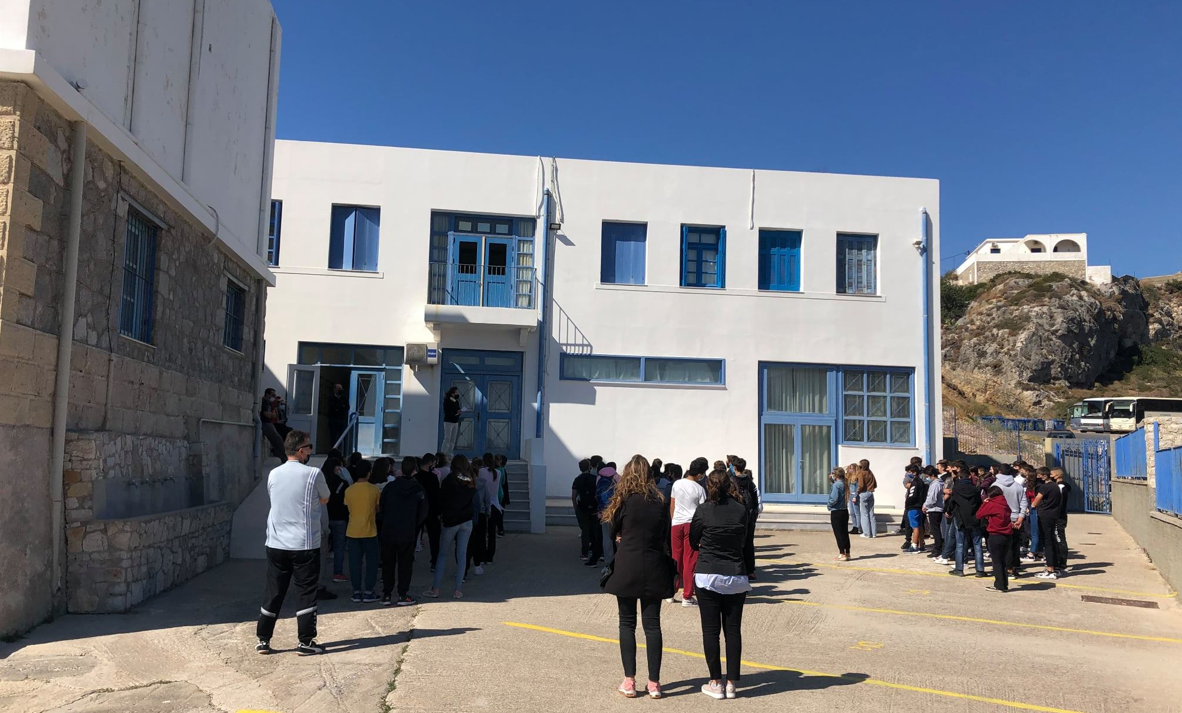
The traditional blessing ceremony will take place in the school courtyard according to the schedule of each school, which will be communicated to parents.
It is customary for the blessing ceremony to take place between 8:15 and 9:30 a.m. Immediately after the blessing ceremony, students will go to their classrooms to receive their books and timetables.
Middle Schools and High Schools
Older students, those in middle and high schools, will be informed by their schools about the time of the blessing, but traditionally it takes place between 8:30 and 11:00 a.m., depending on the municipality and the availability of priests. The procedure is the same as for primary schools.
After the blessing, students receive their books and timetables, and classes begin as normal on Thursday, September 12.
Changes for the new school year
1. Overcrowded classes – more teachers moving around
This year, many students are forced to study in classes of 25-28 children, with all that this entails for the educational process. In addition, more teachers will be forced to move between 2, 3, 4, and 5 schools.
2. What time will classes finish?
The departure of elementary school students who attend the upgraded All-Day Elementary School program will take place at 15:50, at the end of the second teaching hour of the 2nd zone, or at 17:30, upon completion of the program.
Furthermore, the possibility is given departure to take place at 14:55, at the end of the first teaching hour of the second zone. Otherwise, the program remains unchanged, with students to attend classes from 8:15 a.m. to 1:15 p.m.
In middle schools and high schools, classes They start at 8:15 a.m. and end at 2:00 p.m., depending on each department's weekly schedule.
3. How many absences will students be allowed to remain in the same class?
Classes will formally begin the day after tomorrow, Thursday, September 12, with the new ministerial decision on absences of middle and high school students to take immediate effect and bring about three major changes. The promotion and dismissal of students depends not only on their performance but also on their regular attendance at school during the school year.
The decision of the Ministry of Education regarding new absence policy strengthens the role of parents and guardians, and provides for the reinstatement of the distinction between unjustified and justified absences.
Distinguishing between justified and unjustified absences
According to reports, the role of parents and guardians is being strengthened. Parents/guardians/caregivers are informed on a case-by-case basis about student absences.
The distinction between justified and unjustified absences is reinstated. Absences are recorded in the Attendance Register (absenteeism register) and, after being tallied every four months and classified as justified or unjustified, are recorded in the students' Individual Reports so that their parents/guardians are informed.
Adequate or inadequate schooling
Attendance is considered adequate or inadequate based on the total number of absences recorded during the academic year.
Study is considered adequate if:
1) the total number of absences recorded during the current academic year, regardless of the reason for them, does not exceed 40.
2) the total number of absences does not exceed 114, of which more than 40 are justified or due to health reasons.
It is considered inadequate if:
1) There were over 40 unjustified absences or over 114, of which 74 were justified.
Students whose performance is deemed unsatisfactory are required to repeat the same grade.
Differences in absences among students with disabilities and athletes
For students with disabilities and special educational needs, attendance is considered adequate when the total number of additional absences ddoes not exceed thirty percent (30%) of the provisions of the relevant detailed study program based on the timetable, and any absences in excess of those specified are demonstrably due to their participation in rehabilitation and treatment programs certified by the implementing body.
Absences due to serious chronic health problems or serious and urgent circumstances requiring a long period of recovery are exempt.
The facility for students who participate as athletes in national athletic competitions or international athletic events remains in effect. approved by sports federations recognized by the Ministry of Education, Research, and Religious Affairs, with the possibility of exceeding the limit of 114 absences by up to 70 additional absences.
4. «Anyone who films will be transferred to another school.»
The Minister of Education pointed out that there used to be a circular prohibiting mobile phones in schools, but it had no effect.Consequences for their use.
Open possession and use will be punishable by a one-day suspension, while anyone who films a child at a very sensitive moment the person filming the person, the student filming, will change schools, the minister clarified.
These measures, ranging from the reinstatement of five-day suspensions in schools, as was the case in our day, to measures concerning changes in the school environment, are a set of consequences that teachers themselves requested during the last school year, said Kyriakos Pierrakakis, pointing out that these are tools in the hands of educators.
5. Digital tutorial
This year, a pilot program is being launched Digital Tutorial on September 16, offering thousands of students the opportunity to attend live afternoon lessons covering subjects included in the national exams, as well as special subjects such as French, German, and architectural design.
Students will also have access to educational material in electronic form, with the aim of covering all courses by 2025.
6. Autonomous classes
Schools in remote areas areas such as Gavdos and Arkoi They will have permanent teachers for core subjects, while modern distance learning will be used for other subjects, thus providing access to education for students living in isolated areas.
7. Interactive learning systems
By the end of 2024, the following will have been installed 36,264 interactive whiteboards in all grades from fifth grade to third grade of high school, while 28,504 boards are already in classrooms. At the same time, schools are being equipped with new robotic systems.
8. e-parents application
The new e-parents app provides parents with information about grades, announcements, and notifications from schools. During the school year, features will be added for absences, curriculum progress, and scheduling meetings with teachers.
9. Stop-bullying.gov.gr platform
The platform against school violence, which began operating last school year, has already received significant participation from students and parents, while teachers have been trained to deal with the phenomenon.
10. New school operating regulations
Greece is introducing stricter rules on the use of mobile phones in schools, following the example of other European countries. Possession and use of mobile phones will be prohibited during lessons, and offenders will face disciplinary measures.
11. Active citizenship actions
The curriculum is aligned with the UN's 17 Sustainable Development Goals, emphasizing social responsibility, environmental protection, and creative thinking.
12. IT certificate
The computer science curriculum is being revamped, with a new certificate covering four main areas: basic computer science principles, data analysis, the internet and networks, and ethical/social aspects.
13. Changes in literature
The reading of complete literary works is introduced in all grades, from kindergarten to high school, with the aim of promoting reading and critical thinking among students.
14. The multiple book in digital form
Finally, the concept of the multiple book will be implemented gradually, in digital and printed form.
15. School career guidance
By the end of the year, all first-year high school students will have access to a digital career guidance platform, through which they will be able to discover their aptitudes and talents.