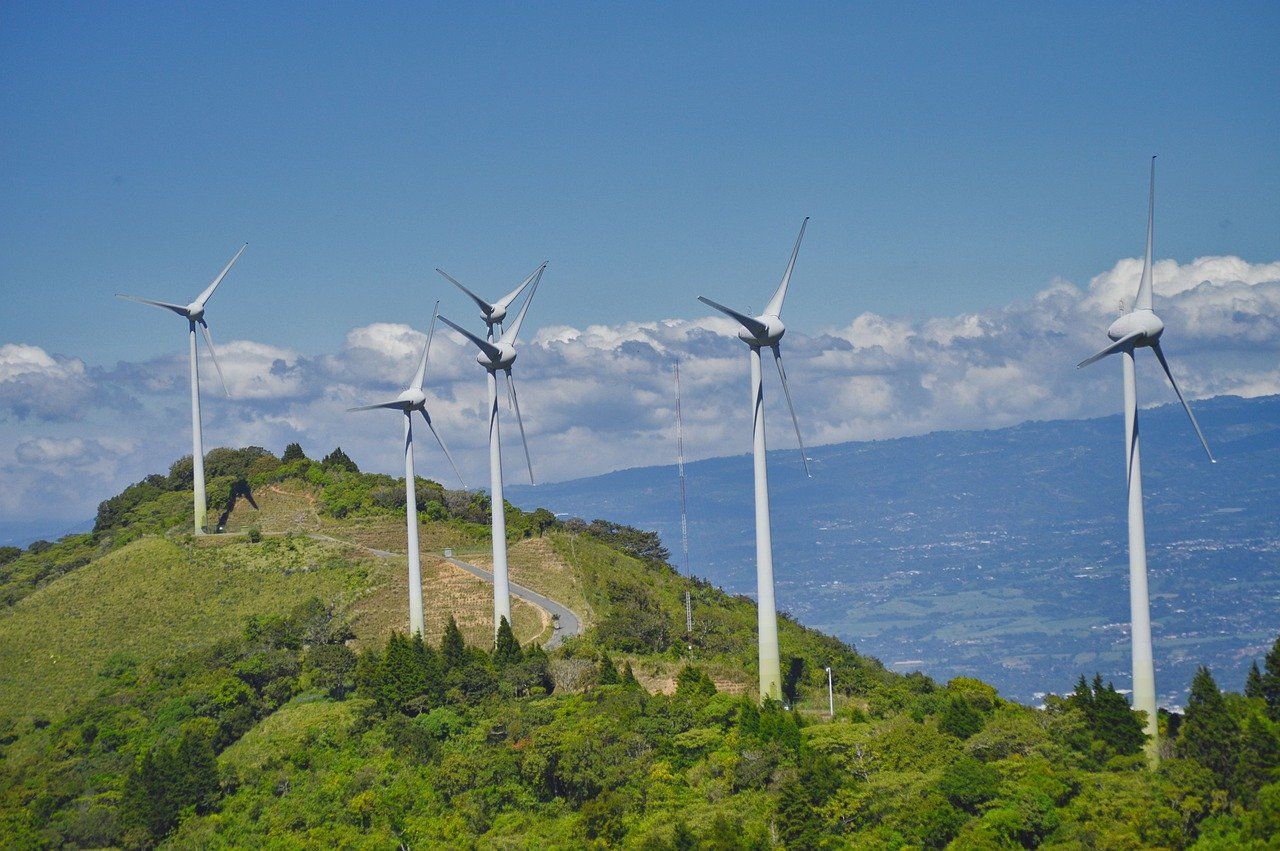
It may appear today that the climate change needs the projects Renewable Energy Sources, but the history of its policy Europe for their widespread use, demonstrates that It was the renewable energy projects that needed to address climate change. This is evident from the European Commission’s Green Paper «Toward a European Strategy for Security of Supply» (2000), which states that the problem of rising international oil prices caused by increased demand in developing countries could be addressed «provided that efforts are made at the international level to promote renewable energy sources and energy efficiency, for example as part of the fight against climate change.»!
Energy dependence is a major issue
This text is extremely interesting because it reflects Europe’s priorities in shaping its energy policy. It examines the historical development of all energy sources, the geopolitical landscape, and the constraints it imposes, and of course, as part of the effort to develop a «liberalized» internal energy market.
It begins by stating: «»This Green Paper was drawn up in response to the following observation: that Europe’s energy dependence is increasing at an alarming rate,’ and for this reason «The European Union must take full control of its energy future!»
The main issue it raises is the risks posed by Europe’s dependence on external energy sources. «Given the available technologies, conventional primary energy resources within the EU do not allow for the possibility of Europe’s energy self-sufficiency to be considered. Only high-tech renewable sources can curb the trends toward increased energy dependence.» Although: «Technological forms of renewable energy and advanced technologies are still in their infancy… thanks to the increased efforts of public authorities, they have been spreading quite a bit over the past few years…» Renewable energy sources are the only source of energy over which the European Union has any room for maneuver. »The Union cannot afford to ignore this form of energy."
Priorities
The issue at hand is that Europe, the world’s second-largest consumer and leading importer of energy products, with an installed capacity of 600 GW in 2000, is facing a situation in which it must replace approximately 300 GW of power plants that have reached the end of their life cycle, as well as the installation of 200–300 GW of new power plants to meet the increase in consumption during the 20-year period from 2000 to 2020.
Unpredictable increases in hydrocarbon prices are leading to a search for a strengthened mechanism for maintaining strategic reserves and new import routes.
Oil is viewed favorably, as long as it comes from European countries, but In the North Sea, oil reserves are limited, and the cost of extraction is much higher.
With regard to natural gas, it is stated that poses a risk of «a new form of dependence.».
However: «Nuclear energy and solid fuels are now undesirable energy sources»… even though their contribution… to electricity generation is of crucial importance”, with 35% and 26%, respectively.
The future of nuclear energy appears uncertain, «due to opposition from part of the public.» Other problems include uranium imports (95% dependence) and the management of nuclear waste. However, the proposal is: «The European Union must maintain control over nuclear technology for civilian uses in order to preserve the necessary expertise, develop more efficient fission reactors, and enable the achievement of fusion.» Moreover, thanks to nuclear energy, «312 Mt of CO2 emissions are avoided annually, representing 7% of the Union’s total greenhouse gas emissions.».
As for coal, much of which was imported, the reasoning is that: «tough decisions must be made regarding its future… because It is not competitive. For reasons related to the security of energy supply, maintaining access to certain reserves could be considered as a possibility. In this way, it would be possible to »to maintain the leading position of European technology in the areas of carbon capture and clean coal combustion."
They went ahead, ignoring society
So they concluded that The share of renewable energy projects should be doubled. Knowing from the very beginning that the development of these projects would not enjoy social consensus: «Local communities... are currently hindering the development of renewable energy facilities.». Recognizing, furthermore, that there was no scope for expansion of hydropower due to public opposition, with the exception of small hydropower projects, and: «Therefore, the remaining forms of renewable energy (biomass, wind energy, solar energy, geothermal energy) must account for nearly the entire targeted increase. This implies a fourfold increase in their relative share, not merely a doubling in reality.»
The text states that the Union’s energy dependence in 2000 was 50%, and that if no measures were taken, this percentage would rise to 70% in 20 to 30 years.
After twenty years of reforms, an official report by the European Commission shows that in 2018, Europe is facing an even more acute problem of energy dependence, amounting to 58.2%, and This is due to imports of fossil fuels and natural gas!
Edited by: Vanna Sfakianaki