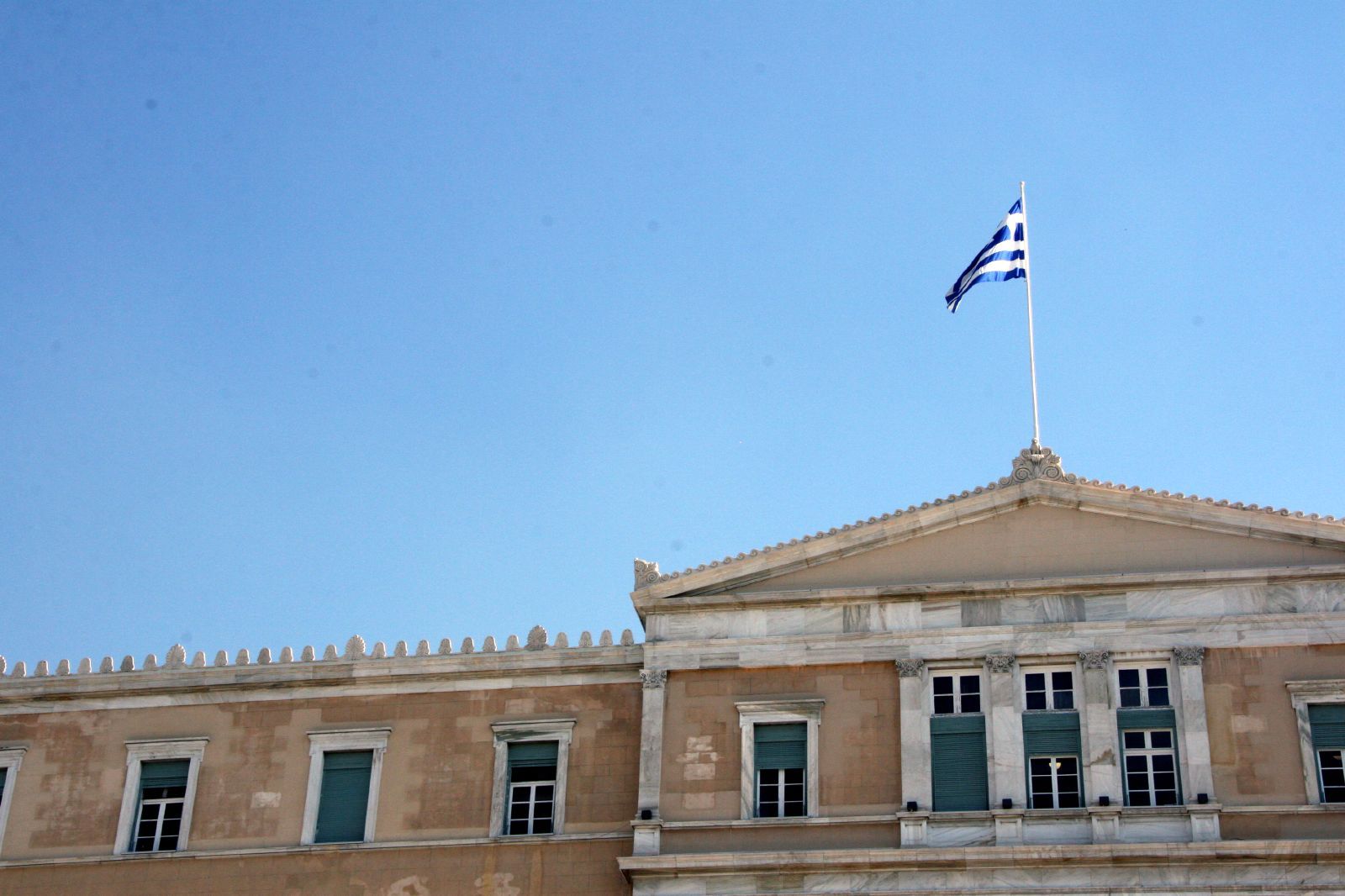
The defense agreement with France was ratified with 191 «yes» votes in the plenary session of the Hellenic Parliament. Konstantina Adamou, the Member of Parliament for Thessaloniki B, who has broken away from the MERA 25 parliamentary group, also voted in favor of the agreement. A total of 109 members of Parliament voted against the agreement.
This was preceded by a discussion that took place in a rather heated but expected tone, highlighting the differing views and principles on foreign and defense policy held by the government and the official opposition, with the prime minister emphasizing that the government is changing the SYRIZA doctrine that had left the country wide open, and Alexis Tsipras arguing that Kyriakos Mitsotakis is trappedand trying to straddle two stances.
During his remarks, the prime minister acknowledged that Turkey’s ever-increasing provocations and the threat of a casus belli are a cause for concern for the government; for this reason, the government’s primary concern —as he put it—is to shield the country.
«Yes, I am anxious, Mr. Tsipras. When I’m facing Turkey with a casus belli threat, I’m anxious. Were you anxious? I’m very anxious, and my top priority is to shield the country,» said Kyriakos Mitsotakis, adding that the mutual assistance clause is an extremely powerful tool.
The prime minister, who was challenged by the opposition parties over the Bogdanou case, responded from the floor of Parliament, emphasizing his firm opposition to divisive behavior.
«From the very moment I was elected president of the New Democracy party and later prime minister, I made a commitment not to reopen the wounds of the past, and that commitment is being put into practice; anyone who crosses the line should know that they have no place in the New Democracy parliamentary group,» was the message he sent.
Regarding the substance of the discussion, which was limited to the topic at hand, Kyriakos Mitsotakis stated that the government’s priority is to strengthen the country’s deterrent capability through reliable armed forces. He attacked SYRIZA, accusing it of pettiness and opportunism in its approach to the agreement, and emphasized, addressing Alexis Tsipras, that «Greece is small only if you see it that way.» He continued in the same vein, saying, «We see a Greece that is self-confident, that plays a role in Europe and a stabilizing role in the southeastern Mediterranean. We will not allow Greece to be reduced to your perception of its small size.».
In response to criticism directed at the government regarding the cost of the frigates, Mr. Mitsotakis commented that «the pre-war dilemma of »bread or cannons’ no longer applies in Greece. Our country will have both.”.
The prime minister questioned SYRIZA’s change in its initial stance and noted that «from »no’ to ties, it went to ‘no’ to frigates,” and in response to Alexis Tsipras’s claim that the government is changing the country’s doctrine.
«If the doctrine was that Greece has no maritime borders and anyone can enter whenever they want, well, then we’re changing that doctrine. We are protecting our borders, and in February we did not allow Turkey to violate our borders by sending thousands of migrants. »So we’re changing your doctrine, Mr. Tsipras,« said Kyriakos Mitsotakis, adding: »If, Mr. Tsipras, your doctrine was to acquire frigates through leasing, we’re obviously changing it because that’s not a serious doctrine. The Armed Forces need long-term planning. If, Mr. Tsipras, the country’s doctrine were to constantly talk about international law but do nothing else on other fronts, we’d change it—which is why we signed EEZ agreements with Egypt and Italy. If our doctrine was to leave submarines without torpedoes and our fleet in a state that made surveillance difficult, of course we’re changing that doctrine. If our doctrine were to have Mr. Kammenos as Minister of Defense—a figure who was a combination of kitsch and absurdity— well, then we’re changing that doctrine, and I’m proud of the leadership we have today at the Ministry of National Defense and the Ministry of Foreign Affairs.”.
Alexis Tsipras called the prime minister «Little Bogdano,» arguing that Kyriakos Mitsotakis is trapped in the Gerapetritis doctrine, which sets as a red line the 6 nautical miles and the Samaras doctrine, which states that “I do not negotiate with pirates.” It was also claimed that the prime minister is trying to have it both ways in order to win votes.
He reiterated SYRIZA’s objections that the defense agreement is unbalanced, as it does not include maritime zones of sovereign rights, and he also opposed the deployment of Greek forces to conflict zones where France has interests, such as the Sahel.
«This Agreement does not safeguard our sovereign rights; it draws us into conflicts far from our borders, nor does it secure a single euro for our defense industry, and we will vote against it. We will amend the Agreement with regard to the article concerning the presence of Greek soldiers outside our country,» said Alexis Tsipras, emphasizing that SYRIZA will not go along with this mistake.
Regarding the Sahel, Mr. Tsipras asked, «How many coffins draped with the Greek flag is the limit?» prompting an angry response from Kyriakos Mitsotakis.
«That comment about the coffins draped with the Greek flag was the most deplorable thing I’ve heard in this chamber since I became president of the New Democracy party,» he said.
The president of SYRIZA criticized the government for its handling of Turkish provocations in the Aegean and the Eastern Mediterranean.
«I understand the very serious internal party issues you’re facing, your need to straddle two camps—on one hand, the center-right, and on the other, the far right,» he said, adding: «You said that our defense and foreign policy doctrine left the country wide open, and you wondered if we were concerned. We had neither Belharra nor Rafale when Turkish research vessels, escorted by Turkish Navy ships, entered the country’s EEZ off Kastellorizo with the Barbaros to conduct research.’.
Continuing in the same vein, Mr. Tsipras noted that SYRIZA, as the government, did not come out to say that there was a wind sweeping ships into our EEZ. «We didn’t come out and say that they aren’t conducting surveys and therefore aren’t violating our sovereign rights just because the nearby ships are making a racket. We didn’t tuck our tails between our legs, and we had neither Belharra nor Rafale, but we defended our country’s sovereign rights with the presence of Navy ships there.’.
KINAL votes in favor of the agreement, with Fofi Gennimata highlighting the need for a new national strategy to counter Turkish revisionism.
«We are voting in favor of the Greece–France «strategic partnership» agreement because, in general terms, it lays the groundwork for enhanced cooperation in the fields of defense and security. We support the modernization of the fleet through the purchase of French frigates, in accordance with the requests of the Armed Forces» general staff. We are interested in and agree to maintain the closest possible relations with France. “It is a traditional ally of our country and is of particular value at a time when Turkey is once again escalating its provocations,” he said, adding that the government must plan, through the broadest possible consultation and research and with absolute transparency, the next steps to make the best possible use of the opportunities provided by the agreement for the benefit of Greece, with a medium- to long-term perspective.
The KKE opposes the agreement. Dimitris stated that «the Greek-French agreement does not serve the needs of the Greek people but rather the goals of big business.».
The Greek Solution party voted in favor of the agreement, with Kyriakos Velopoulos stating that his party is fulfilling its national duty. «The agreement will push us deeper toward bankruptcy,» said Yanis Varoufakis, whose party is voting against the agreement.