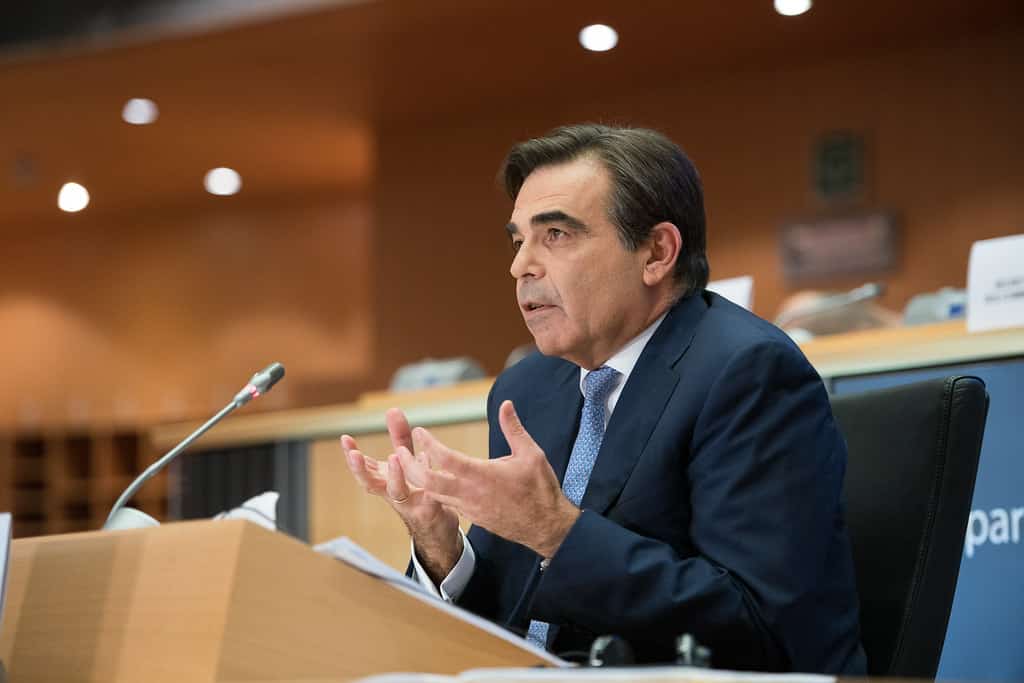
The Stability Pact after the pandemic will certainly not be the same as the one that existed before the pandemic, but neither will it be the same as the one that existed during the pandemic. We are now shaping the new fiscal policy framework, which will be adapted to the new circumstances. There are proposals such as the exclusion of some types of expenditure from the public debt. These are being discussed, said the European Commission's Vice President for the Promotion of the European Way of Life, Margaritis Schinas, at the Greek Economic Summit conference organised by the Hellenic-American Chamber of Commerce. Referring to the health situation, he said that ’mandatory is on the table, we are moving towards enlargement and it is the issue that will be discussed at the EU summit on 16-17 December’.
The Vice President announced developments on an issue of particular interest to Greece, such as the instrumentalization of the refugee-migration issue, saying that we have successfully dealt with it politically and that «in the context of our proposals for the reorganization of the Schengen rules, we will put the term instrumentalization in a legal context and we will open a series of options for states that suffer these phenomena to be able to better organize their defense».
Referring to Greece's growth prospects, he said that the EU's combined responses to the pandemic - vaccinations, a Community certificate and a Recovery Fund - led Greece to a growth rate of 7.1% for 2021 and better prospects for the coming years.
On both sides of the Atlantic there is the intention to build a better model of development, he said, emphasising the qualitative characteristics of this new production model.
In the EU, the pillars of the new growth model are the Green Deal and the digital transition and for the first time we have the financial tools to support them: The Recovery Fund and the National Development Plans already in place.
He explained the Greek plan to the businessmen, describing it as «one of the best structured» with three main aspects: One third of the €6.2 billion of subsidies is for climate targets; the second is for investments in the social fabric - employment, skills, social cohesion - with €5.2 billion; and the third is for investments and loans for the transformation of the investment framework, amounting to €17 billion.
If we add, he stressed, the spending of the seven-year NSRF, «we have for the first time in the 40 years of the country's accession to the EU an unprecedented record, a great development opportunity that we must not miss.».
All these tools, he added, need to be accompanied by aggressive investment and private sector innovation.
He referred specifically to the American business sector in Greece, which «plays a key role and we want it to be strengthened». He spoke in detail about the creation of Pfizer's digital hub, the creation of an international innovation center by Cisco, the presence of Deloitte, as well as the planned investments by Microsoft and Amazon. «We are seeing a dynamism in the US business presence that is not only welcome but also compatible with European growth priorities,» he said
On the transatlantic agenda, as formulated at the June US-EU summit with four main priorities: fighting the pandemic, promoting green growth, strengthening trade and technological cooperation and finally security, he said that “we have made a lot of progress in the last few months”.
We worked very closely together in Glasgow on the environment, in trade we resolved long-standing differences on civil aircraft, steel, aluminium and we launched in September a very ambitious EU-US Trade and Technology Council to create common rules for cutting-edge technologies.
On the pandemic issue, we have a joint working group to remove any obstacles in the vaccine supply chain.
In response to journalist N. Lymperaki's questions regarding Euro-Atlantic relations after the US agreement with Britain and Australia (AUKUS), he said that while we have made a lot of progress in US-EU relations, in some geopolitical developments the EU would like more consultation and this requires investment in relations and trust.
Finally, he defended the new refugee structures on the islands, saying that Moria was the occasion to rebuild a framework of structures funded by 100% from the European budget and helping Greece and Europe to manage together the pressure at the external borders. They are structured according to our values, they are a new page and before judging them some people should visit them.
Nina Melissova