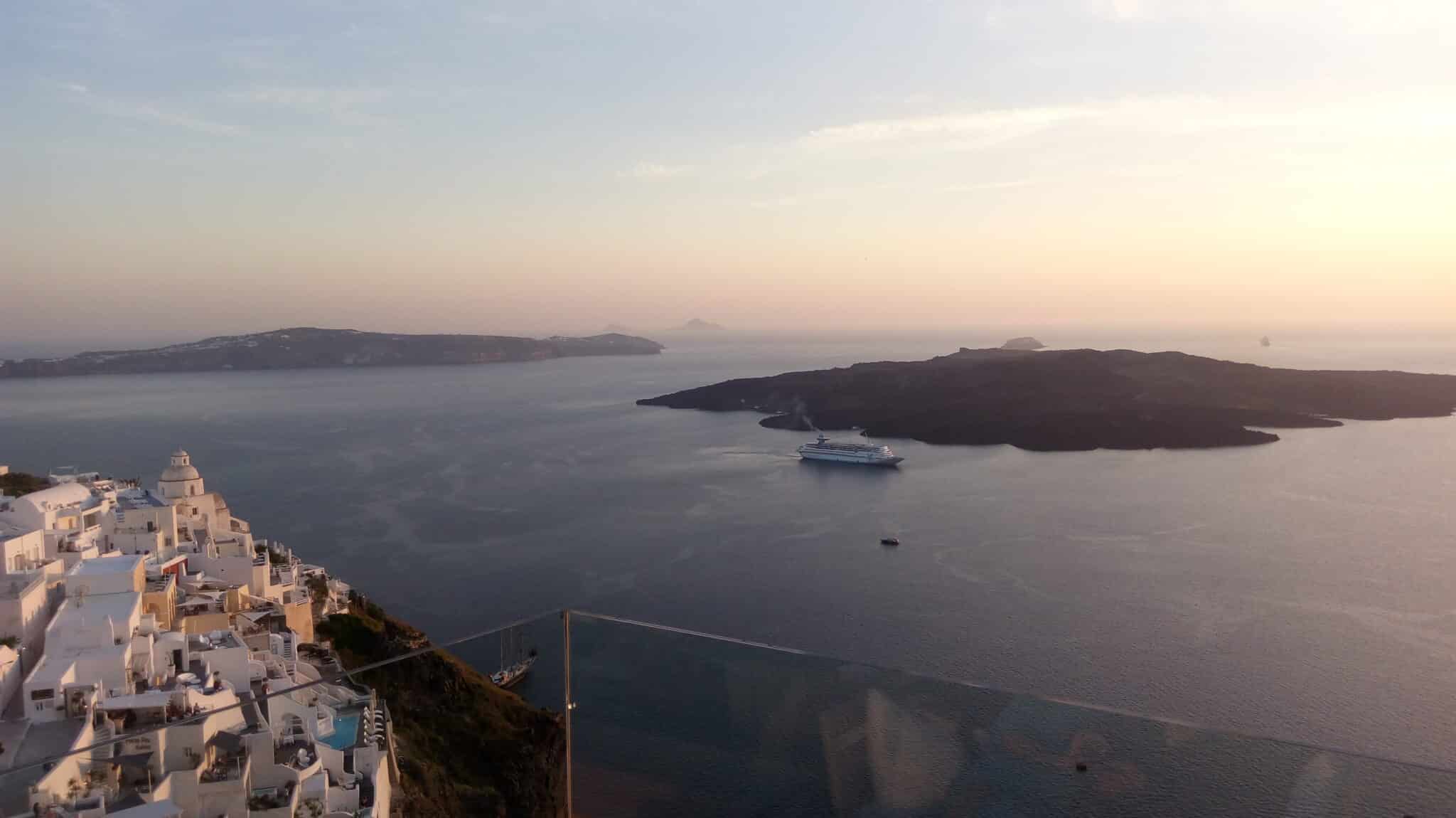
Changes in the water level of the Aegean have affected the timing of his outbursts Santorini Volcano, according to new estimates by foreign scientists.
A new international scientific study, which correlated volcanic activity on the island with changes in sea level over the past 360,000 years, has concluded for the first time that When the water level drops by more than 40 meters, the likelihood of an explosion increases. Consequently, in our time, when, due to climate change, ...the opposite is true; that is, while sea levels tend to rise, volcanic activity is clearly on the decline. This finding could have implications for millions of people living on volcanic islands around the world.
Researchers from the United Kingdom and Sweden, led by Chris Sato, a lecturer in physical geography at Oxford Brookes University in Oxford, who published their findings in the geoscience journal *Nature Geoscience*, studied developments during the last four glacial periods, comparing the geological record of the Santorini eruptions with the record of global sea-level changes. Previous studies of the successive layers of ash on the island have revealed 211 past eruptions, ranging from very violent to less explosive. The «Minoan» eruption that created the caldera, it was this study that brought to light a remarkably detailed geological history of previous eruptions.
The new study found that 208 of the 211 eruptions—that is, almost all of them—occurred after water levels dropped at least 40 meters below current levels, a phenomenon that has frequently occurred in the past due to the periodic expansion of the ice sheets. Scientists used a specialized model to estimate that when the sea level drops below a certain threshold, the pressure inside the upper part of the Santorini volcano’s magma chamber increases, so that the magma is then able to create cracks in the Earth’s crust and thus find outlets to reach the surface, causing eruptions.
«The mechanism is quite simple: As sea levels drop, mass is removed from the Earth's crust, causing the crust to fracture. »These fissures allow magma to rise and fuel eruptions at the surface," said Dr. Sato. As he noted, it is well known that volcanic eruptions can alter the climate (e.g., the 1992 eruption of Pinatubo in the Philippines led to a drop in global temperatures of half a degree Celsius), but the reverse is also true: climate can influence volcanic activity.
The behavior of magma chambers that fuel volcanic eruptions is influenced by various factors, including the weight and pressure exerted by the overlying materials. Erosional and tectonic processes can remove or add such materials over time, as can—according to the new study—fluctuating sea levels, which are directly dependent on climatic conditions.
In the case of Santorini, according to foreign scientists, the geophysical, petrological, and geochemical data analyzed to date provide strong evidence for the existence of a shallow magma chamber at a depth of approximately four kilometers beneath the island’s caldera. Following the powerful «Minoan eruption,» which affected a large part of the Aegean Sea as far as Crete, the volcano is now believed to be at the beginning of its third cycle of activity, and the most likely risks from it are merely small eruptions. In fact, based on the new study, the researchers concluded that, as sea levels have risen since the last ice age and, at the same time, is gradually rising due to the current increase in temperature caused by climate change, even the relatively small eruptions of the Santorini volcano in the recent past will likely cease soon.
The volcano, in essence remains «dormant» following the 1950 eruption of Nea Kameni, while the minor activity observed in 2011–12 did not lead to an eruption—which, according to the researchers, is yet another indication that the volcano has likely entered a period of dormancy, partly due to rising sea levels. Nevertheless, they estimate that the risk of major eruptions remains over the long term.
Finally, using Santorini as a model, they also emphasize that it is now necessary to take sea-level changes into account when assessing volcanic hazards around the world. According to Sato, «57% of the world’s volcanoes are located on islands or in coastal areas and are often adjacent to large populations. Further research is vital to fully understand the consequences of sea-level changes on these volcanoes, as well as the risks to nearby residents.».