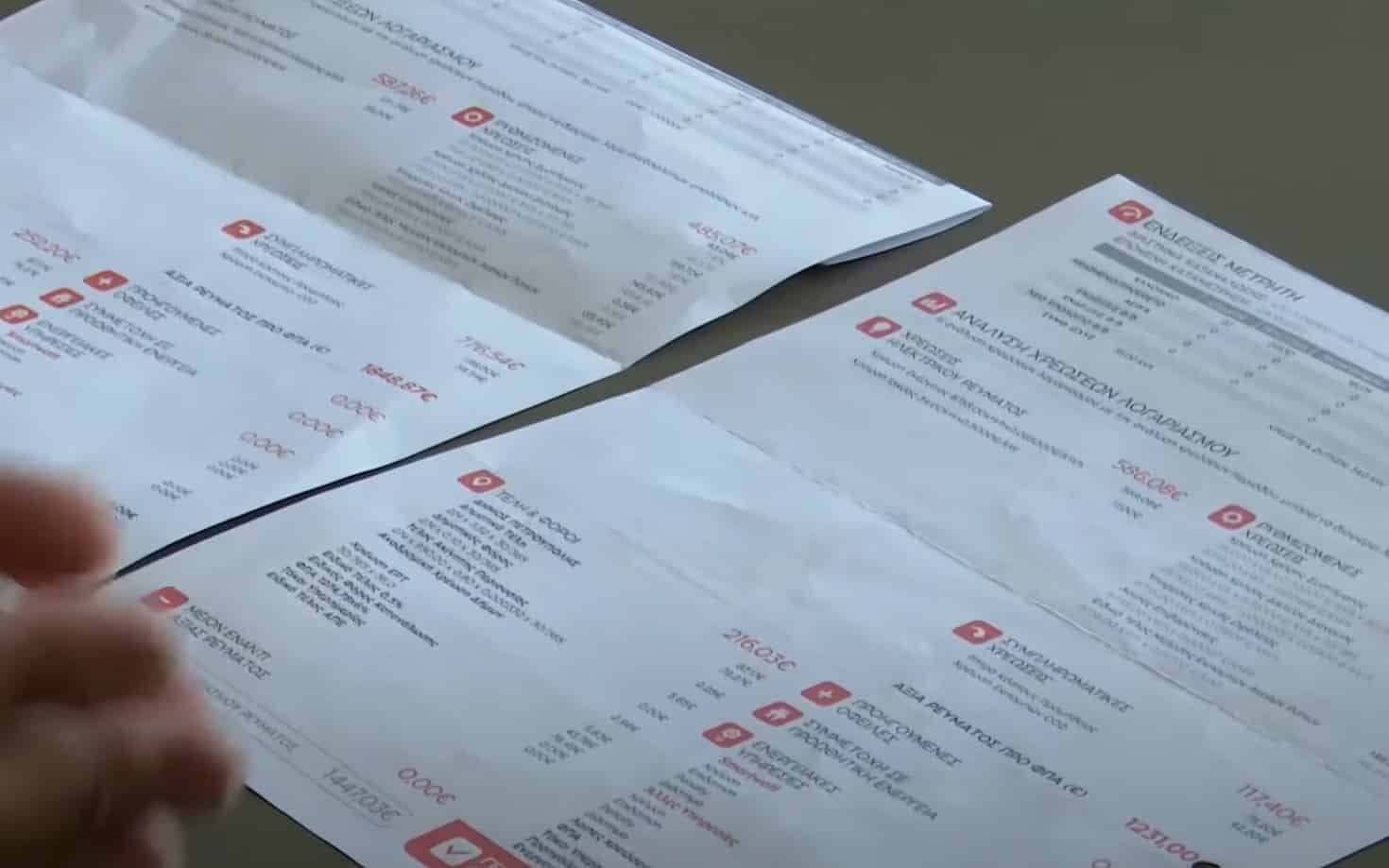
Rules that will apply to the whole market in terms of the way retail companies will submit bids for both electricity supply and electricity bills, RAE proposes in the second round of public consultation with electricity suppliers launched yesterday.
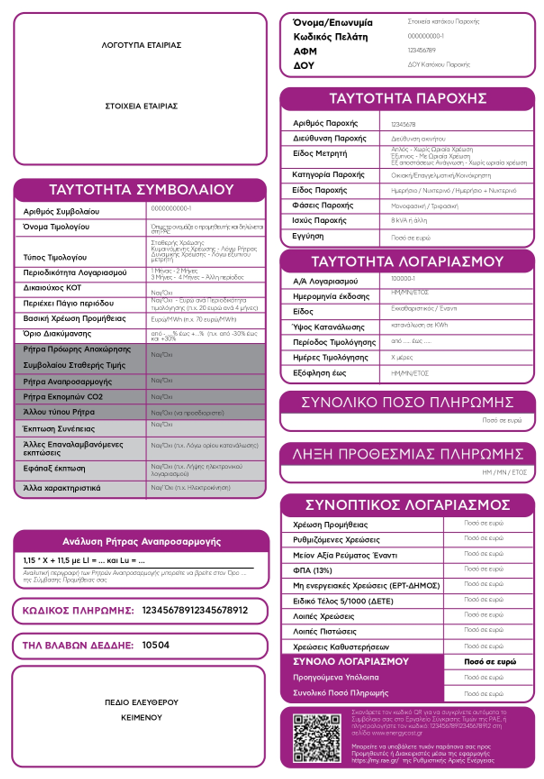
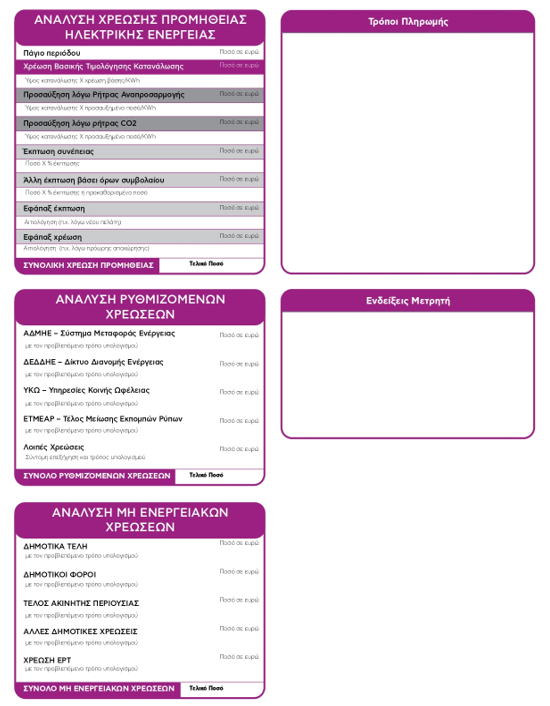
The RAE's proposals aim to enhance transparency and make it possible to compare electricity tariffs in a simple way. In this context, the bill form in addition to the data of the supplier and the customer, includes in separate places indications for:
- The type of tariff (fixed or variable charge)
- The periodicity of the account (e.g. 1, 2, 4 months)
- Whether the consumer is a beneficiary of the Social Household Tariff
- If the account contains fixed assets
- What is the basic supply charge and the variation limit (e.g. from - 30% to +30 % as recommended by RAE)
- Whether a consistency discount or other discounts, recurring or one-off, is provided.
- If there is an early withdrawal clause, indexation clause, carbon emissions clause or other type of clause
- Detailed description of the indexation clause
- Separate indication of the basic invoicing and the additional amounts resulting from penalty surcharges and discounts applied
- Separate indication of regulated charges for networks, Public Utilities, ETMEAR, municipal fees, taxes, etc.
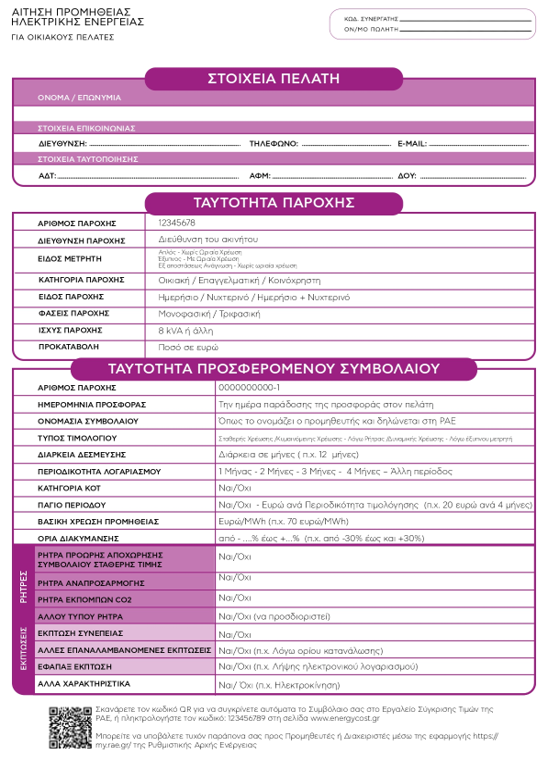
For the same reasons as mentioned above, RAE has put to consultation and the proposed standards for the standardised «Form of Request for Offer to Supply Electricity», which you can see in the images below. Through these, RAE aims to provide consumers with all the necessary information before they decide to sign a contract so that they know in advance the reasons for any future price adjustment and the method of its calculation.
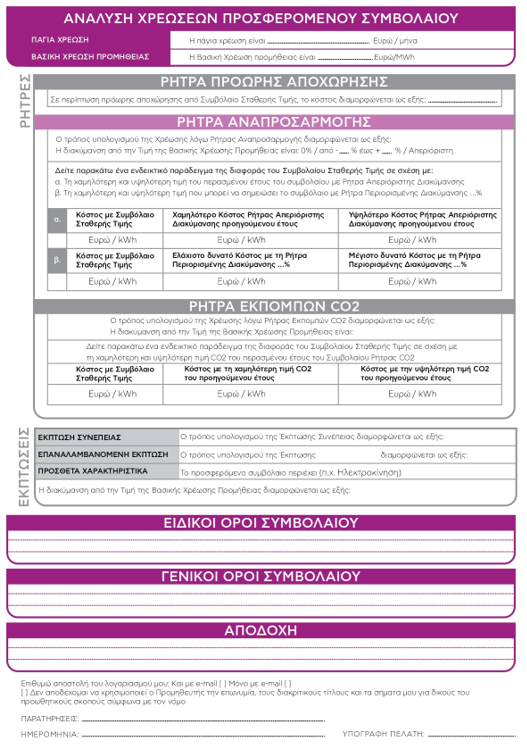
The application of the proposed standards will start from 1 January, according to the announcement.
«Three-phase» tariffs
At the same time, RAE proposes the categorisation of low voltage electricity bills, which will be based on the range of mark-ups on competitive charges that may or may not be caused by the existence of a clause.
In particular, the three categories according to RAE's proposal are fixed tariffs identified as «zero risk» tariffs, variable tariffs with a mark-up limit or «capped risk» tariffs» and finally variable tariffs with no mark-up limit, which are assessed as «high risk» tariffs.
Interested parties are invited to submit comments, observations and additional proposals until 25.10.2021. Thereafter, RAE, in accordance with its standard practice, will publish the views of stakeholders.