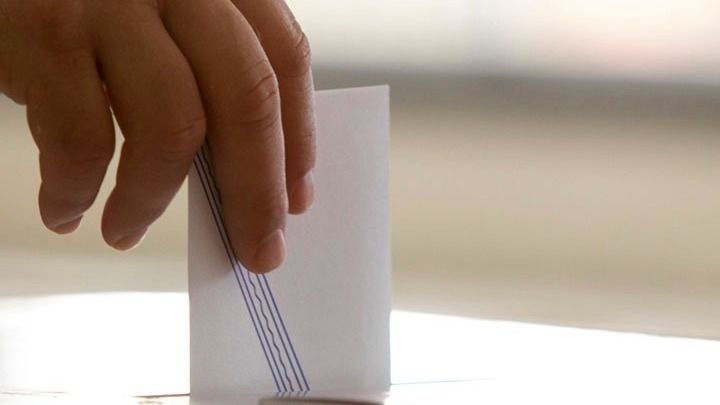
The government proposal allows voters within the country to vote by mail in European elections and national referendums if they so choose, without justification, while for voters abroad it will be the only way to vote, as no polling stations will be set up.
How to vote from home
For both categories, it is essential toregistration on electoral rolls for postal voting which will be carried out via an electronic portal on gov.gr that will open after the bill is passed. The voter, by use of taxisnet codes, submits their application and fills in the address to which they want the election material to be sent. Their mobile phone number and email address are verified with a one-time password (OTP).
The deadline for submitting applications is 40 days before the election, For the European elections on June 9, 2024, when the measure will be introduced for the first time, applications must be submitted by April 28 at the latest.
Until that date, voters may change their delivery address or any other details, or cancel their application.
The envelope containing the election material is sent no later than 20 days before the elections by the Ministry of the Interior without charge to the recipient and delivered only to the recipient by registered letter or to someone authorized by the recipient.
The voter is informed by mail for sending the file and with a link to track the progress of the shipment.
Ο election envelope It will contain the return envelope for postal voting, the voting envelope, the ballot paper, a form with instructions and a list of candidates, and a form for a solemn declaration. All envelopes will have a raised feature on the outside so that they cannot be forged.
The ballot The first page will list all the parties participating in the elections, and the selection will be made by placing a cross in the box next to the name and emblem of the party.. The candidates for the European Parliament are selected on the second page where there is a large square containing 42 numbered squares (from 1 to 42) corresponding to all the candidates of each party. Instead of a cross, the voter circles the number corresponding to each candidate they wish to vote for (up to four choices) found on the instruction sheet.
In order for the vote to be counted, it is necessary for the voter to fill in the affidavit that he/she is registered on the special electoral rolls for postal voting and cannot vote in person, and that the ballot paper was completed and the candidates selected exclusively by him/her without the presence of another person.
The sealed ballot envelope containing the ballot paper, the solemn declaration, and proof of identity (photocopy of identity card, passport, or driver's license) shall be enclosed in the return envelope and sent free of charge by post or a partner courier company.
The envelopes must arrive at the postal vote collection point by 5 p.m. on the eve of the election and are received by a special three-member committee.
The postal voting stations may be located in public or private buildings, which will be rented for this purpose (e.g., exhibition space), guarded by the police, and monitored by closed-circuit television.
Clearance of electoral rolls
Postal voting is one of four parts of the Ministry of the Interior's bill, which will be titled «Election of MEPs, Facilitation of Voter Voting, Clearing of Electoral Rolls, and Other Provisions.».
The other three parts concern the clearing of electoral rolls, facilitating access to polling stations (and other provisions for persons with disabilities), and provisions for the election of MEPs.
Η clearance of electoral rolls was deemed necessary as there are registered individuals who died abroad and the Greek municipal registers were not updated. Because of this There are 555,000 more Greeks registered over the age of 75 compared to the census.or, as a result, the abstention rate increases.
The bill stipulates thatthose born before January 1, 1944 and have not filed a tax return for the current tax year or have not been declared as related persons, at the end of June 2024 they will be placed in a special category «to be deleted» from the electoral rolls. Those who are alive and wish to have the deletion removed may request this by submitting a statement to the municipality, a KEP (Citizens' Service Center), or a consulate, or online, by October 31, 2024.
To facilitate accessibility to elections, a register of electoral districts and polling stations is to be created, which will include a complete map of polling stations that are accessible to persons with disabilities, where voters will be able to vote upon request.
In addition, television messages from political parties and interviews with political leaders will be broadcast on a mandatory basis with interpretation sign language.
Finally, the provisions on election of MEPs provides, among other things, for the declaration of combinations to be made through the electronic candidate portal, reinstates the disqualification for incumbent MPs, coalitions must consist of 42 candidates, while the coalition fee and the candidate fee are combined and set at €20,000, which is refunded to the coalition if it obtains at least 1.51% of the vote.
The government says it will seek «consensus»
According to the Athens News Agency, «the greatest possible parliamentary consensus on the introduction of postal voting into the Greek electoral system is a key objective of the government.».
Thus, the leadership of the Ministry of the Interior will open a round of talks with representatives of the parties in order to explain the parameters of the plan and to submit any objections and proposals. The meetings will begin on December 11, after Minister Niki Kerameus returns from Paris, where she will chair this year's OECD Global Strategy Group.
The aim is to complete consultations with political parties and then public online consultations by the end of December, and to submit the relevant bill to Parliament for voting. the first half of January.
SYRIZA-PS: Answers sought
As emphasized by the Head of Internal Affairs of the SYRIZA-PS Parliamentary Group, G. Poulou, the prime minister's announcement on postal voting «comes with a long delay and recalls the relevant amendment that the party had tabled before the national elections, prompted at the time, among other things, by the issue of young seasonal workers,» while pointing out that «answers are needed regarding possible constitutional obstacles, ensuring the secrecy of the vote, as well as safeguards that will protect the election results from possible tampering and ensure the credibility of the process.».
Most other opposition parties welcomed the government's announcements with caution, while the Communist Party of Greece (KKE) declared its outright opposition (calling it an «unacceptable and dangerous announcement»).
The government says it is seeking broad consensus, although for the bill to be passed and implemented in the upcoming European elections, it only needs to be voted on by New Democracy MPs, as a simple majority of 151 votes is required.
Kerameos assures integrity
In a statement to the Athens-Macedonian News Agency, Interior Minister Niki Kerameos said, among other things: «With the introduction of postal voting for the first time in our country's history, all real/practical obstacles to participation in elections are removed. Through a simple, easy, and completely impartial process, all Greeks who are eligible to vote and live abroad, as well as all those who live in Greece and wish to do so, can now vote. Without having to travel. Without spending money. In the 2024 European elections, fifty years after the restoration of democracy, there will be no obstacles—legal or practical—to the participation of everyone, in Greece and abroad, in the electoral process. Postal voting was a widespread demand of the Greek diaspora, responding to the demands of Greek society, but also to the requests of many political parties, as expressed a few months ago in Parliament during the debate on voting rights for expatriates. This is undoubtedly an initiative by our government that “deepens” our democracy, and I hope that we will send a horizontal message as a political system to facilitate participation in the European elections.