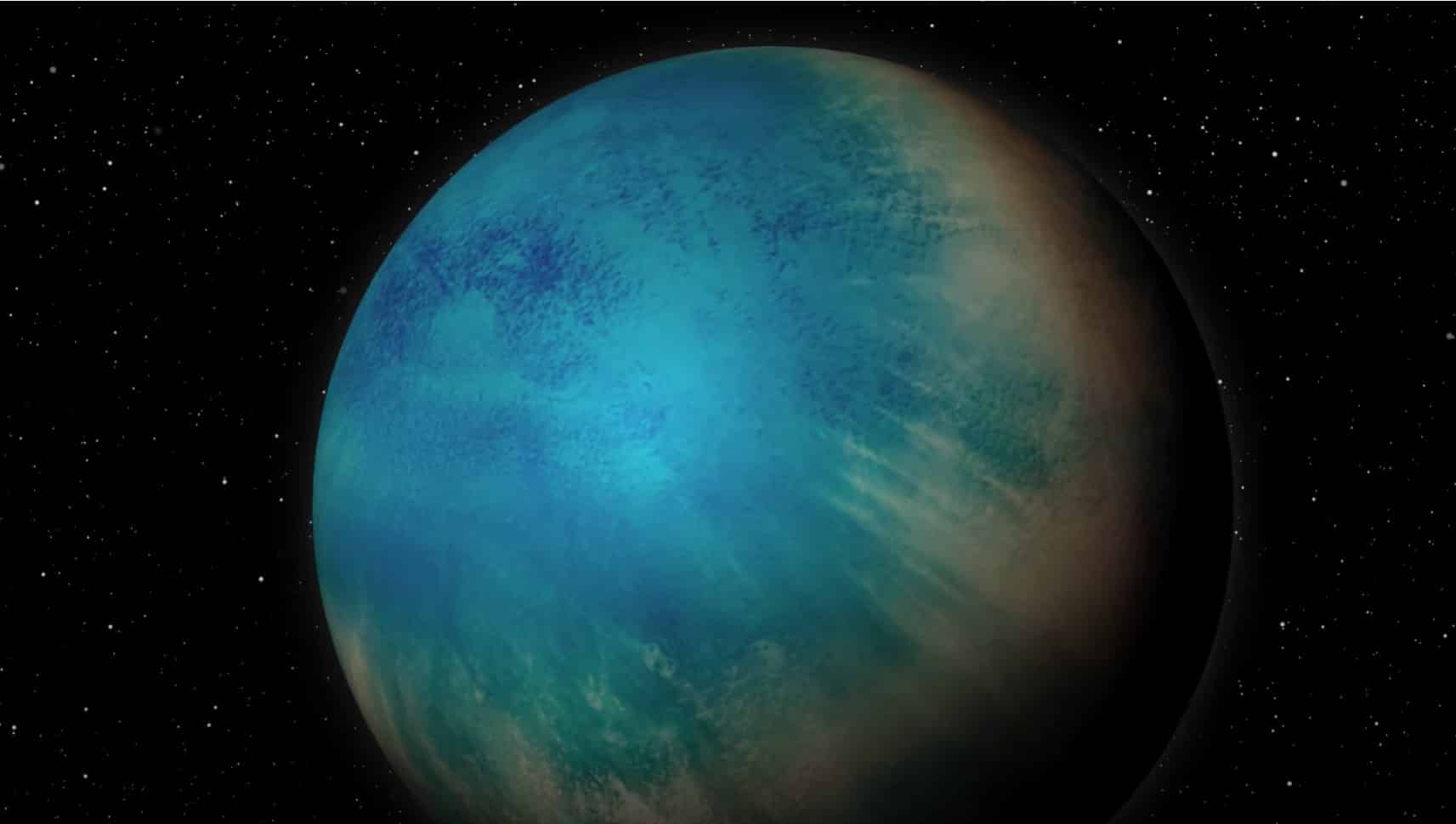
An international team of astronomers announced that it has discovered an exoplanet, TOI-1452 b, which is likely rocky and entirely covered by a deep ocean.
The exoplanet, which is slightly larger than Earth in size and considerably larger in mass (nearly five times as much), orbits a small star in the constellation Draco, about 100 light-years from our own planet.
The exoplanet’s distance from its star is just right, so that its temperature is neither too high nor too low, making it possible for liquid water to exist on its surface. In fact, the scientists—led by Charles Cantié of the University of Montreal, who published their findings in the astronomy journal *The Astronomical Journal*— believe that the planet is likely covered by a deep layer of water.
According to the Athens-Macedonian News Agency (ANA), the planet was initially detected by NASA’s TESS space telescope, followed by observations from other telescopes. The host star TOI-1452, an M-type dwarf star, is much smaller than our Sun and is accompanied by a second star of similar size; together, they form a binary star system, with the two stars separated by 97 astronomical units (approximately 2.5 times the distance between the Sun and Pluto).
The Earth is covered by water to about 70%, but this accounts for less than 1% of its mass. Some exoplanets are estimated to contain much more water, which makes up a significantly larger portion of their mass (in the case of TOI-1452 b, up to 30%, a proportion comparable to that of moons such as Jupiter’s Ganymede and Callisto and Saturn’s Titan and Enceladus), which is why they have been designated ’water worlds« or »ocean worlds.«.
«TOI-1452 b is one of the best candidates for an ocean planet we’ve found to date,» said Cantier. This exoplanet will be studied further by the new, powerful James Webb Space Telescope, as it is close enough to Earth to allow for the study of its atmosphere. The researchers also want to confirm that it is indeed a water-rich world, as they cannot rule out, at this point, the possibility that it is a rocky, dry planet.