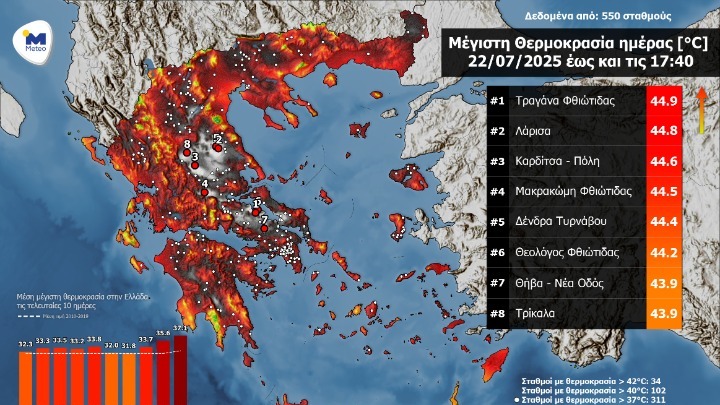
Heatwave conditions prevailed today with the mercury exceeding 43°C in many parts of the country. According to the network of automatic weather stations of the National Observatory of Athens / meteo.gr, for another day the highest temperatures of the territory were recorded in Thessaly and Eastern Sterea, where they approached 45 ° C. As shown by the information presented in the map below, the temperature exceeded 37 ° C in 311 of the 550 active stations, 40 ° C in 102 stations and 42 ° C in 34 stations. Finally, it is worth noting that the average maximum temperature (37.1°C) was 1.5°C higher than on Monday 21/07 (35.6°C).
Below is a map showing the distribution of maximum temperatures in the country and the 8 stations with the highest maximum temperatures. The white circles indicate the stations where the maximum temperature exceeded 37°C.
Mercury soars - Most difficult days Thursday and Friday
The temperature in our country will remain at very high levels in the next few days with the highest values expected on Thursday (24/7) and Friday (25/7). The heatwave is expected to last until Sunday.
According to the update of the Emergency Weather Bulletin of EMY, it is noted that:
A. minimum temperatures will be high (around 27 to 29 degrees Celsius mainly in urban centres).
N. from Friday (25/7) gradually in the east and mainly in the Aegean Sea will prevail strengthened northerly winds of 6 Beaufort that will increase on Saturday (26/7).
Until Friday, in more detail:
1. Today and tomorrow the maximum values will reach:
a) 39 to 41 degrees Celsius in mainland Greece, 42 degrees Celsius in central Macedonia, eastern Sterea and eastern Peloponnese and 43 degrees Celsius in Thessaly. In Athens and Thessaloniki 39 to 40 degrees Celsius.
b) 37 to 39 degrees Celsius in the East Aegean islands and in the Dodecanese and locally 40 to 41 degrees Celsius tomorrow.
c) 37 to 38 degrees Celsius on the Ionian Islands and tomorrow in Crete.
2. On Thursday (24/7) the maximum values will reach:
a) 39 to 41 degrees Celsius on the mainland and 42 to 43 degrees Celsius locally in the east. In Athens 41 to 42 degrees and in Thessaloniki 40 degrees.
b) 38 to 40 degrees Celsius on the islands of the Eastern Aegean and the Dodecanese.
c) 37 to 39 degrees Celsius on the Ionian Islands and Crete.
3. On Friday (25/7) the maximum values will reach:
a) in the mainland 40 to 41 and locally 42 and in the west 43 degrees Celsius. In Athens 41 to 42 and in Thessaloniki 39 degrees.
b) 38 to 40 degrees Celsius on the islands of the Eastern Aegean and the Dodecanese.
c) 38 to 40 degrees Celsius on the Ionian Islands.
d) 39 degrees Celsius in southern Crete.
Heatwave protection measures - Who is most at risk?
The Ministry of Health, due to the prolonged high temperatures that will prevail in the coming days and always having as its first concern the protection of Public Health, reminds the instructions for protection against the effects of the heat wave and calls on all citizens -especially those belonging to vulnerable groups- to follow them.
The country's health units are on high alert, while municipalities are called upon to ensure cool and air-conditioned spaces for the public.
Who is most at risk:
* elderly people
* infants and young children
* pregnant and breastfeeding women
* people who are overweight or obese
* people who work or exercise intensively in a hot environment
* people with chronic diseases (cardiovascular diseases, hypertension, diabetes mellitus, lung diseases, hemoglobinopathies, kidney diseases, liver diseases, mental illness, dementia, alcoholism or drug abuse, etc.).
* people with an acute illness, such as an infection with fever or gastroenteritis (diarrhoea or vomiting) * people who for purely medical reasons are taking medicines for their chronic illnesses, such as diuretics, anticholinergics, psychotropic drugs, hormones (including insulin and anti-diabetic tablets). Particularly during the period of high ambient temperatures, they should consult their doctor for possible dosage modification.
Pathological conditions caused by high temperatures and treatment instructions
When the temperature of the environment rises to limits not tolerated by the human body, in synergy with other factors (humidity, apnea, etc.), pathological conditions of varying degrees of severity are created, which can lead to severe illness and even death. The initial symptoms may be: severe headache, weakness, feeling of being overwhelmed, tendency to faint, drop in blood pressure, nausea, vomiting and palpitations. Heatstroke syndrome is manifested by: sudden increase in body temperature (>40.5°C), red, warm and dry skin (sweating has stopped), dry, swollen tongue, palpitations, palpitations, tachypnoea, intense thirst, headache, nausea, vomiting, dizziness, confusion, inability to orientate and speak clearly, aggressive or strange behaviour, convulsions, loss of consciousness or coma.
The treatment of people with the above symptoms, when the ambient temperature is high, should preferably be carried out in hospitals, but as first aid until they are taken to hospitals, body temperature reduction measures should be applied immediately: Transfer the heat stroke victim immediately to a cool, airy, shady place, preferably air-conditioned, with complete removal of clothing, placement of ice packs or cold patches on the neck, armpits and groin area, immersion in a cold water bath or shower or cold water spray, provision of small gulps of cool liquids (water or diluted fruit juice, 1 part juice to 4 parts water) if he can swallow, etc.
General precautionary instructions:
* Stay in air-conditioned rooms.
* Dressing light and comfortable with light-coloured clothes made of porous material to facilitate body ventilation and sweat evaporation.
* Use a hat made of material that allows ventilation of the head.
* Use black or dark sunglasses with lenses that protect against solar radiation.
* Avoid sun exposure, especially for infants and the elderly.
* Avoiding heavy physical work.
* Avoid long journeys on means of transport that do not have air conditioning.
* Public transport vehicles must ensure that their air conditioning is in good working order, taking into account the first paragraph of the general instructions for the best service to the public.
* Lots of lukewarm showers during the day and applying cool compresses to the head and neck.
* Small, light, low-fat meals, with emphasis on fruit and vegetables.
* Drink plenty of fluids (water and fruit juice), especially for infants and the elderly, and avoid alcohol. If sweating is high, additional intake of small doses of salt is recommended.
* People suffering from chronic diseases should consult their doctor, who will give them additional instructions depending on their condition, as well as instructions for a possible change in the dosage of their medication.
* Older people should not be left alone but should be provided with a person for their daily care.
* Workplaces must have air conditioning or simple fans, preferably ceiling fans, and in any case natural ventilation of the premises. The same applies to establishments caring for newborns, infants, children, the elderly and people with disabilities.
PHOTO ΑΠΕ-EBE/APE-EBE/ORESTIS PANAGIOTOU