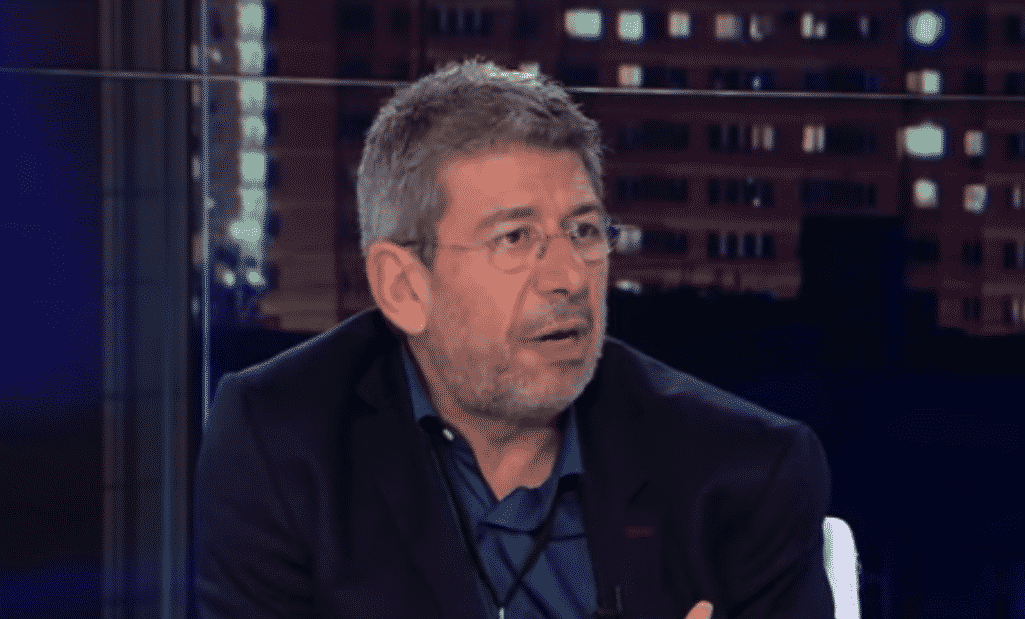
The Social Media Research Laboratory presented a very interesting study this summer on how the media «cover the coronavirus epidemic». There, several weaknesses in this issue were revealed. Ο Costas Argyros and the rosa.gr they spoke with George Pleyo for the communicative management of all three phases of the pandemic as he has characterized them, the first «warlike», the second «triumphant» and the third «apologetic-authoritarian». He also spoke of the government's apparent desire to introduce content control measures on the Internet.
- So what were the characteristics of the first phase?;
I would describe it as the «warfare» of heavy communication management, because the government used this phraseology, trying to show that we are in a state of war. There were also a number of aids to the media, even some non-existent ones, but also some administrative arrangements that were made in order to facilitate the media.
At the same time, three filters were used to check the information provided to citizens. One concerned which accredited journalists would have access to the daily press conference. The second was the mediation of the state representative who read the relevant questions. They were not asked directly by the journalists, so he had a margin of at least managing the questions in an exegetical way. Communication is not only verbal it is also the extra-verbal that exists. And the third was that all three representatives, Tsiodras, Chardalias, Kontozamanis, were political representatives. And Sotiris Tsiodras was officially the spokesman for the Ministry of Health on coronavirus. In that capacity he was briefing. So there were three representatives, but only the journalists had one question. A similar model was followed in the Czech Republic, where access to the briefing room was also controlled. There were, of course, more serious cases such as Hungary, but that is out of the question.
So this was a «heavy» communication management of a war type with many proclamations, accompanied by sanctions of a positive or negative type. There were, of course, many elements of inconsistency in the communication management. For example, while there was a strong element of «severity» there was a looseness towards the Church. You remember the government spokesman saying that you can fill in a supermarket code and go for «individual prayer». Such contradictory messages worked in multiplying ways for those who did not believe in the coronavirus. They reinforced the mistrust of the correctness of what the science said about the virus and its mode of transmission. It actually aided what was later called the «spraying movement». Similar contradictory messages were sent by the statements of the spokesman of the Ministry of Health on the masks, which sometimes «do not help» and sometimes «help».
In terms of the media we surveyed, we saw that 70% of the topics were not related to protection measures, and there was little reference to modes of transmission, but also to the extent of the pandemic in some countries. The briefing was dominated by the «Stay at Home» commercials, which had the good and the bad that an advertisement always has. Good information is one thing and a commercial is another.
- And then came the summer period of relaxation.
The second period, which started in early June immediately after the lockdown was lifted and lasts until about mid-October, I could describe as «triumphant». That is, it is the communicative management of the «triumph» in the face of the pandemic. But at the same time there is also a cashing in of the success in market terms. A clear attempt by the government and the media to promote the country as health safe for tourists to come. That is, a management that is cashing in on the success of the first season in terms of tourist flows. Both domestically for political reasons, but also abroad to attract tourists. In other words, every communication step has both a political and an economic dimension.
At this stage, because at some point they realised that there would be an increase in cases, they worked out the strategy of «individual responsibility». Not that they weren't talking about individual protection in the first phase, but here, because they started to see the increase in cases, the logic of «individual responsibility» became dominant. The purpose as the cases began to rise was, as we understand, to hide the political responsibility, which is two-thirds of the protection against coronavirus. And I'll explain what I mean. Obviously individual protection is one part. Distancing is the second part. And most of the responsibility here lies with the state because we are talking about distancing in the means of transport, in schools, in churches, in places of catering and recreation... But the state had chosen to attract tourists and without adequate control and tracing of their contacts. The third part concerns medical treatment, which means doctors, hospitals, ICUs, tests, medicines and so on. And there the government has basically sat idle, doing nothing. So two-thirds of the responsibility lies with the public administration with the focus on the government of course. So when they saw the situation deteriorating they introduced the theory of ’individual responsibility« with great urgency, which continued of course until recently, until the decision on the second lockdown. It was essentially a new guilt-inducing and at the same time incriminating »wrapping« of their communication strategy, which then took the form of repression.
- And the third and most difficult period began.
Which I call «authoritarian» and «apologetic» together. Apologetic because the main element in communication management is the attempt of various representatives of the state, ministries, departments, to apologize for doing their job well. In other words, they are constantly trying to justify with various arguments this large increase in cases and deaths, given that very little has been done in the area of health and social distancing. The same people who were calling for people to take holidays, to boost tourism, gradually began to accuse him of this. Because they saw that the situation was getting out of hand.
So they were faced with this reality. On the one hand, their inaction and on the other, the problem is growing. So we have the «apology», the attempt to justify what has happened and to deflect responsibility from themselves and, on the other hand, what is worrying for me is the strengthening of authoritarianism, to the point of taking absurd measures. It is absurd, for example, to fine you if you walk alone in a park near a mountain without a mask on your face. This irrationality of certain measures also exacerbates the climate of mistrust in the ranks of the «sprayers», as they call them. In other words, there are again contradictory messages that multiply the distrust.
In relation to authoritarianism we have seen a violation of fundamental political and social freedoms, such as the right to «assembly». At the same time as police officers are being rounded up without any protection measures, political events are in fact being banned where measures are respected. As long as the demonstrators respect the protection measures, what is the sanitary reason for banning them from assembling?;
So because the management of the health problem becomes difficult from the other side as well, because in the media the dominant voices are not the only ones, but there are alternative voices, which are expressed and circulate mainly on the internet, I predict that an attempt will be made to limit expression on the internet as well. As a professor in this field, I am sounding the alarm. There will be an attempt to restrict freedom of expression on the internet. It is the only place where alternative voices can be heard on such a scale.
- Do you think that we are going through a period when the credibility of some institutions and bodies is being damaged?;
I believe that the credibility of those who refused to accept the existence of the problem is now being severely damaged. Above all the Church. I believe that the Church is coming out of this process traumatized. Its prestige in public opinion is wounded and this can also trigger internal reactions. I do not know what kind. But since many prelates have been affected by coronavirus and some have even died, it is logical to look for responsibility somewhere.
- And what about the credibility of scientists, who often express conflicting views?;
Welcome to the world of science. Look. When a scientist expresses a different opinion, he's not expressing a café opinion. It's a conclusion from some scientific measurements. For example, Professor Ioannidis' disagreement does not carry the same weight as the opinion of anyone who discusses in a coffee shop and now that coffee shops are not open, who discusses on the internet. One is a mere opinion of the uninformed and the other is a knowledge of the expert. Whether Ioannidis' authority will be diminished is for the scientific community to judge. It is not up to us. Science doesn't work that way. Let's leave the scientific community alone to decide.
Here I want to say one more thing. Especially in the first phase, the media did not respect the principle of impartiality. There was no diversity of voices and opinions, neither from the political nor from the scientific world. The job of the media is not to decide which scientific opinion is correct and which is not in order to promote it. It is their duty to present all scientific opinions, but especially the official scientific opinions, such as those of the WHO and the NHS. And as we concluded in the study we did, the media paid little attention to these organisations. They were mostly concerned with projecting what the government was doing, especially in terms of policing and enforcement measures. It is interesting here that the media instead of being «representatives of the citizen» turned into representatives of the power that controls the citizens. In other words, the media played the role of a «health police». But this is not their role. And this is very dangerous, because apart from the truth or otherwise of the matter, it is passing on to everyone's subconscious that the media can also play such a role.