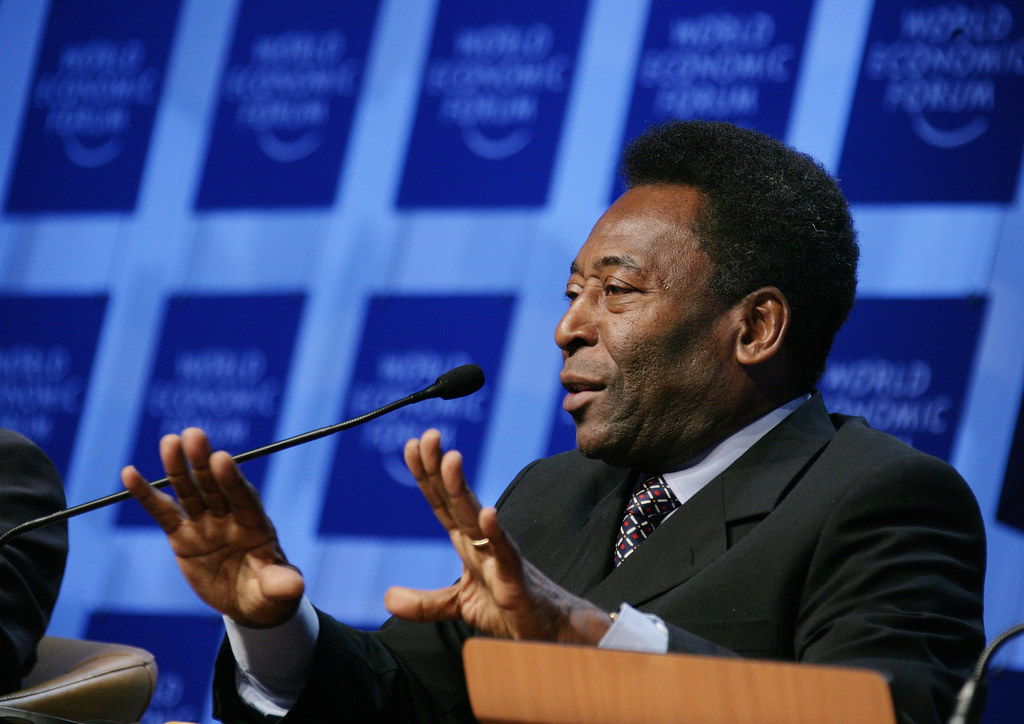
«The King» Pelé has «passed away.» He was 82 years old (born October 23, 1940), after battling colon cancer for more than a year.
Living a life as if it were a thousand. Becoming a household name and a familiar face in every soccer-loving—and not just soccer-loving—neighborhood on the planet. Beginning his reign, starting to make a name for himself—for good—and conquering the world, from the soccer fields of Sweden, when, at the age of 17 years and nine months, he won his first—of a total of three—World Cups. How many people, truly, have the privilege of such enduring popularity among billions of people around the world, across different ages and generations?
Pelé «passed away,» having… fallen and risen again in battles more difficult than those he won on the soccer field while making history—battles of life, waving his hand vigorously in the air, as he used to do—all the previous times, but not this one.
Before he became a legend, Pelé was born Edson Arantes do Nascimento. The legend, the «black pearl» (Perola negra) of world soccer, was born on October 23, 1940, in the city of Três Corações (note: which means «three hearts» in Greek) in the state of Minas Gerais, Brazil. He was the first of three children in the family and was baptized Edison in honor of the inventor Thomas Edison (who had visited his hometown shortly before Pelé’s birth), and the “i” was later removed from his name.
In recent years, he has faced health problems. He was battling his illness when he was admitted—once again—to the hospital on November 29 with a respiratory infection, but also so that doctors could reevaluate his treatment for colon cancer, having completed his last round of treatment in late April. Pelé underwent surgery to remove a tumor in September 2021.
In any case, his public appearances had already become less frequent before the Covid-19 pandemic, and since then he has rarely left his home near Santos.
Pelé, one of the 20 most important people of the 20th century according to *Time* magazine, the only player to have won three World Cups, had been suffering from hip problems for years and could not walk without assistance; he had even used them to refute claims made by his son, Edinho, who had said that his father was suffering from depression.
THE YEARS OF HIS CHILDHOOD
His childhood was marked by poverty. He had to play soccer by stuffing his socks with paper, since his family couldn't afford to buy him shoes.
The father of João Ramos do Nascimento, a promising international soccer player who played as a center forward but was forced to retire due to a serious injury at age 25, wanted his son to follow in his footsteps, unlike his mother, Dona Celeste. Wanting to support himself financially and be able to buy his own soccer ball, he worked as a clerk in tea shops and shined shoes outside movie theaters.
Pelé only managed to attend school up to the fourth grade of elementary school. The path he was meant to take was different.
«I had a happy childhood. My dad used to tell me that to be a soccer player, you need a strong liver. It’s a vital organ; if it doesn’t work properly, then you’re not well. It’s like the heart. My dad was a soccer player; he was a No. 9 and had scored many goals with headers. The only thing I ever wanted—the one thing I prayed to God for—was to play just like my father. One of his best pieces of advice: «Don’t think you’re better or more important than others—you’re just like them, so respect everyone,» said the famous Brazilian, speaking on the Italian television show «Che Tempo che fa» (What’s the Weather Like?).
WHEN HE BECAME… PELÉ AND «THE KING»
And while the name Pelé is known throughout the world, he had stated that he didn’t know how the nickname came about and also that he didn’t like it, noting that it doesn’t mean anything in Portuguese («My name is Edson; then they started calling me Pelé. I didn’t like it. I admired Thomas Edison—he’s important! »). Much later, when a theologian told him that the word appears in the Bible and means “miracle” in Hebrew, he changed his mind.
A classmate of his at school gave him that nickname. To this day, there are two versions of how it came about. The first one says that one day, while he was playing soccer in the fields of Tres Corasós with his friends, using a makeshift ball made of rags and paper, he found an old, deflated, worn-out, but leather soccer ball lying near a train station, an old, deflated, worn-out, but leather ball. Hence «pele,» which means «leather» in many Latin-based languages. The other version is that the name came about when he mistakenly called out the name of his favorite player, “Bile,” the goalkeeper for Vasco da Gama.
As for «the king,» it’s a title given to him by playwright Nelson Rodrigues when he was just 17 years old.
PELE AND THE… OTHERS
Over the years, Pelé has been compared to other greats in soccer history—Di Stefano, Cruyff, Maradona, and the… younger Messi and Cristiano Ronaldo. Certainly, this comparison between them is not only unfair but also impossible, as the Spanish newspaper Marca recently pointed out: different eras, stadiums, refereeing, balls, and physical abilities. After all, soccer has changed, and nothing is the same in any aspect of life as it was 50 years ago.
In any case, there are certainly few who question the historical credibility of César Luis Menotti, the 1978 World Cup champion with Argentina, who maintained—despite the fact that three Argentines «participated» in the discussion—that: «To me, he was the greatest in history. Pelé had it all; he lacked nothing: a privileged physique, a player who won one-on-one battles, a leader like the gods… He was the greatest, the best of all time.».
He once said: «People ask me when the next Pelé will be born. Never! My parents shut down the production line. When Messi scores 1,283 goals like I did and wins three World Cups, then we’ll see,» he often emphasized.
«On November 19, 1969, I scored my 1,000th goal at the Maracanã; I still have the ball. I’ve shared some memorable moments with everyone,» he said.
THE CHALLENGE AND THE RESPONSE
And if the main argument of those who doubt his status as the best is that he has never played for a European team, where the level of competition is higher than in the Brazilian league, the answer lies in history itself. Despite pressure from Europe’s major clubs to sign him, Pelé remained at Santos for 19 years because of his deep love for the team, but also because of a ban imposed by the country’s government, since President Zânio Quádros declared him a «national treasure» in 1961 to prevent him from leaving.
His Career, Style, and Records
He played as a second striker. His technical skills and athleticism were praised worldwide, and throughout his career he was known for his excellent dribbling and passing, his exceptional ability in the air, his creativity, and his exceptional scoring ability.
He played for Santos for 19 years (1956–1974), racking up an impressive total of 658 goals in 639 matches! He then moved to the U.S. to play for three years with the New York Cosmos (37 goals in 64 appearances), and was named its honorary president in 2010.
Pelé ended his long career with the New York Cosmos.
Officially, the «King of Soccer» scored 753 goals in 813 games. Of those, 77 (in 91 matches) were scored for the Brazilian national team, a total that still keeps him at the top of the Seleção’s all-time scoring list—though since the Qatar World Cup, he has been tied with Neymar. He—and others—often cite the number 1,283 when discussing his goals, including those scored in unofficial matches (1,281 in 1,363 matches according to FIFA).
Among other things, he holds the world record for the most hat tricks (92!!!), is listed in the «Guinness World Records» book for his goal-scoring records and for being the youngest soccer player to play in a World Cup final and win the trophy, since in 1958, during the match against Sweden, he was 17 years and 249 days old!
He won three World Cups (1958, 1962, 1970) with the Brazilian national team, the first of which—the one in Sweden—he won at the age of 17 years and 9 months.
«The World Cup in Sweden in ’58? I never imagined I’d be called up at that age. There were so many people who looked different from Brazilians (editor’s note: the first time Pelé left Brazil); when we arrived at the airport, there were no Black people. »I can’t forget the goal in the final. And even today, I think about how good God has been to me,” he has said.
Pelé is considered the greatest soccer player of the 20th century by FIFA and the International Federation of Football History & Statistics (IFFHS). Throughout his career, he was the highest-paid athlete in the world for a long time. He holds the titles of “Player of the Century” from FIFA and “Athlete of the Century” from the International Olympic Committee, and is a member of the Soccer Hall of Fame. In 1999, he was elected “Player of the Century” following a vote by the winners (1956–1999) of France Football magazine’s Ballon d’Or. In 2000, in a global FIFA online poll asking who was the greatest soccer player of all time, he came in second with 18%, with Maradona coming in first with 53,60%; in contrast, in the vote by FIFA’s “Football Family” and readers of FIFA Magazine, Pelé came in first with 72% of the votes. In the poll of sports journalists, Pelé came in first with 1,705 points, and Johan Cruyff came in second with 1,303. In a poll in Brazil for the best soccer player of the century, he came in first, with Garrincha in second place.
«UNTOLD STORIES»
There are many stories surrounding—and shaping—the legend of Pelé. Guillermo Velázquez, the former referee, played a leading role in one of them. It was June 18, 1968, in Bogotá, during a friendly match between Santos and the Colombian national team, which was preparing to compete in the Olympic Games in Mexico. Forty-two minutes into the game, Pelé fouled an opponent and was shown a red card.
The protests by the Santos players rallied the thousands of fans in the stands at Estadio El Campin, who demanded his return to the field. The outcry forced the Colombian Football Federation to replace Guillermo Velásquez at halftime and allow Pelé to return to play in the second half.
A year later, on November 19, 1969, at Maracana Stadium, Pelé made history by scoring his 1,000th goal (in official and unofficial matches), beating Argentine goalkeeper Edgardo Andradi from the penalty spot to make it 2–1 in the Santos–Vasco da Gama match. The match was interrupted as a crowd of journalists and fans stormed the field to celebrate him.
AUCTIONS AND «THE BIRTH OF A LEGEND»
Thousands of Pelé’s personal items have been auctioned off, including his three World Cup medals, in order to raise money for charity and to support his former team, Santos.
At the Tribeca Film Festival in New York, the film about his childhood, titled *The Birth of a Legend*, was screened. The film was directed by brothers Jeff and Michael Zibalis, writers of the documentaries «Favela Rising» and «The Two Escobars.» The film stars several famous Brazilian actors, including Rodrigo Santoro, Milton Gonçalves, and 18-year-old soccer player Kevin de Paula, making his screen debut as Pelé.
HIS THREE MARRIAGES AND HIS CHILDREN
Pelé married Rosimeri Chibi, with whom he had three children (Edinho, Jennifer, and Kelly), as well as with singer Assíria Nasimento, the mother of twins Josué and Celeste; he also had a daughter with his former housekeeper, Anizia Masado, Sandra Arantes, who died in 2006. Shortly before turning 76, he married Marcia Sibel Aoki, a 50-year-old businesswoman of Japanese descent, in Garauha, on the coast of São Paulo; with whom he had been in a relationship since 2010 and whom he had met in the elevator of an apartment building in São Paulo, where they lived.
PELE IN… NUMBERS:
EVENTS
WITH CLUBS: 722 MATCHES, 676 GOALS, 27 TITLES
Paulista Championship 407 465 10 (Santos)
Rio-São Paulo Tournament 53 48 4 (Santos)
Brazilian Championship 172 102 6 (Santos)
Copa Libertadores 15 14 2 (Santos)
Intercontinental Cup 3 7 2 (Santos)
Recopa Sudamericana 2 1 1 (Santos)
Recopa International 1 0 1 (Santos)
South American Super Cup 5–2
NASL* 64 37 1 (New York Cosmos)
WITH THE BRAZILIAN NATIONAL TEAM: 91 MATCHES, 77 GOALS, 3 TITLES
World Cup (Qualifiers) 6 6 –
World Cup 14 12 3
Copa America 6 8 0
Other games 65 51 –
INDIVIDUAL TITLES
Top Scorer, Paulista Final Round 3
Top Scorer: Paulista 7
Top Scorer of the Brazilian Cup 3
NASL 2 Ideal Starting XI
NASL MVP 1
- From 1961 to 1968, the Brazilian championship was known as the Taca Brasil (31 games, 31 goals, 5 titles) and the Torneio Roberto Gomes Pedrosa (57, 37, 1)
** North American Soccer League
***The figures are from the Spanish newspaper *Marca*