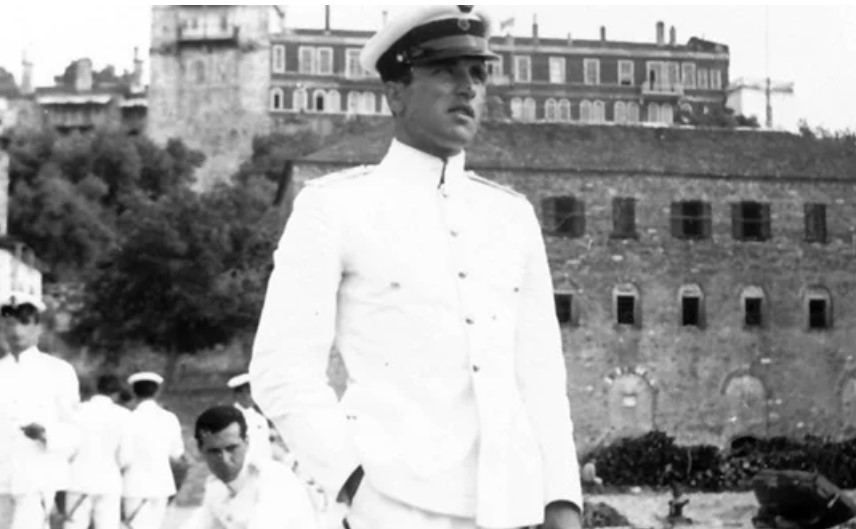
Captain Katundas is the handsome and noble knight we meet on the pages of novels. He has a beauty and nobility that stems from his ancestral origins, is imprinted in his genome and soul and, finally, he has a beauty and nobility that is clearly reflected in his face, his behaviour and his actions. Without a doubt, this is a wonderful man of diamond character, intellectual culture and romantic disposition. A man who personifies the primordial model of the timeless champion of the one and ideal beloved: the Fatherland.
Based on his character and temperament, Nikolaos Katountas was doomed by fate to follow the military life. Perhaps because only there could he seek the Field of Honour he felt was his due for life. Mostly, though, because deep in his soul he knew that it was there that his destiny was calling him. Men like Katounta are a reference point for the existence of Hellenism, because they are the self-evident truths that document the age-old and universal Greek virtues and values. And just as the self-evident truths on which the documentation of mathematical science is based are called axioms, so too Katounta was destined to become an Officer, giving with his personality the atmospheric dimension that befits the concept of the Greek Officer.
From the moment he entered the Evelpidon School he stood out immediately. His service career and development was amazing and complex. In the grey and dull military establishment of the time, filled with half-hearted cries and mothballs, Katundas was accompanied by light, vibrant colours, melodious sounds and fragrant air. It was not his military skills and physical qualities that made him an excellent officer and a formidable commando. Nor was it his graduation from the University Law School that made him a cultured man. It was his overall psyche that gave off a penetrating and charming aura. An aura that betrayed that he was not an ordinary Officer, but a charismatic leader, a true master of the art of war, a herald of chivalry and generosity.
Those who met Katunda felt admiration. One person's admiration for another, in the vast majority of cases, evokes sympathy that culminates in love, even bordering on worship. But there is also a percentage of people, absolutely shallow and deeply sympathetic, whose admiration for someone else causes them to be crushed. And this crushed admiration is the definition of envy. Katundas inevitably experienced both: love from the vast majority of people, and envy from a small portion of his darker colleagues. But that is precisely the fate of handsome and gentle knights in novels: They are adored by all and envied by dark kings and evil wizards...
Captain Katounta's transfer to Cyprus confirmed an enviable course. He had already had an impressive career, was raising a wonderful family and a bright future lay ahead of him. Katounta's bright future, however, was now crossing paths with the bleak future of Cyprus. The martyred island was caught between the complementarities of Cold War international diplomacy, the vested interests of the British crown, the incessant predatory ambitions of Turkey and the fratricidal conflict between the Greek junta of the colonels and the government of Archbishop Makarios.
Katudas was placed in 33η Commando Squadron, one of the best Commando Squadrons of the island, taking command of 31no Strike Company. Very quickly the Company under his command surpassed all precedents of operational evaluation and became the spearhead of the island's defence. But there was something else, equally important: The Captain's personal stature and reputation, respected by his superiors and adored by his subordinates. And only in the throne of their Captain, the men of his company were transformed into the Myrmidons of Achilles, the Lacedaemonians of Leonidas, the Macedonians of Alexander, the Moravians of Nikitaras. For they knew that their Captain would lead with bearing and a lion's heart in the fire of battle, that his footsteps would show them the way to glory. For they saw daily that their Captain was an amalgam of the essence of Achilles, Leonidas, Alexander and Nikitaras.
At that time, however, plans for political diversion were also being hatched by dark circles, both inside and outside the island. A political diversion that led to the Turkish invasion and the betrayal of Cyprus. Katounta stubbornly withstood the grip of these dark circles and their ruthless mechanisms, regardless of the consequences. Had he succumbed to their treacherous bidding, Archbishop Makarios would have been annihilated and Katudas would be living safely among us today. Such a thing, however, was structurally contrary to the chivalrous character of Katundas. That is why he received the fury of these mechanisms. A fury that he himself eventually paid dearly for and his family continues to pay it to this day, equally dearly. Above all, however, it is a fury that Cyprus and Hellenism paid dearly for.
Katunda's march to the sacrifice did not begin on the morning of the 20thof July 1974 and the Turkish invasion. It had started before the diversion of 15of July 1974, when the dark mechanisms - from all sides - began to exploit the military defence of the island and to undermine the capabilities of the military units and sections of those Officers who did not participate in the diversion. Despite the undermining, however, that he and his Company suffered, Katundas emphatically gave his presence to the dawn of the Turkish invasion. Realizing the praiseworthy attitude of the entire military hierarchy, he strongly and stubbornly recommended the implementation of the war plans before the landing of the brazen invaders had even manifested itself. He was not listened to. But even when the landing began, the Lionhearted Captain insisted on an immediate and vigorous response to the Italian challenge. Even though he had a picture of the intentions of his hierarchy, the incomprehensible orders, the empty recruiting depots, the disused heavy weapons and radios, the destroyed vehicles and ammunition. He strode forward boldly, even though he had to chuckle at the tragic truth. He consciously walked towards the Voluntary Passion, just like Constantine Palaeologus...
Katounta's military action during the Turkish invasion of Cyprus is literally cinematic. His spear flashed and thundered deafeningly. When everything was falling apart, the commandos of 31no They were a shining example of a valiant section, fighting alongside their Captain in a coordinated manner, with unparalleled courage, steely fortitude and unwavering faith for victory. The most pivotal, however, of the battles fought by Katundas and his commandos was that of the high ground of St. Hilarion. For there he was denied a decisive victory. If he had been allowed to hold the high ground, for he had effectively captured it when he was ordered to dismount, then the outcome of the invasion would have been quite different. Instead, they took him away from the Objective Purpose that the cruisers had and sent him on an infantry mission, without artillery and heavy weapons support. That is, they sent him out as a sheep to the slaughter. Perhaps because that is what the dark circles were after all along.
From being victorious at Agios Hilarion, Katudas was ordered to constrict and subsequently deploy in the open field to hold back the flood of invaders who had already succeeded in establishing the first bridgehead at Kyrenia. Katundas deployed his Raiders in the best possible way, trying to prohibit the widening of the enemy bridgehead, hoping for reinforcements with heavy weapons and tanks. When he realized that not only would reinforcements not come, but that the enemy had surrounded him with a considerable number of tanks, he realized the trap that had been laid against him. And not through the sole fault of the Turks. Despite the losses, he managed to disengage his company through a barrage of enemy fire and to concentrate in a perfectly co-ordinated manner in an olive grove south of Kyrenia.
At this point, Katudas experienced his own personal Gethsemane. It is the final test that Divine Providence has in store for those who have chosen to transcend their human condition. The picture has been described in a stirring way by his fellow warriors. The company has regrouped in an olive grove south of Kyrenia and are trying to rest for a while. The Captain is seated on the ground, with his rifle resting on the earth between his legs and the barrel resting on his shoulder. He thinks about the idea of energy they should pursue. Before him are two paths. One, the safe and easy one, is to cut off on the road to Nicosia and escape. The other, the dangerous and difficult one, is to make a desperate attempt to hold back the southward advance of the Turks, by slowing down the invaders' joining with the Turkish Cypriot enclaves of Kioneli, while covering up the broken sections of the Greek units that were retreating disorderly and giving the Greek forces time to organize their counterattack, securing the crossing of Nicosia. Extremely bold!
Two voices are fighting inside him. One voice, the voice of reason, tells him to retire safely. No one can accuse him of not doing his duty. At the same time, his young first-born daughter and his wife, who is about to give birth to their second child, are waiting for him. It is the voice of Christ's human nature that says «My Father, if it be possible, let this cup pass from me.’ The other voice, however, is that of the knight's heart. It commands him to protect his country and his broken colleagues. It is the voice of Christ that speaks the rest of the words of His stirring prayer »...but not as I will, but as Thou wilt«. Like Christ at the foot of the Mount of Olives, in the garden of Gethsemane, which in Hebrew means olive press, so Catudas, in the olive grove of Kyrenia follows the voice of Debt. He lifts his eyes. There is a ravine before him. He knows that he must cross it and dip himself in blood to cross over, just as Christ decided to cross Calvary and dip Himself in blood to do His duty.
Ο 31os Strike Company entering the ravine in coordinates. And then all hell breaks loose. Torrential and crossing overhead fire falls on the Raiders from all sides, who, trying to take cover and retaliate, find trapped barbed wire with explosives and grenades everywhere in front of them. Amidst the chaos, the stentorian voice of Katuda, who, while already wounded in the leg, is constantly heard, firing incessantly at the enemy, and at the same time shouting to his commandos, «Courage, boys!».
The situation is tragic, casualties are mounting, ammunition is running out. He realizes that he cannot complete his plan. But he loves his men and knows he must keep them alive to fight the decisive battle in Nicosia. He decides to break the cordon to save them. But he stays behind alone and covers the escape with fire, continuing to shout «Courage, boys!» When the last commando comes out of the ravine, Katundas is left alone behind and fights furiously. The scene is epic, as amidst the smoke and the uproar of battle, the Captain fights alone, as if he is carrying the honor of Hellenism on his back, as if he is trying to lift the sins of the world with his sacrifice. Destiny beckons him...
Since that noon, Captain Nikolaos Katountas has been missing. No one knows where he is anymore. The heartbreaking efforts made for years by his wife and daughters to find him have been fruitless. For the official state has not only failed to provide any substantial assistance in the effort, but has been actively hostile to even the idea of locating him. Perhaps because even dead they still fear him. Because the story of Captain Katounta, the betrayed knight, is identical to the story of the betrayed Hellenism of Cyprus. The dark circles that sought the partition of the island knew that the Commando Squadrons had to be quickly exterminated and not be concentrated in Nicosia. For with the commandos alive and fighting in the streets and on the airfield of Nicosia, Attila could not set foot in the island's capital and march on Famagusta. If one considers the possibility that Katudas would have managed to concentrate his company in Nicosia and would have been reinforced by the commandos who came as reserves with Operation Victory, one would conclude that not only would Nicosia not have fallen, but they would still be there and would be fighting to this day!
Knowing Katuda's history, I can understand why we can't locate him. Because Captain Nikolaos Katountas is where the medals grow! If we knew where this place was located, Hellenism might have been deprived of its demigods for centuries. But even if we did find the place, it is still doubtful that we could explore it. For it is not enough for fate to bring you before the volcanic gates leading to the Phlegraean Fields of Heroes. You have to have the heart to walk through them...
Hellenism does not know where the tomb of Achilles, Leonidas, Alexander, Palaeologos, Nikitaras is. It does not need to, because all of them are in the soul of the anonymous Greek. As is Katundas, the last hero of Hellenism in national wars. He too stands silently in the chorus of National Heroes, calmly looking at us and calling us to a ceaseless confrontation with our destiny. He is silent, but the sound of his voice echoes sternly from that ravine in the olive groves of Kyrenia: «Courage, children»!!!!
The legend wants the mermaid, the sister of Alexander the Great, to turn eternally on the seas and ask «Does King Alexander live»? Since noon on July 22, 1974, the wife and daughters of Captain Katundas have been asking the same heartbreaking question «Does Captain Katundas live?» The answer is a resounding «Yes». For just as King Alexander lives forever in Graniko, Issus and Gaugamela, so Captain Katuntas lives forever in Kyrenia, in Agios Hilarion and in that olive grove ravine. For handsome and gentle knights never die...
* Excerpt from the book «Nikolaos Katountas - Leonidas of Kyrenia», from the chapter «They said of Nicholas... his colleagues in arms», p. 171, published by Infognomon, Athens 2019