In a new public statement, the Municipality of Alimos has revisited the issue of the Kythira Cultural Center, sending a letter to the media outlets in Kythira and Antikythira, including the Kythera.News. The letter is apparently in response to a recent An article in the newspaper «Ta Kythiraika», regarding the long-standing dispute between the Municipality and the Trifyllio Foundation over the development of the property in the Kythiria area of Alimos. (Following the Municipality’s letter, we are republishing the relevant article from the newspaper.).
In its announcement, the Municipality seeks to clarify its position, asserting that it never sought to acquire ownership of the site, but that its sole objective is to uphold the purpose of the donation and complete the Cultural Center for the benefit of the people of Kythira. At the same time, he raises objections regarding the long-standing inaction on the part of the Trifyllio Foundation in implementing the planned actions, noting, among other things, that the sale of the five plots of land has not proceeded; according to the Municipality, these plots were donated specifically to finance the completion of the project.
The Kythera.News, in an effort to provide its readers with the most comprehensive information possible and in accordance with the principle of pluralism, publishes the letter from the Municipality of Alimos verbatim, as it was sent to our publication.
LETTER TO THE MEDIA IN KYTHIRA AND ANTIKYTHIRA
In light of reports in several local media outlets regarding the Kythira Cultural Center in Alimos, and in order to fully inform the citizens of Kythira, we would like to bring the following to the attention of your publication and your readers, and we kindly request that you publish this information:
- The Municipality of Alimos does not wish to take over the Cultural Center’s premises from the Trifyllio Foundation and has never raised such an issue.
- The Municipality of Alimos, following a request and proposal from Trifyllio and local residents, offered to undertake the completion of the existing Cultural Center building, in order to resolve the long-standing issue of inactivity and to fulfill the wishes of the donor (the Kythira Cooperative of Alimos).
The process of providing consideration in return—which the Municipality of Alimos would be required to undertake—was the one proposed by the Trifyllio Foundation and was neither an initiative nor a request on the part of the Municipality. The Municipality accepted it in order to assist the Trifyllio Foundation in fulfilling the purpose of the donation.
In any case, the Municipality’s proposal to complete the Cultural Center on its own initiative and at its own expense has, in fact, lapsed and is no longer valid.
- The sole objective that the Municipality of Alimos, as the competent public authority, has consistently pursued over time, institutionally and legally, is the completion and operation of the Cultural Center, in accordance with the purpose and terms of the donation made by the Kythira Cooperative to the Trifylleio.
In other words, the only thing that matters to the Municipality is that the terms of the donation are not violated and that the space is not used for any other purpose (commercial—apartment buildings) beyond the lawful purpose of the donation, namely, the public-benefit use specified by the Kythirian donors.
How Trifyllio will achieve the above goal is entirely up to it and is its own responsibility. Trifyllio must, of course, sell the five (5) plots of land in the Kythiria area and use the proceeds from the sale to complete the Cultural Center. We would like to remind you that these five (5) plots of land were donated by the Kythira Cooperative to the Trifyllio Foundation specifically for this purpose (i.e., their sale and the completion of the Cultural Center) and They may not be used for any other purpose or in any other way. To date, this sale has not taken place.
- The action required by law is to proceed with the sale of these five (5) plots of land so that the Cultural Center—which will remain the property of Trifyllio—can then be completed.
Trifyllio’s long-standing failure to take these actions (sale of plots of land, completion of the Cultural Center) is a situation that cannot continue and that violates the will and purpose of the donors—the people of Kythira.
- In conclusion:
- The Municipality of Alimos does not wish to to take control of the space.
- The Municipality wishes respect for and adherence to the purpose of the donation (completion and operation of the Cultural Center).
- The Municipality is Public Authority, which is legally charged with safeguarding the upholding the public benefit purpose of the donation.
- All of the above is also known to the Trifyllio Foundation, based on the contacts between the Foundation’s Board of Directors and the municipal authorities during the period 2018–2021.
FROM THE PRESS OFFICE
BY THE MUNICIPALITY OF ALIMOS
—
ALIMOS: The chronicle of an absurd «war» (Kythiraika Newspaper)
When we say «Alimos Cultural Center,» for the past few years we’ve all been referring to the now-famous saga surrounding a cultural center in the Kythiria neighborhood of Alimos and how it came to to capture the attention of so many people, especially within the Athenian community. But how many people know the background of this story? For those who would like to learn more, but also for those who are familiar with some «episodes» of this saga—especially those who, while they know or, at the very least, should know, yet pretend to be unaware—even though they played an institutional role in the relevant discussions—“K” has prepared a history that is as concise as possible. Everything mentioned below constitutes an accurate account of this case, so that the matter may be fully clarified and no one can claim that they were not informed.
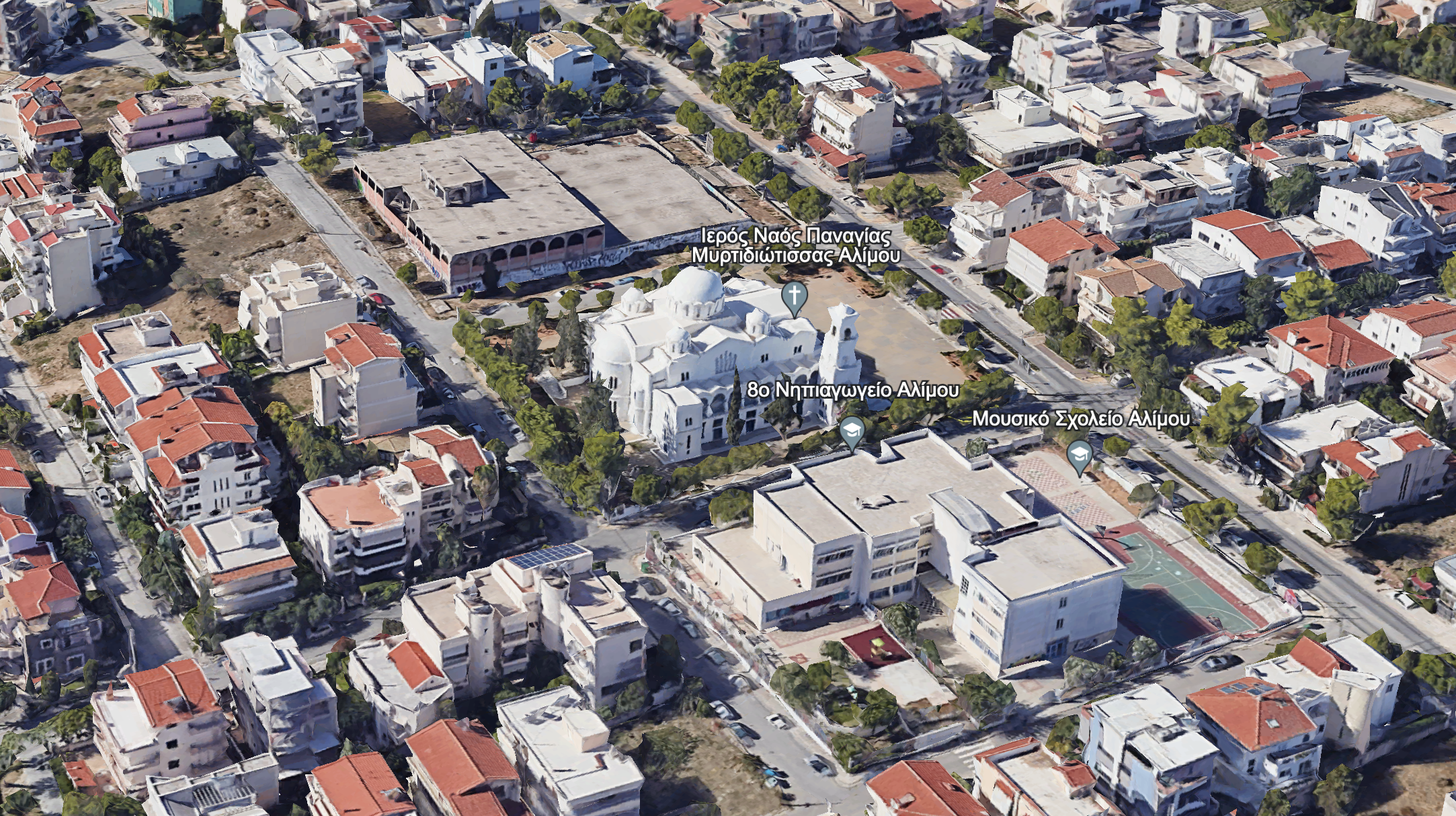
The story begins with the noble intention of the founders of the Kythiria settlement in Alimos to erect a triptych of buildings at its heart: a school, a church, and a cultural center, so that it would become a landmark for the residents of Kythiria and the surrounding area—and beyond. Consequently, the local Building Cooperative began construction of this complex using funds from the sale of its own plots of land. After more than two decades, it became clear that there was a complete impasse in financing a project that was «pharaonic» given the Cooperative’s financial circumstances, as well as the apparent and certain inability to complete it, ideas and discussions began, culminating in 2004 with the transfer of the unfinished complex to the Trifyllio Foundation for completion, since the Cooperative would provide five plots of land as a «dowry» for this purpose. But let’s take a look—without getting bogged down in financial details—at what had been accomplished up to that point. On a plot of land in a purely residential area, with an area of 3,431.5 square meters, the following had been constructed (with concrete): a 2,294.38-square-meter basement and a 1,152.5-square-meter ground floor, while there were plans to complete the building with a 1,026.86-square-meter upper floor. In other words, the Trifyllio took possession of a total of 3,446.88 square meters, and another 1,026.86 square meters would be added in the future on the upper floor. We do not know (at least we do not) whether this entire massive structure was built based on a feasibility study and a land-use plan; and, to be perfectly honest, not even Trifylleio at the time appears to have conducted any such study before accepting the donation. Because even the most uninformed person would wonder, how this project was ever going to be completed, since even a rudimentary financial study—which apparently was not conducted—would have shown that it would be impossible to complete? But even if a way had been found, the project would have been a Sisyphean task, since its maintenance would have required resources—and all indications today suggest that no one had even attempted to do so, since it was obvious that the value of the plots of land that had been granted was insufficient! Meanwhile, as if that weren’t enough, legal proceedings were immediately initiated by a former member of the Cooperative’s board against both him and the Trifyllio, for cancellation of the transfer. The legal tug-of-war continued until 2011 with the issuance of irrevocable a court ruling against the plaintiff, even as the major economic crisis—which had «frozen» everything—had already been brewing since 2009. Meanwhile, the two sides (the Cooperative and Trifyllio) had extended their agreement for five years and had begun negotiations, which culminated in 2015 in a new agreement, notarized, introducing significant amendments to the original agreement in order to make it the continuation of the project and its subsequent sustainability are financially feasible. In summary, the agreement provided for the following: «The Trifylleio Foundation, accepting the donation of the property along with the unfinished building located on it, undertakes not to transfer to any third party (natural or legal) person. Since this term has been banned The case of developing the above property through a quid pro quo arrangement is expressly excluded.». And this is because, as is obvious, there was no other way to get the project back on track that was financially feasible. For its part, Trifyllio would be obligated to hand over to the Cooperative for use «a separate part of it (area until 150 square meters), which will serve as the cultural center known as «KYTHIRA CULTURAL CENTER,» which will also house the office (a two-room office) of the Cooperative (and the Beautification Association). The hall of the cultural center will be made available, preferably, to the «PANAGIA MYRTIDIOTISSA» Beautification Association and to the other Kythirian organizations in Alimos free of charge. It will also be made available to organizations of Kythirians from all over the world, as well as to other residents of the area, for a reasonable fee».
In 2019, the Building Cooperative is dissolved by an irrevocable decision of the Piraeus Magistrates' Court, Later, the Trifyllio Foundation sought ways to make use of the property, and to that end, it also contacted the Municipality of Alimos. It should be emphasized here that the Foundation was and remains subject to the laws governing foundations, and the development of the property, based on the strict regulatory and legislative framework currently in force, required the conduct of a competitive bidding process, under terms most beneficial to the institution’s interests and always with the knowledge and approval of the supervisory authority, namely the Bequests Directorate of the Ministry of Finance, a condition that was accepted by all. It goes without saying that, prior to the tender, a thorough review had been conducted by the Ministry of Finance regarding the property’s ownership status and compliance with the terms of its donation. Thus, after all procedural formalities were completed, a call for bids was approved in 2022, to which the following submitted proposals: the Municipality of Alimos and a construction company (DAKON S.A.), whose proposal was approved by the Trifyllio Committee with the consent of the Ministry of Finance. A crucial factor in the selection of the contractor was not the percentage of consideration—which was slightly in favor of the selected contractor—but the following significant factors: 1. The selected bidder offered more than double the floor area of main and auxiliary spaces. 2. It provided the Foundation with 12 apartments, 12 storage units, and 14 parking spaces, totaling 1,240.17 square meters, as well as the multipurpose hall to fulfill the terms of the donation. In exchange, the Municipality offered four offices totaling 353.12 square meters and the multipurpose hall. 3. There is no doubt that the rental of the 12 apartments would have generated significantly more revenue for the foundation than the four offices. 4. The completion time was 3 years, whereas for the Municipality 5 years, with the possibility of up to 15 years. 5. The first bid offered compensation of up to €100 per month until completion, while the Municipality offered no compensation. Finally, it is worth noting that the Municipality stated that the completion costs would be covered, among other sources, by funds from various programs—funds that were by no means certain to be approved. It should be noted that the contractor ultimately selected and the foundation had jointly decided to strictly comply with all urban planning regulations in effect for the area, and indeed without making use of the so-called «building bonuses» that were in effect at the time, and without exceeding either the height limit (11 meters) or the legally permitted coverage ratio.
Finally, in November 2023, a construction contract was signed with the cooperation and approval of the relevant legal and technical departments of the Ministry of Finance. Immediately after the contract was awarded as described above, the Municipality, together with local residents, began a campaign against the construction of the residential complexes, while at the same time, appealed to the competent body of the Ministry of Environment and Energy, requesting that the entire area be designated as for public use (cultural purposes) rather than purely residential use, as had been the case until then. In fact, in all the proceedings that had preceded it was never mentioned that this had been requested by the Municipality as early as 2019, and no relevant objection had been filed in connection with the tender. However, the competent body (KESYPOTHA) It rejected the municipality's request and designated the area as exclusively residential. Subsequently, as soon as the contractor requested and received a demolition permit for the existing building from the Alimos Urban Planning Department, the same agency revoked it and forced the contractor to file an appeal with SYPOTA, which ruled in his favor and recommended that the Municipality of Alimos overturn the decision not to demolish, which has not happened, as the Municipality cites the advisory nature of this decision. Meanwhile, the contractor made two attempts at reconciliation, offering «compensatory» benefits to the Municipality in order to move the project forward for the common good, but were rejected, the latter in fact as recently as last March (the one that was deliberately presented as a supposed proposal by the Foundation, even though it had not even been discussed by its Board of Directors during the «consultation» with residents!).
And what happens now? Trifyllio is required to await the contractor’s decisions, as there is a valid construction contract in place. In the event that the contractor withdraws and/or files a lawsuit, the Foundation is obligated to take legal action in turn and, if necessary, seek compensation from those whose actions resulted in significant financial loss, whether these involve legal entities or individuals who were involved in the proceedings of recent years. Of course, in this case, it is possible that the Ministry of Finance will recommend repeating the bidding process within a timeframe that will be far from easy to determine. And the major question that naturally arises is: for what reason, by whom, and with what motives did the Municipality of Alimos start this «war»? And indeed, with the support (and encouragement?) of some residents of Kythira, who—either because they were not properly informed, as they should have been, regarding the legal status of the property and its history leading up to the current outcome, or believed that these actions served the original purpose—a purpose that, however, had long since become unattainable, since, although it began with clearly good intentions, it subsequently devolved into «Pharaonic» projects that were practically impossible to complete. And this, moreover, had been realized early on by those who were then in charge of the Building Cooperative and turned to the Trifyllio for «salvation»—that is, whatever could be salvaged from the project. But who among them expected that today the Foundation would have to face, among other things, a relentless war? Now, as has already become apparent, various completely unauthorized individuals are gathering and deliberating on whether to accept or reject plans concerning foreign assets. It is also worth mentioning here a serious issue concerning the Municipality of Alimos. If, in fact, the municipality wanted this prime 3.5-str plot for any purpose, it could easily have acquired it through the the only way, as provided for by the Constitution and the laws, that is, to expropriate it, by paying the owner the compensation prescribed by law. In this way, it could preserve the existing structure—which seems to be very popular among those participating in the relevant consultations—and do whatever else it wishes, such as creating cultural centers, parks, etc. Perhaps the Municipality did not proceed with this—the only logical and lawful course of action—for one reason alone. In order to expropriate a property belonging to a private individual, each municipality must first prove that compensation is due! If that were the problem, the way forward is still open. All it would take is a simple statement and the deposit of the provisional compensation with the Public Debt Management Agency. In fact, there would be no need in the future to go through the trouble of «consultations» with those who dream of «Memorial services with foreign kollyva»! Simple things.