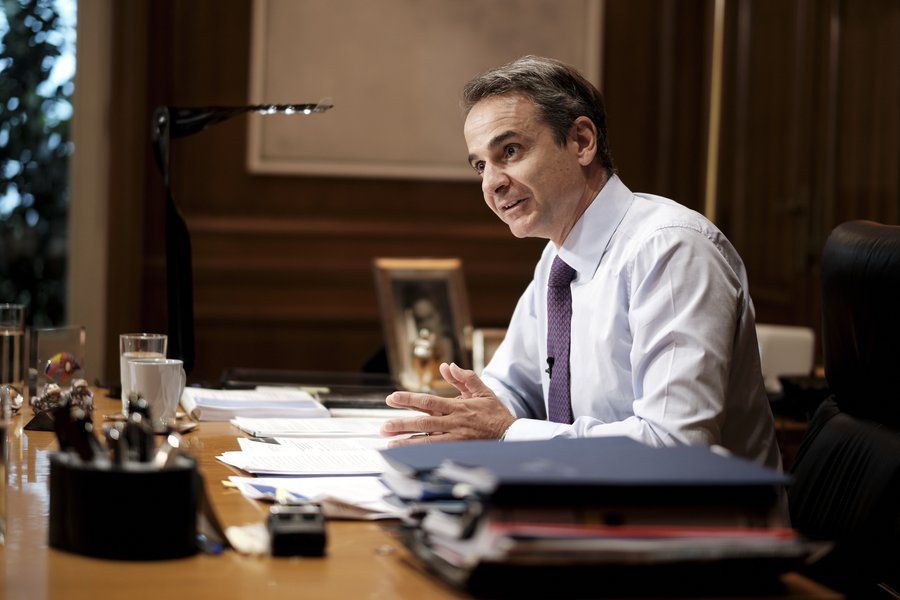
In the policy of the six points, as he pointed out, the focus was on Kyriakos Mitsotakis in his remarks during his visit to the Ministry of Migration and Asylum. «I believe that this policy strikes exactly the right balance between national sovereignty and international legitimacy on the one hand, and humanitarianism and the rights of refugees on the other,» the prime minister noted.
In analyzing the government’s immigration policy, Mr. Mitsotakis specifically noted the following: «Protection of Land and Maritime Borders, because, as we've said many times, the sea has borders, immediate distinction between refugees and economic migrants, return of those who are not entitled to international protection, closed and controlled facilities, transparency in nongovernmental organizations, which are involved in managing the refugee and migration issue, fairness in benefits for those who remain in the country but also a well-organized integration policy »for those who have been granted the right to remain in our country because their asylum applications have been approved.« He added that »it is always easy to resort to simplistic slogans and vague accusations, but it is very difficult to address such a complex problem on the ground.”.
Kyriakos Mitsotakis also referred to the reduction in migration flows: «From 72,000 in 2019, the number fell to about 15,000 in 2020 and has dropped to just 2,500 in the first four months of 2021. This is a striking decline that I believe has been fully recognized, especially on the islands of the eastern Aegean, which have long suffered the consequences of the migration and refugee crisis.».
He also highlighted one aspect of our policy, as he pointed out, that is very important humanitarian nature. «We had committed to addressing specifically the issue of unaccompanied minors. That is why we discussed the special secretariat headed by Ms. Agapidakis, and I believe that the results there are impressive—not only in terms of reducing the number of unaccompanied children being hosted in our country, but above all in terms of the conditions under which they are being hosted. There are no longer any unprotected children which are stacked in jungle-like piles Moria On our islands, all minors are currently housed in shelters, and, of course, the measure of protective custody—which, unfortunately, kept unaccompanied refugee children inpolice stations. The national emergency response mechanism now provides them with immediate assistance and shelter.».
The Minister of Migration and Asylum, Notis Mitarakis, among other things, noted: «We achieved two important goals. First, a substantial reduction in migration flows, to ensure that our country does not serve as a gateway for human-trafficking networks. By implementing a six-point strategy, we have managed to reduce flows by 80% in 2020 and by 73% in the first four months of 2021. Our second goal is to significantly reducing the impact of the migration crisis on local communities, especially in remote areas of Greece and the five islands of the Eastern Aegean, which in recent years have borne the brunt of the crisis for the entire EU. We have implemented a program that provides financial support to municipalities. We have reduced the number of facilities in our country. From 121 in operation in 2020, there are now 37. A reduction of 70%.’.
The prime minister visited the new facilities of the Ministry of Migration and Asylum, observed the procedures followed by the Residence Permit Department for third-country investors, and had the opportunity to speak with the staff, thanking them for the excellent service they provide.
Specifically, the Prime Minister noted in his remarks:
Ladies and gentlemen, it is with great pleasure that I am visiting the Ministry of Migration and Asylum today; this is my first visit to this facility. I have been impressed by the quality of the infrastructure. And once again, I am surprised by the fact that this public property remained underutilized for such a long time until we decided to consolidate the Ministry’s services in this location and make the the best possible way a truly impressive piece of government infrastructure.
I wanted to meet with you today to discuss the priorities of migration policy, but also to sincerely congratulate you on the work you have accomplished over all these months since the Ministry was reestablished the Ministry was reestablished. It is a remarkable achievement—one that, as the Minister said, has yielded measurable results.
First of all, regarding the reduction in migration flows. From 72,000 in 2019, the number fell to approximately 15,000 in 2020 and has dropped to just 2,500 in the first four months of 2021. This is a striking decline that I believe has been fully recognized, especially on the islands of the eastern Aegean, which have long suffered the consequences of the migration and refugee crisis.
The second point I want to emphasize—which the Minister mentioned—is the fact that The number of facilities for accommodating refugees and migrants has decreased significantly throughout the country. From 121 to 37 now. Isn’t that right? Thirty-seven, while the number of refugees and migrants housed in these facilities has obviously also decreased. By nearly 50%. At the same time, the asylum process has been significantly accelerated.
And of course, I would like to focus specifically on one aspect of our policy that has a very important humanitarian dimension. We had committed to addressing the issue of unaccompanied minors in particular. That is why we discussed the special secretariat headed by Ms. Agapidakis, and I believe the results there are impressive—not only in terms of reducing the number of unaccompanied childrenin our country, but above all in terms of the conditions under which they are housed.
There are no longer any unprotected children crammed into Moria-style camps on our islands; all minors are now housed in shelters, and, of course, the measure of protective custody—which, unfortunately, kept unaccompanied refugee children inpolice stations. The national emergency response mechanism now offers them immediate assistance and shelter. And to put it another way, the smiles on the children’s faces just before they fly to be reunited with their families in Europe not only earned the Ministry and the Greek government the Commission’s congratulations, I believe these flights also bring smiles to our faces, as we remained consistent in a commitment we made to the most vulnerable, and regarding the high standards we had set, I believe that ifwe have met them with complete adequacy.
From the very beginning, the Minister and I had agreed on a six-point policy. Protection of land and sea borders—because, as we have said many times, the sea has borders—immediate separation of refugees and economic migrants, return of those who are not entitled to international protection, closed and controlled facilities; transparency regarding the non-governmental organizations involved in managing the refugee and migration issue; fairness in benefits for those who remain in the country, as well as a well-structured integration policy for those who have obtained the right to remain in our country after their asylum applications have been approved.
And I believe that this policy operates precisely at the intersection of national sovereignty and international legitimacy on the one hand, and humanitarianism and refugee rights on the other. It is always easy to resort to simplistic slogans and vague accusations, but it is very difficult to tackle such a complex problem on the ground.
After all, this is also confirmed by all the reports from Frontex, which operates alongside the Greeks on Europe’s eastern borders; So impressions and words are one thing, but the reality and actions regarding migration are quite another. This is all the more true now that it has been proven that organized gangs of smugglers are operating on this front—networks that, unfortunately, are often shielded by certain nongovernmental organizations of dubious origin.
And of course, while Turkey insists on not honoring its commitments to Europe, it could at least now demonstrate that it means what it says by taking the first step of finally accepting the 1450 people who have been definitively ruled ineligible for asylum and must be returned to where they came from.
We have also discussed Greece’s policy at length with the Minister, as well as our participation in the European dialogue on the new European Pact on Migration and Asylum, and I would especially like to congratulate the Ministry’s leadership for having forged a united front among the countries located at Europe’s external borders, which are vigorously—and, I believe, persuasively—articulating—the argument that we cannot bear the burden of a challenge affecting all of Europe on our own. That is why our efforts are focused on the fair sharing of responsibilities among all, and certainly on updating the asylum procedures required to adapt to the new circumstances.
It is already very important to emphasize that, on the five islands of the eastern Aegean—following painstaking efforts—new facilities meeting the very latest standards are now being established on Lesbos, Chios, Samos, Leros, new facilities meeting the very latest standards are being established; on Kos, the existing facility is being expanded to meet the same standards; This is a program funded by the European Commission, and I am pleased that, as far as I understand, we are also seeing positive developments regarding the new reception center on Lesbos. This is a tangible recognition of Greece’s role, but I believe it is also a concrete demonstration of the trust that exists precisely because of the progress our country has made in this area.
And of course, in closing, I would like to focus in particular on the new national integration strategy, dear Sophia (Voultepsi), for those who will remain—a plan that includes adaptation, learning Greek, the European way of life, and human rights. I believe these are measures that will improve the lives of refugees, facilitate their coexistence with our fellow Greek citizens by reducing incidents of violence and, above all, by dispelling outdated stereotypes. Because while our people may not accept threats, they know how to welcome our new friends. And that is why the decision to transform Eleonas into a national integration center is so important.
I’d like to conclude by thanking all of you once again, as well as those who are not here with us today—and I’m referring to the true heroes of our border security: the border guards, the Coast Guard, and, of course, the asylum authorities and the entire staff of the Ministry. I want you to know that the government stands with you as you carry out your duties—whether on the waves of the Aegean, along the Evros River, or within the facilities and agencies—serving our country and helping people. We will continue to find ways to support you with both resources and personnel, because your mission is literally a national one, and none of these achievements— of the many things that have been accomplished, would have been achieved without the professionalism, dedication, and sense of duty reflected in your daily conduct and actions. And rest assured that all Greeks appreciate your contribution, and take pride in it; on their behalf, therefore, I would like to once again offer you my heartfelt congratulations on the important work that has been done over the past 15 months at the Ministry of Migration and Asylum.
The meeting, chaired by Prime Minister Kyriakos Mitsotakis, was attended by the Minister of Migration and Asylum, Notis Mitarakis, the Deputy Minister of Migration and Asylum, responsible for Integration, Sofia Voultepsi; the Deputy Minister to the Prime Minister, responsible for coordinating government work, Akis Skertsos; the Secretary General for Migration Policy, Patroklos Georgiadis; the Secretary General for Asylum Seekers, Manos Logothetis; the Special Secretary for the Protection of Unaccompanied Minors, Irini Agapidakis; the Special Secretary for Coordination of Stakeholders, Evangelos Konstantinou, as well as the Acting Secretary of the Ministry of Migration and Asylum, Fotini Koulouri.