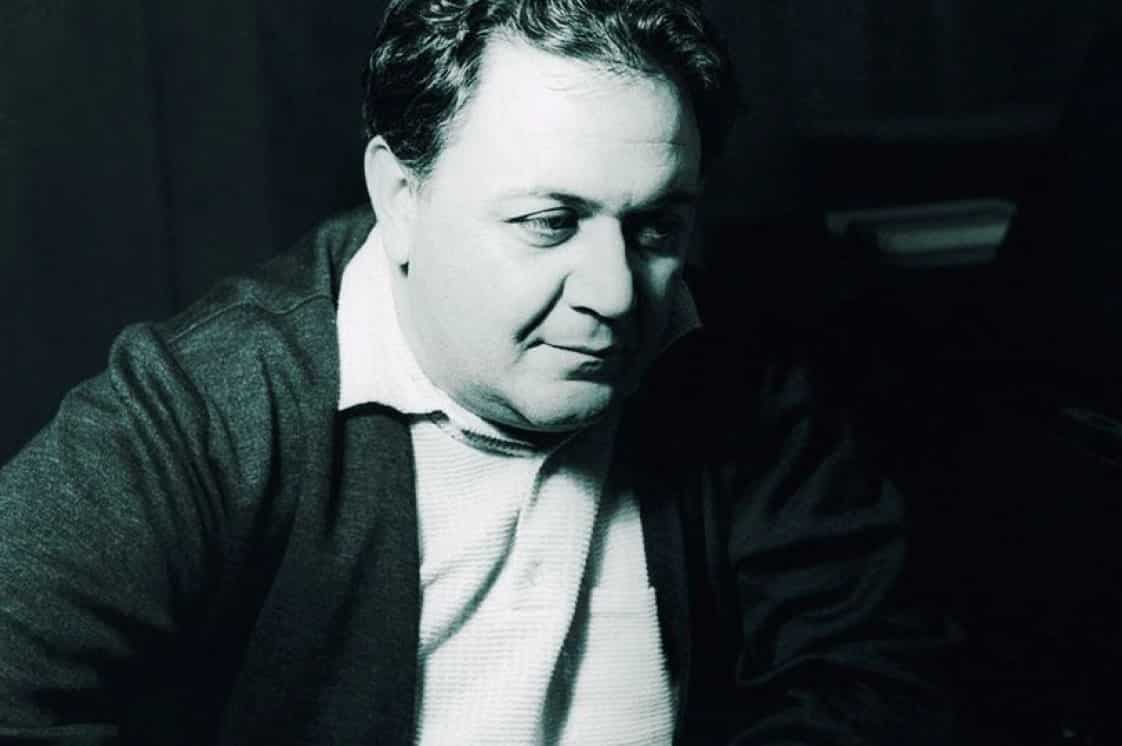
«I was born on October 23, 1925, in Xanthi—the historic one, not that other, dreadful one built later by immigrants from the interior of the country. The coexistence at that time of a Belle Époque-style town with authentic Turkish minarets added color and substance to a society —a melting pot from every corner of Greece, which, as it happened, found itself living in a remote region and dancing the Charleston in public squares. When I opened my eyes, I was surprised to see a large crowd waiting for me to appear (I continued to wonder later as well, as if they were waiting for me to show up somewhere late). My mother was from Adrianople, the daughter of Konstantinos Arvanitidis, and my father was from Myrthio in Rethymno, Crete. I am the product of two people who, as far as I know, never collaborated, except for the moment they decided to conceive me. That is why I harbor within me thousands of contradictions and all of God’s difficulties. However, my urban consciousness, combined with my so-called ’European’ upbringing, has produced a striking result.
The whole time we lived in Xanthi, I tried to get to know my parents better and to make my sister disappear. I didn’t succeed at either. So in ’32 we moved to Athens, where it was impossible for me to forget my failure.
I was beginning to live and receive my education in the capital, while at the same time studying love and the poetic function of my time. I received, however, an Attic education when our homeland was still home to both Attica and Education. I was deeply influenced by Erotokritos, General Makrygiannis, the Fix Factory, Charalambos from ’Byzantium,“ the humid climate of Thessaloniki, and the unknown faces I met by chance and who remained unknown to me in all the years that followed. During the Occupation, I realized how useless my music lessons were, since they insidiously distanced me from my original goals, which were to communicate, to channel my energy, and to disappear; that is why I stopped taking them immediately after the Occupation. So I didn’t study at a conservatory and consequently avoided ending up like the members of the Panhellenic Music Association. I wrote poems and many songs, and I trained myself especially to assert my views through democratic processes—something that, incidentally, has benefited me immensely since I became a civil servant in recent years. I then avoided, with the utmost abhorrence, anything that wounded my romantic sensibilities and my personal sensitivity.
I’ve traveled a lot, and that helped me realize that stupidity wasn’t a phenomenon exclusive to our country, as Greek chauvinists and lovers of national piety proudly claim and constantly demonstrate. At the same time, I discovered that the people who interested me absolutely had to speak Greek, because communication in a foreign language became painful and made half of my face disappear.
In ’66, I found myself in America. I stayed and lived there for about six years—the years of the dictatorship—for purely tax-related reasons: it turned out I owed the government about three and a half million. Once I had paid off my debt, I returned around ’72 and opened a coffee shop that we named “Polytropon,” until the political transition of ’74, at which point I closed it because the era of stadiums and large-scale public gatherings was just beginning…
In ’75, a famous period of my life began—one we might call, to set it apart, my ’civil servant’ era—which made me particularly well-known to a large and uninformed audience, admittedly Greek, as a sworn enemy of Greek music, Greek musicians, and Greek culture itself. During this period, and following an unsuccessful heart attack, I tried again— unsuccessfully, it is true, to implement my specific ’coffeehouse“ ideas—sometimes at ERT and sometimes at the Ministry of Culture—meaning to impose my views through democratic procedures. Both of these organizations, however—rotten and corroded from their very inception—managed to successfully resist and, as they say, defeat me ”in a landslide.’ Nevertheless, during this time, the Third was born and established itself in the country. And now, the culmination of my life so far is:
I don't care… about glory. It imprisons me within the boundaries it sets—not the ones I set.
I b e l i e v e… in the song that reveals us and expresses us from the depths of our being, and not in the one that flatters our superficial and hastily acquired habits.
I despise… those who do not strive for renewal and intellectual youthfulness, the politicians and artists who are “famous” for all the wrong reasons, my complacent peers, obscure and suspicious journalism, as well as vulgarity of every kind.
That’s how I managed to heal the personality that had been scarred since my childhood, ending up selling “lottery tickets to heaven” and earning the respect of those younger than me, since I remained a true Greek and a Great Romantic.».
(On the occasion of today’s anniversary of the great composer’s birth – From his official website)