Tonight, Friday, August 26, at 21:00, the screening of the film «Lunana: A Yak in the Classroom» by Cine Portokalia in the hospitable space of the Agricultural School of Karavas.
On the occasion of the screening of the film, Georgia Tsatsani, a philologist - comparativist and a regular contributor to Kythera.News, wrote a very interesting article entitled «Bhutan and eco-cinema: Lunana».
In the article we read about Bhutan, the country where the film was produced, a tiny, landlocked state the size of Macedonia, which advertises “happiness” as a gross national product and is experiencing the effects of climate change in many ways.
Here is the article by Georgia Tsatsani.
If nature is a mirror for our inner self, the new film from Bhutan is a catharsis of Asia against the modern way of life.
The first Oscar nomination
Bhutan was represented this year at the American Academy Awards by a sui-generis film, Lunana: A Yak in the Classroom. Out of 93 nominations in International Production, Bhutan's nomination made it to the final five. A distinction won by the central Asian country for the first time in its history, having been competing for two decades. The gold statuette may not have reached Bhutan for the time being. However, the film has set cinema as a modern art form in its ecological dimension for the Asian kingdom. However, the Oscar-winning beginning was made by a film with a national and sustainable developmental colour that highlights the country itself.
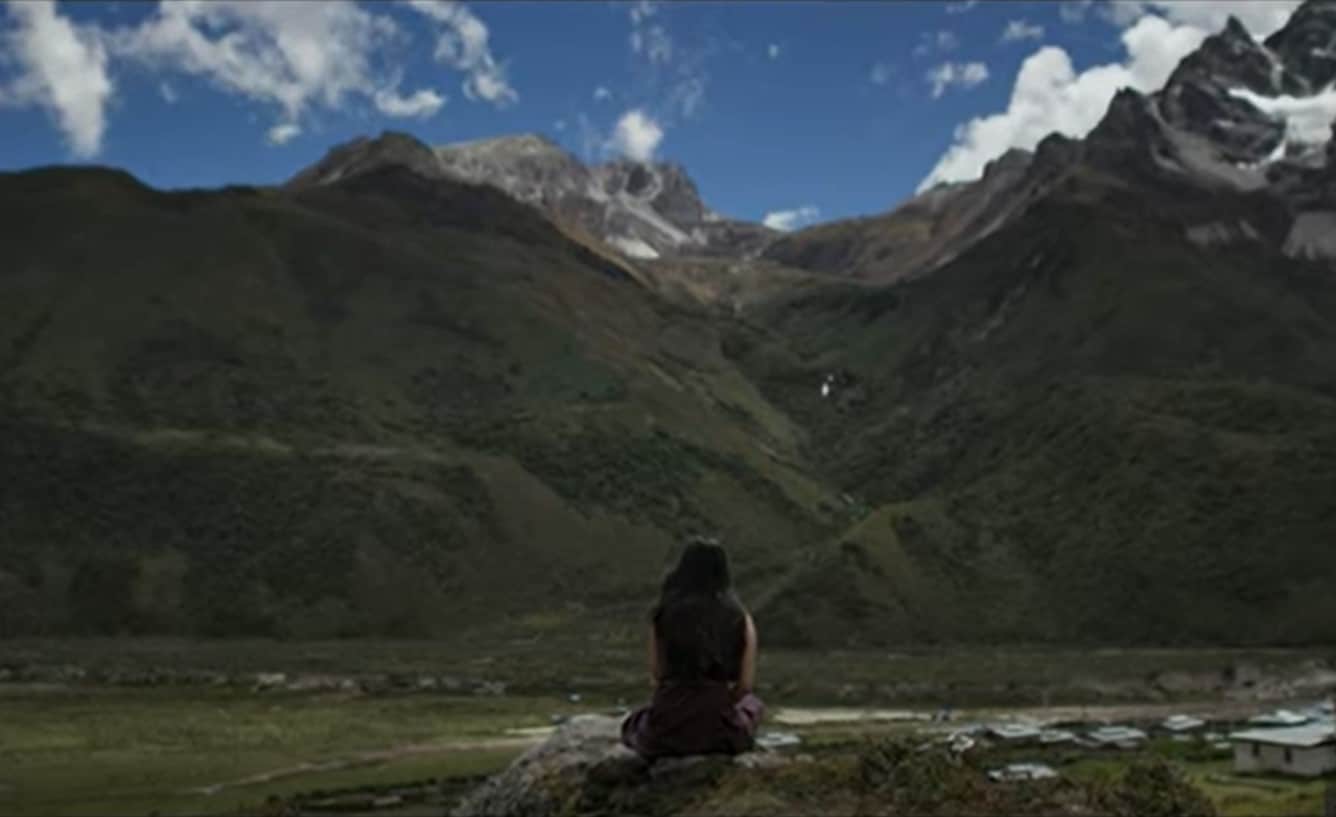
The film Lunana: A Yak in the Classroom was filmed in the mountainous region of Lunana on the Great Himalayas at 5.200m. In Lunana there is a small community of 50-60 people where a primary school operates continuously despite the inaccessibility of the area. The school is usually open for eight months of the year from March to October. Changing weather conditions sometimes shorten the school term to four to six months from May to October. Lunana is experiencing the effects of climate change with diversity. Previously, winter lasted longer, while now it only snows in March and April.
The original film not only touches on education in a traditionally Buddhist country, but also incorporates all the political and environmental dimensions. But the training in remote Lunana is the occasion for a new narrative. Pawo Choyning Dorij as writer, director and producer takes us on a journey through the space and time of a different culture. Climate change has now changed life in northern Bhutan significantly, especially after the major floods on 7 October 1994. In fact, the king has advised the few locals to relocate further south. The inhabitants of the Gasa district - one of the twenty districts of the Asian country - where Lunana is located are witnessing a new reality every day.
Lunana, an unseen valley
Lunana is a apt choice for reasons of climate and social change. It is a community that is also notable for the residents' medicinal knowledge of Himalayan herbs. The few residents live in miserable living conditions. Often people live in the same stone huts with their animals. Η economy in the region is based on yaks, a type of ox, the divine gift of the Himalayas. Residents utilize the yak for wool, leather, meat and milk, a cattle species endemic to Bhutan and Tibet. Lunana is a three-hour walk from Tibet. The two regions, Bhutan and Tibet, share the same culture in terms of agricultural economy and Buddhist religion.
The Great Himalayas in the east extend over 7,500m in northern Bhutan. The Gasa district with its namesake town is in the northwest. In the Gasa district lies the highest peak of the Great Himalayas in Bhutan Gangkhar Puensum -unreached to date- at 7,570m. The impregnable location of the Lunana area is at 5,200m in Gasa with no road network and therefore means dark side. The journey from Gasa to Lunana is ten days on foot and one hour by helicopter from the country's only airport in Paro.
Those who choose the difficult route of the Himalayan mountain ascent via Laya, are obliged to stay there to familiarize themselves with the environment. Laya is the last head village of the region at an altitude of 3,800m and has about a thousand inhabitants (2007). From Laya, with an experienced local guide, the ascent of one of the most difficult mountain trails in the world begins. With eight hours of walking a day, the average climber needs eight days of hard walking and overnight stays on the spot. Lunana had no electricity until 2019 and the film was shot entirely with solar panels for 2.5 months.
The latest film about Lunana: A Yak in the Classroom
The creator Pawo Choyning Dorij has an impressive CV with studies in International Relations (USA) and Buddhist Philosophy (India). Ο director, writer and producer so it is a rare amalgam of western and oriental education. This is the third film work in which he has participated after Vara: A Blessing as an assistant director and the film Hema Hema: Sing me Song while I wait as a producer. Pawo Choyning Dorij is a professional photographer and contributor to international publications such as Vice, Life, The Wall Street Journal.
It is a social film about a teacher who is «obliged» by contract to teach for a whole school year there. The teacher is played by Sherab Dorij. Lunana, far from civilization, offers him a new approach to life. The interaction with the local community has elements of a romantic comedy about a project that fulfilled goals, both explicit and implicit. The film, for example, stars children from the real school who had never used toothpaste before. One of the students even expresses a desire to become a teacher himself because teachers touch the future.
Awareness of traditional education and climate change provides us with a guide to new film production in Bhutan. Bhutan is the first country in the world to receive direct funding from the UN for projects worth $7.4 million. Climate change is, after all, one of the two pillars of the film. The Thorthormi Project in Lunana was a three-year project in 2009-2012 to create natural dams that hold back water. Estimates for Bhutan make the year 2035 a terminus ante quem for complete glacier melt. A very sad fact because the country does not participate in the generated global warming. The rates are high and reaching, according to a related study, pointing to neighboring countries with China first at 29% and India fourth at 7% as responsible.
Bhutan, politics and climate change
In Bhutan the glaciers are transformed into 3,000 lakes, of which four large lakes are in Lunana. The University of Bhutan with Professor Karma Toeb runs a project on proper mountain and water management. The resulting new catchment areas contain large volumes of water. In the project Thorthormi Project local residents from Lunana work on the timely settlement of water in lakes and rivers. Constitutional governance in the 21ο century protects the natural environment as a monument of Bhutan's cultural heritage.
According to the current first constitution of Bhutan, 60% of the country's surface area will forever remain forest land. Bhutan's constitution has been a constitutional monarchy only since 2008, when the first elections were held. The new path to democracy is described in the documentary Road to Lunana (BBS). Two documentaries have been made about Lunana, the first on education School Among Glaciers (2006) and the second on political change Road to Lunana (2007). The fiction film Lunana: A Yak in the Classroom (2019) is the first ecological film production about the inaccessible region.
Bhutan is a landlocked country, with less than 800.000 inhabitants in an area as large as Greek Macedonia. The kingdom has had five hereditary monarchs from 1907 to the present. The small country has ethnic purity thanks to the ethnic cleansing of recent decades. The ethnic cleansing but they are never realised in states with effective democracy. Absolute monarchy united the two tribes east and west into a single state, while south of Bhutan there were native speakers of the official language of Nepal. About 100,000 refugees with Bhutanese passports, but Nepali-speaking, have been living in Nepal's refugee camps for two decades. This is an unresolved refugee issue, without a shred of interest or protection from the world community, much more of interest to be resolved.
Travelling in today's Bhutan
Ο tourism in Bhutan is controlled by numerus clausus ranging from 10.000 to 60.000 per year. At the time of the pandemic, the number of authorised incoming tourists was deliberately reduced. Tourism is controlled by the Kingdom of Bhutan with a pre-paid visa, accommodation, food and a driver, plus a local guide, in groups of more than three people. The aim is to cleanse the country of anything alien or touristic degenerate.
To this end, the country advertises the happiness as the gross national product. Since 1974, when the country partially opened its borders to incoming tourism, happiness was invented. It is a tourism advertisement by the same monarch who later makes the nationalist adverts from 1988 to 1996. In reality it is a marketing mix that failed to convince, even the local people themselves. No happy country has expatriate refugees or increasing migrants to the West.
The film about Lunana comes after twenty years of the advent of television and the Internet in Bhutan. The media have short-lived history in the little forbidden kingdom, a provision from the same ruler of refugee persecution. The monarchy only allowed the use of television, internet and mobile phones in 1999 as a result of an extroversion. Cinema illustrates the communication of the local traditional element with the national culture. With the film Lunana: A Yak in the Classroom begins a new era of recall from the heart of Asia for world civilization.
https://www.youtube.com/watch?v=XqCFIyCTtyM
Happenings: a single ancient culture?;
Although Bhutan is an exotic country for tourism to Central Asia, the film is an occasion to get to know it better. At Sanskrit for highland or towards the end of Tibet, geographically for a country confined between India and Tibet. Religious worship is the common code of belief among Buddhists. Buddhism and language link the peaceful world of the Greater Himalayas centred on modern Bhutan throughout history.
 The ancient tradition of art and sport as events is remarkable. The country's traditional image abroad is reinforced by ancient activities. The archery for example in the open air is public sport as a show in present-day Bhutan. This is a sporting event that takes place every day as a natural human activity, but also as a tourist attraction.
At the same time, the two annual festivals by Buddhist monks every December and June they repeat the primordial orgy of religion. Together residents and visitors alike have a good reason to gather in the capital, Thimbu, to celebrate the ritual. The dancers prepare for six months in Buddhist monasteries across the country to perform the masked worship dance. This is an occupation of the Buddhist monks that clearly resembles the Greek dances, especially the dithyrambo and phallic dances.
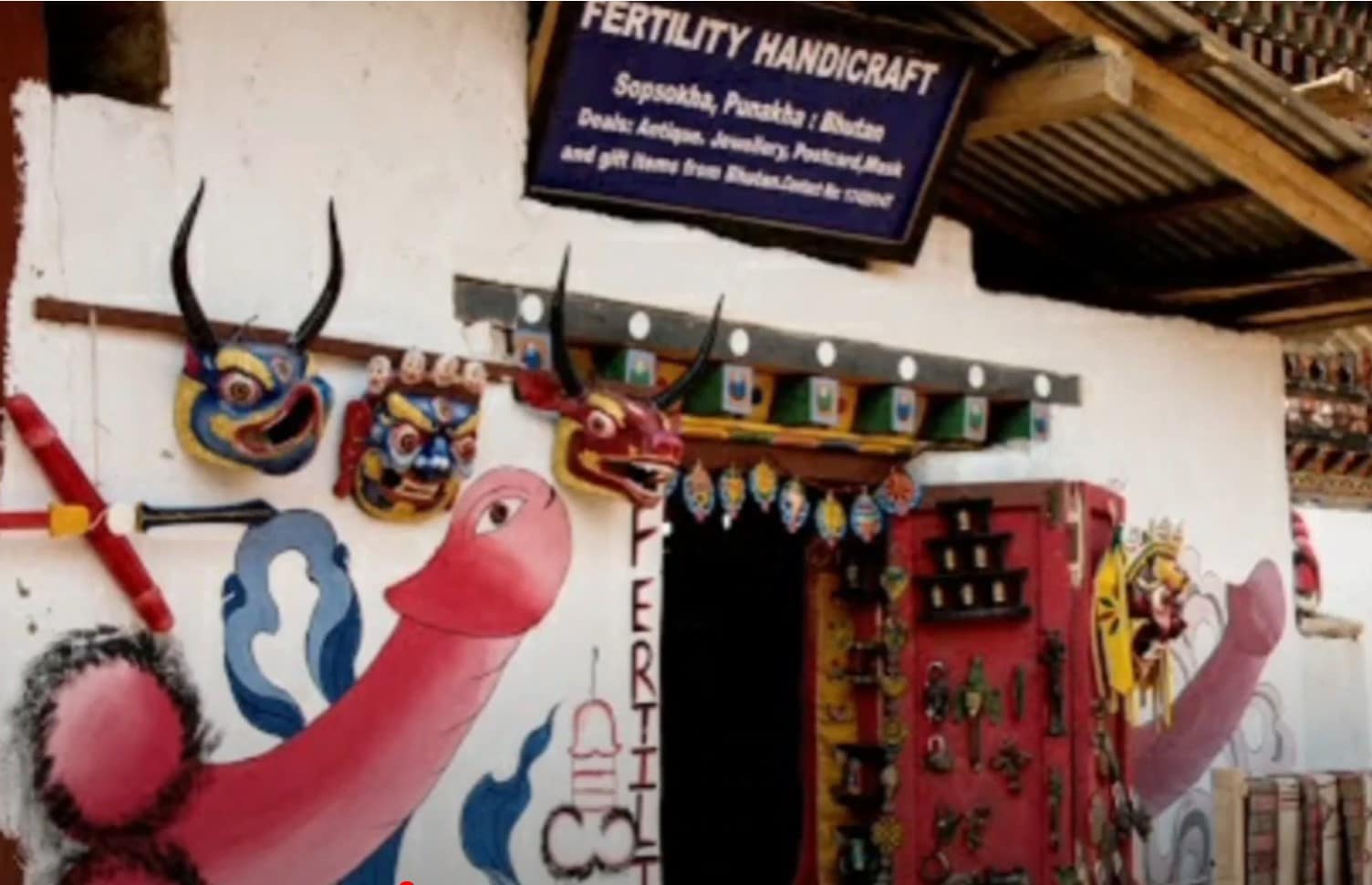
In ancient Greece, dithyrambs were performed in public by masked men in honour of the god Dionysus. The origin of Dionysus from Asia has always been accepted and this admission returns us to the early animistic cult of fertile and fruitful nature. In Bhutan also in the ancient capital Punakha one finds phallic frescoes in houses, but also in the Buddhist monastery Chimi Lhakhang. The Phalliphora as a theatrical performance about the thulled land in Greece in the 5th centuryno pre-Christian century will «give birth», according to Aristotle (1449a), to tragedy and comedy, ancient drama and theatre.
A school at the edge of the earth
Culture, ancient and modern, is of interest to us as an intersection of Bhutan's history. Eternally dependent on India as an economy in conjunction with the British empire from the past, Bhutan very recently became a democracy and acquired a constitution (2008). Tourism is completely controlled, while the fledgling film industry is helping the otherwise poor country resist the old regime. Anthropogenic change is bringing the consequences of geographic upgrading to Bhutan's doorstep in short order. Pawo Choyning Dorij puts on the table all the serious nuances about Lunana and illuminates an ’unknown’ country of the Asian continent with colour and history.
By Georgia Tsatsani
Author of the article:

Georgia Tsatsani is a philologist and comparative literature scholar.