If you look in books, tourist guides or magazines of earlier times, to read about the physiognomy of Kythera, you will find many references to Potamos which is characterized as the head village of the island. And anyone who searches for the etymology of the word «head village» will read something like this: "the largest or most important village in a region, usually the richest, which was not dependent on other villages". It is generally agreed that Potamos was for decades, perhaps even centuries, the strongest commercial centre of the island. Together with the neighbouring settlements, it still today accounts for most of the resident population.
For the past ten years, those of us who live and follow local affairs have found that the River has now lost that primacy. Much earlier we had accepted the demise of Chora, the capital, which in the winter months becomes a haunted town, more so than Paleochora. The two once largest villages on the island have «handed over the reins» to Livadi. A settlement that until 70 years ago did not exist well - well, and by «Livadia» they meant the surrounding small settlements such as Katouni, Stratpodi, Fatsadika and Kato Livadi.
Slowly and steadily Livadi was built up, acquired commercial life, tourist accommodation and services that today serve most of the island's inhabitants. To see its excellence in various areas, it is enough to consider what it offers to the island's residents and visitors alike. Today Livadi has about ten catering businesses, a butcher's shop, a bakery, food shops - supermarkets, clothing, electrical appliances, travel agencies and other services, three courier offices, a conservatory, a conservatory, a nursery, a pharmacy, a petrol station, a bookstore, an OPAP agency, a hairdresser's and a barber's shop. The large commercial presence of AB Vassilopoulos (Ahold Delhaize Group) as well as Bros. Lourantou Ltd. with significant commercial activity, just 1 km from Livadi, should be taken into account.
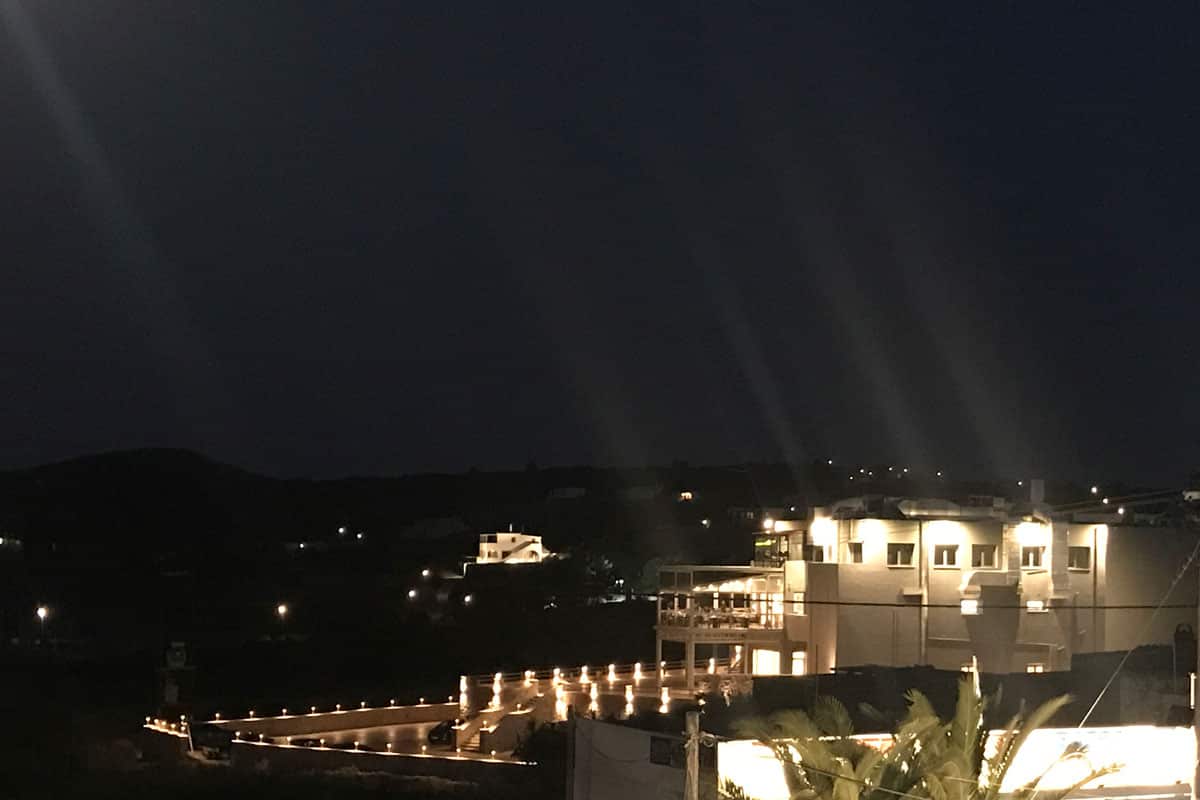
In 2021, an ambitious project of entertainment activity, Kamares Multivenue, in the interest of the company «Mavromatis IKE», officially started in Livadi. This multisite, housed in approximately 2500 sq.m. offers the island's residents a state-of-the-art gym, a martial arts school, a luxury restaurant - bar, a playground and recreation and game rooms. Recently, the same company has purchased a large private area south of Livadi, where it has created a large free parking area and plans to develop other activities there.
Livadi, still having large unused areas and buildings that are still in an unfinished state, has established itself as the most developing settlement and it is of particular interest how it will evolve in the coming years.
On the opposite side of this frenetic growth is the River, which is facing perhaps the worst period of its commercial life, and has emerged from a decade of major changes. For Potamos, things are starting to go downhill since the time when Greece was subjected to the policy of memoranda. To this day, three years after the country's exit from the strict surveillance of the memoranda, Potamos is still counting «wounds» as in this decade it «lost» a bank, a hospital, the commercial store of OTE, the OPAP agency, while half of the commercial street from the pharmacy to Ilariotissa remains unoccupied almost all year round. And perhaps very soon, as part of the «consolidation» of the ELTA, the local post office will also be closed. To all this should be added the «freezing» of the large Panagopoulos investment at the entrance of the village, the abandonment of the Municipal Theatre for many years and the inaction in solving the major problem of parking in the centre of the village.
The country, although it has lost its glamour and importance for decades - the discontinuation of cruising has shrunk it economically - has also faced changes with a negative connotation in the years of the memoranda. The closure of the tax office, the provincial office and other services intensified its downward spiral, turning it into a deserted landscape for most of the year.
Both the River and the Country are experiencing a critical situation with an uncertain future. For both settlements there are no promising prospects as long as things remain stagnant and problems increase. A vision is sought by many that will give hope for the vitality of the two settlements. It should be noted that neither did Meadow suddenly one day acquire a vision for development as we have seen. Its development can be described as circumstantial and certainly favoured by the geomorphology of the area. It is well known that already in the summer months the main road is suffocated by road traffic. The alleged redevelopment 10 years ago on the main road of Livadi did not help the village, while the notorious bypass road that politicians promised in previous elections has been almost forgotten. Consequently, a comprehensive development plan is nowhere to be found.
How can the River and the Country regain their lost glory and economic and social life? We will not make specific suggestions in this article, we will leave that for another time. But we do point out here a few issues that without further adjournment can and should be discussed and solutions found. First and foremost, public spaces must become more society-friendly. The car should be removed from the centres of settlements as is the case throughout the developed world. Let people and children breathe a sigh of relief. Entrepreneurship should be encouraged. We need «injections» of capital and business ideas. There is a need to open up roads and parking areas that will allow the settlements to develop. Public space should be used, with conditions, equity and service to citizens and professionals. To return to the children again the stolen space we took from them. The aesthetics of prohibition without providing an alternative is a plague on the younger generation. If you want to ban football in the square, first build a small stadium on the edge of the village.
One of the most important issues for these settlements and a starting point for progress is the will of the residents and professionals themselves. Decisions will have to be taken at the local - collective level, sometimes to the detriment of some petty interest, some colic, or some individual privilege. A place cannot change and develop unless the human factor first and foremost consents to a new progressive contract. In conclusion, the big question we must answer is: «How do we dream of the River, the Country, the Meadow and our villages in the next ten to twenty years?» Such a dialogue must begin now. Residents, business leaders and institutions must engage and act progressively. And soon policies will be drawn up to ensure a better future for our settlements.