A Venetian proverb says: «Un mondo fa un mondo, e Cerigo un altro mondo» - The whole world is one world, and Cerigo is another world.
How much truth there is in this quote, about my mother and my husband's beloved island of origin.
An island that the primordial myths connect with a place that removes the boundaries between myth and reality. The Minoans called it Porphyrousa, the Phoenicians Finikounda, the Venetians Kythuria and Cherigo,. Today it is known to most people as Kythera, while the locals affectionately refer to it as Chirigo. So I am a proud Tsirigotissa.
Kythera is magical
I have a love affair with Kythera. A love that, year after year, evolves into an ever greater and deeper love.
I went to the island for the first time when I was 6 months old and spent almost all my summers in their arms until today. As did my children subsequently. And I'm sure their children will do the same.
I was looking forward to finishing school in June and taking the legendary ship Myrtidiotissa to my grandparents' house in Agia Pelagia.
In the early years we landed in boats, there was no electricity in the house, but we had lux lamps, and the toilet was outside. But I was triumphant. We had a boat and fresh fish every day. We had an orchard of cattle, chickens, goats, rabbits, and a donkey, Polyxene, who came every morning with Grandpa or Uncle Stelios on horseback. They arrived with baskets full of «goodies» from the fields in the «mountainous areas». With janeras, vanillas, apricots, grapes, figs, almonds.
What a pleasure we had. Similar to the joy we felt with the package my dad sent in his legendary Kapona boat every 15 days. Filled with Mickey Mouse, Lucky Luke, Asterix and Super Caterina, but also with Athenian goodies (chocolates and lollipops) that we treated the whole neighborhood with.
I made lifelong friends on the island and it was there that I met my husband John when I was 13 years old.
We were friends for many years. It took me a while to decipher my feelings and I finally married him at the age of 50 - with a «mythical» party on the beach of Kakia Lagada. But I'll tell you that story of ours some other time.
I also remember vividly the adventures on the island with my fellow student - and my best friend to this day - Maeroula. We had a great time as students in the summers, going from beach to beach, flirting and dancing until dawn at the festivals and at the legendary disco «Gone with the wind» overlooking Kapsali. She got stuck with the island, as did Dimitris , Zafiris, Demi, Varvara, Betty, Betty, Debi, Marina, Laura, Elsie... coming and coming again with loved ones and children......They were intoxicated with aromas and images that remain deeply engraved in the memory and keep you captivated in an addictive way.
Discovering Kythera
«We will never find Kythera» says the song of Katsaros. And some people for years believed that the island does not exist. That it was a utopia...
But the «zathea», the panagia Kythera of Homer are real. And you can discover them by defying the fierce Neptune hiding behind the treacherous rocks of Cape Malea (the legendary Cape Malia, as the locals call it).
An island lazily lying between the Peloponnese and Crete.
Where the Ionian, Aegean and Cretan seas come together. A charming crossroads of cultures, as the architecture of the landscape betrays, where the Cycladic style alternates with Venetian influences, and the simple Maniakian style with the Cretan lavishness.
An island with a confusing identity. It is one of the Ionian Islands, a natural continuation of the Peloponnese, administratively part of Attica, while retaining the peculiar status of domestic property inherited from the English, according to which everything that is not private belongs to the «domestic» and not to the Greek state.
I really feel very lucky to come from this island and to have been surrounded by its magic for years.
And along with most of my friends, who have been captivated by his charms. I cannot explain the magic of the place as it deserves, but a visit is a transcendent experience, as long as one has one's eyes «open». Blessed with legendary and mythical places, Kythera awaits you for a «journey» you will never regret!
The island takes you back in time. Castles, simple rural houses and two-storey mansions, small chapels and majestic monasteries with ornate bell towers, narrow alleys and imposing bridges, water mills in gullies and windmills on hills, compose different elements in unique sets.
As rough as a diamond and with a real soul, this island is «unspoilt» and is waiting for you to discover its secrets..
It is surrounded by a mysterious aura and has created its own identity unlike any other. Perhaps because it has something very special. It is no coincidence that the goddess Aphrodite chose it to be born. Homer calls Kytheria the goddess of Eros. And in ancient times. Acytheros was the name given to a man deprived of attractions. Our place, similar in beauty to its lady, does not reveal its secrets to us at once
The birth of Aphrodite in Kythera was the event that significantly determined the later course of the island and is an important element of its mystery and charm.
I'll tell you a legend...
Once upon a time, the most beautiful goddess chose a place to be born....And that place was Kythera..
«First she approached Zathea (Panithira), and from there she reached Cyprus, where the waters around her are girdling her. And out came a venerable, beautiful goddess, and from her slender feet down the grass grew all around. This Aphrodite [and the goddess of the Afro-born and the well-crowned Kytheria] is called by the gods and men, for she was born in the foam of Kythera.»
Theogony 154-210
According to Hesiod's Theogony, the goddess was born in the foams of the sea of Kythera, just outside Paleopolis, the ancient Skandia with its magnificent beach.
Earth, wanting to punish her brutal husband Uranus for all the suffering he had caused her, asked their children to kill their father. So their son Cronus took a scythe from her bowels and killed Uranus, cutting off his genitals. They fell into the sea of Kythera and became small islands (possibly the Dragons).
Falling blood touched the foam of the sea and from the union of these two elements, the Celestial Venus was born. The waves then carried the goddess away, and she arrived on a shell in the sea-kissed Paphos of Cyprus. It is interesting to mention that in Cyprus there is an area called Kythraia or Kythra, where statues of the goddess Aphrodite have been found, while the common name of the area is Tzyrka. The connection and association with Kythera - Tsirigo is fatal!
Aphrodite was worshipped as Urania, goddess - protector of love and pure love, with Kythera as the main place of worship. She was also worshipped as Pandemos, goddess - protector of carnal love and procreation, with Cyprus as her main place of worship.
In Kythera she saw her first temple from the very early years, according to the always valuable information of Pausanias: «-her sanctuary- the holiest and most ancient of those in Greece».
The foundation of the temple of the goddess in Kythera gave the island the Homeric characterization ζάθεα, i.e. panaya.
The goddess was dealing her time between Cyprus and Kythera, not forgetting that the waves of Kythera first spotted her forming as a beautiful woman in the foams. There is even still her throne (Aphrodite's Seat) at Limni beach in Paleopolis from where she was streaming the natal sea. Together with the Graces she also took her bath in the small lakes of Kythera in the area of Neromili of Mylopotamos. As I do with my friends
It is also no coincidence that Kythera comes from the verb keftho, meaning “to hide”.
Because the Goddess used to hide her secret lovers on the island, as well as the lovers she had in her protection. She hid them in the pine-covered gullies with thick fog (which the locals call “Katsifara”) and on the virgin eastern shores of the island. It was there that Paris stopped for a few days, with the beauty of the centuries by his side.The two of them found shelter in Kythera until a strong wind blew. They arrived at the port of Skandia (Paleopolis) and descended from the trireme to go to the temple of Aphrodite which was located on top of the hill of Paleokastro.
When Beautiful Helen walked on the beach of Skandia the pebbles took the shape of a heart and Paris thought it was an omen from his beloved Thea. At the top of the hill he made the libation and indeed the next day the wind blew and Paris' ships set sail again for Troy. In our time many loving couples flocked to the beach of Paleopolis to find the heart-shaped pebbles.
Barbarossa sacked the capital Paleochora
The island's life was turbulent, with Minoans, Phoenicians, Mycenaeans, Spartans, Macedonians, Romans, Venetians, Turks, French, Russians and English passing through.
The English stayed until Kythera was united with Greece in 1864. During the Second World War, a strong resistance front developed on the island and it was the first to be liberated in September 1944.
All the conquerors who passed over the island over the centuries may have left a deep mark on it, but they never managed to become its masters. For its sole and eternal mistress is the Lady of Heaven Aphrodite.
The first capital was Paleochora above the beach of Kakia Lagada in Agia Pelagia.
It was hidden in a steep rock, between two canyons. It was built by the inhabitants of Monemvasia in the 12th century as the Byzantine capital of the island, and it resembles schematically the famous castle of Mystras in the Peloponnese. It was renowned for its wealth, but was not visible to pirates at sea.
According to legend, in 1537, the admiral of the Ottoman fleet and a well-known pirate, Hayreddin Barbarossa, managed to discover the area by the smoke coming from the chimneys of the houses of the inhabitants during the winter months.
The pirate and his companions climbed the gorge of Kakia Lagada. He carefully observed the walls that surrounded the city and after identifying the weak points, through which he could penetrate the interior, he organized his attack. Then, on his orders, the crew killed 7,000 civilians, and sold many of the prisoners to the slave markets of the East. This is where the common epithet «Slave» came from in Kythera. And they collected money in churches all over the island to free them.
Many of the inhabitants who refused to surrender and fall into the hands of the pirates, jumped over the cliff and were killed. to avoid rape or slavery.
This explains the human skeletons that have been found in the gorge and the local legends of screams heard on moonless nights...
The Archaeological Site of Paleochora is one of the most important archaeological sites of Kythera.It is the largest fortified settlement on the island. Today, one has the opportunity to admire traces of Byzantine churches and monasteries and remains of houses built at the root of the cliff. I went back recently after years, walking along a path from the village of Trifyllianika and was in awe of the sight , but also deeply saddened by the decline of such a state.
Kythera as a timeless element of romantic reference
A symbol for intellectuals and artists and an inspiration for films, paintings and songs, the journey to Kythera is deeply symbolic.
The island embodies the romantic imagination and unbridled passion and retained its symbolism over the centuries until its apotheosis by the Romantics of the 18th century. And it came to be depicted in monumental works.
- Botticelli painted, in the 15th century, the «Birth of Venus», with the goddess of love floating on a green sea of sensuality, the air full of lovers.
- One of the most famous paintings of Western painting on the theme of a utopian paradise is the «Boarding at Kythera» (1717) by Jean Antoine Vato. (now in the Charlottenburg Palace in Berlin), Watteau's dreamy contemplation lifted the beloved island of the arts, from the Renaissance onwards, into the sky.
- The island managed to be recorded in the poetry of the Renaissance, to occupy the Charles Baudelaire the 19th century and continue in the cinematic visual of Theodoros Angelopoulos, in the legendary «Journey to Kythera». Always in the same romantic , almost dreamlike way, As long as, at least in the lives of people the ideal will remain a necessity.
A trip to Kythera. The symbolism
Indeed, it would take a long time to count how many times the title «Journey to Kythera» has been written.
For this world of contrasts and convergences, a symbol of an ideal place towards which we are moving with longing. But which somehow we never reach and never arrive. Kythera is not easy to find. Because it is a Utopia.
The trip is a good start to find one's personal Kythera.
It's not just another trip to a beautiful place. It is a tour of a place that leads to unknown destinations within ourselves. It invites you to explore all its facets and with it your own. It is a journey that is difficult yet so simple at the same time. No frills, no gimmicks, no gimmicks, no stress. You need no guidance, just an open mind and an open heart...
As soon as you set foot on it, a fragile sense of harmony permeates everything.
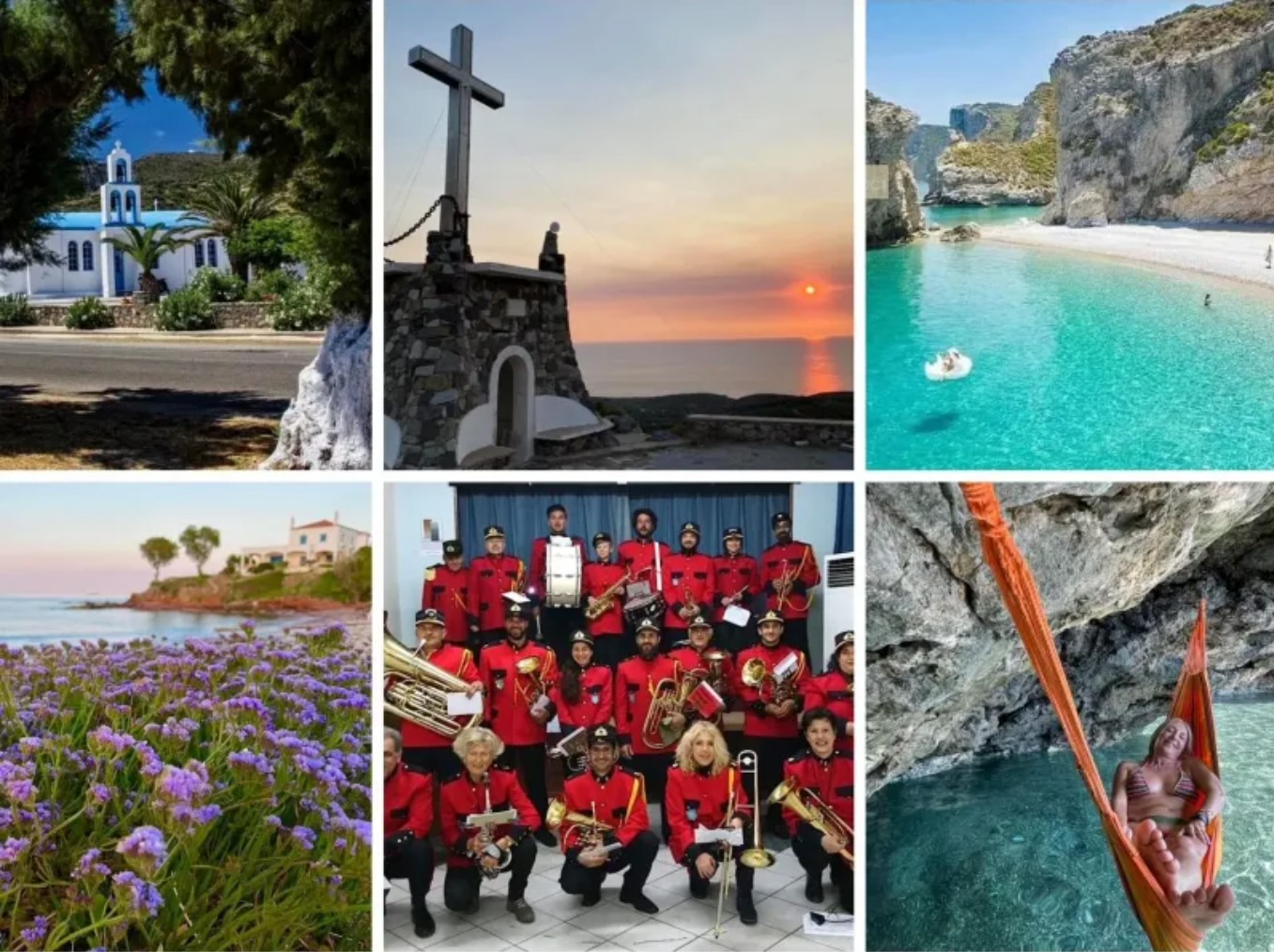
The sounds of the sea and the winds magnify it, while the magnificent villages and ancient stone walls absorb and reflect it. Kythera has a total of 62 settlements with great variety in character, architecture and landscape. From seaside villages reminiscent of the Cyclades, to medieval settlements in the hinterland, but also green villages with springs and rich vegetation that is rarely found on the Greek islands. It is the place where architectural simplicity meets the wildness of the landscape and they go together harmoniously, without one negating the other.
In this landscape many symbols and colour codes prevail. From the dark blue of the open sea to the turquoise of the coastlines. From the bright yellow of the sempreviva to the purple of the rocks. From the lush green cypresses to the blue-green sage and from the dark, robust architecture of the stone castles to the simple white or pale volumes of the houses.
Whether we are visitors or long-term residents, we feel that we are all guardians of this sublime harmony and that we ought to enjoy our stay in the dizzy Kythera «modest and humble».
In the next part of my tour of the island I will explain what you should see when you arrive.
Anastasia Sideri