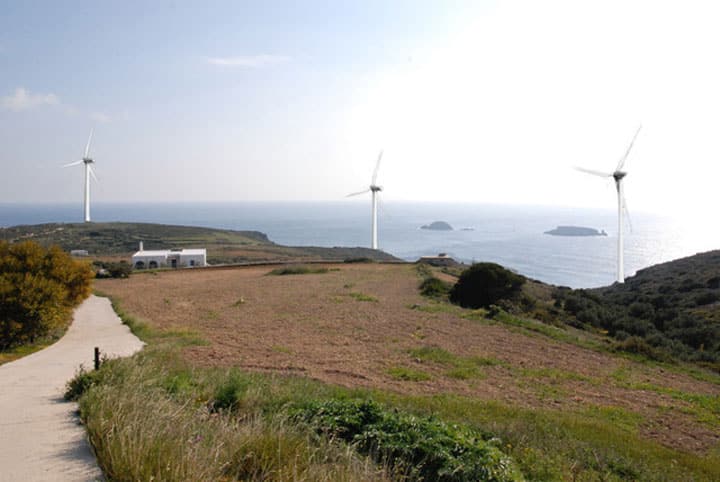
Its deep concern about the prospect of converting Kythira «in a boundless Industrial Wind Farm», expresses in its announcement, the Kythira Studies Society.
The announcement refers to the island's ominous ranking as one of the «12 most endangered cultural heritage sites in Europe» due to the threat of reckless installation and operation of wind turbines on its territory. This development will have a negative impact on balanced development of the region and will jeopardize both the health residents—especially those living in areas close to wind farms—as well as the revitalization of the primary sector.
The announcement follows:
Η Kythira Studies Society considers that the citizens of Kythira, led by Municipal Authority they should discuss together the creation of a Energy Community that will sensibly combine wind and the solar energy as well as energy production from biomass. To this end, it supports the stance and initiatives taken so far by Mayor and the Municipal Council.
Η Kythira Studies Society is watching with intense skepticism and concern the issue that has been preoccupying Kythira in recent months regarding the installation and operation on the island of dozens of enormous wind turbines, which will undermine any prospects for balanced development based on the protection of the landscape and the island way of life, the development of a mild tourism product, and the revitalization of the primary sector,When the areas where they are to be installed are adjacent to settlements, Byzantine and post-Byzantine monuments, places of worship and memory for the people of Kythira, the concern can only become more intense. This is a concern shared by Europa Nostra – the European voice of civil society dedicated to cultural and natural heritage – and its partner, the European Investment Bank Institute, which included Kythira among the 12 most endangered cultural heritage sites in Europe, as they are at risk of being transformed into «an industrial zone with wind farms.».
The initial positive reception of wind farms by the global community has since given way to skepticism about what is actually at stake and whether the impact of their installation and operation has been adequately studied. Questions and uncertainties are particularly acute in areas whose economic development depends heavily on tourism (a sector which in turn supports a host of other activities, seeking to extend the tourist season with mild/alternative forms of tourism (agritourism, ecotourism, geotourism, hiking tourism with activities to promote routes and trails, etc.).
The construction of many kilometers of roads and the clearing of land that will be required, the deep foundations of the wind turbines and the problems that may arise with groundwater and surface runoff, the noise from their operation, and the likely «Wind Turbine Syndrome» (WTS), which international studies claim affects the health of people living near wind farms, the impact on construction activity and property values, the largely unknown consequences for biodiversity, especially when important habitats are threatened, are of great concern to us.
We understand that climate change is a real problem, but this should not lead to the island being turned into a vast industrial wind farm.
For the Board of Directors of the Kythira Studies Society
The President
Aikaterini Aroni-Tsichli
Om. Professor, Panteion University