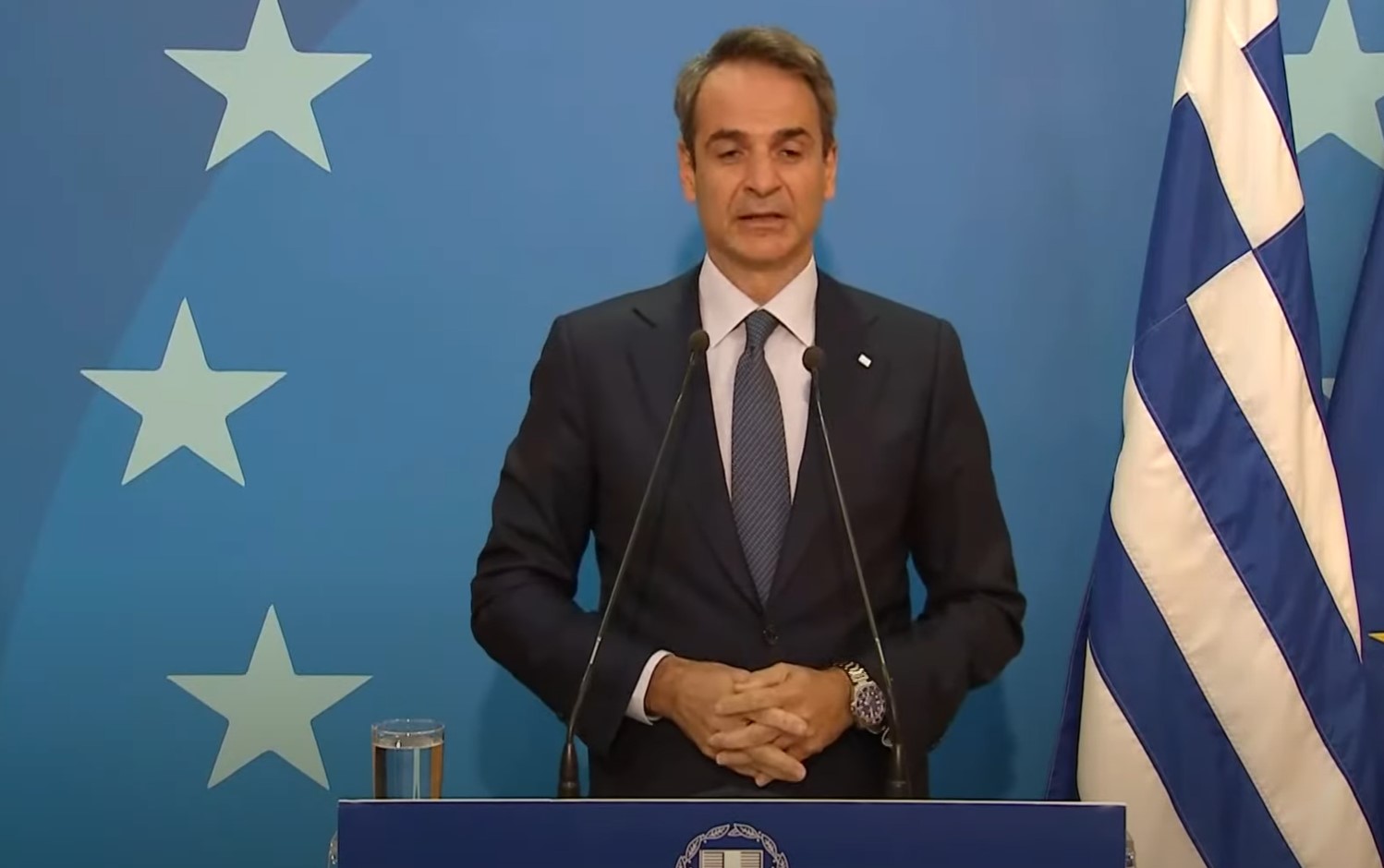
Prime Minister Kyriakos Mitsotakis spoke, on the sidelines of the informal European Council meeting in Versailles, to CNBC and reporter Silvia Amaro about possible interventions in the European wholesale natural gas market, the crisis in Ukraine, and the developments it has triggered regarding Europe’s defense architecture.
«I think there is broad consensus on the council that we should take action regarding intervention in the wholesale natural gas market. I should also point out that since these positions were made public—over the last three to four days—we have observed a significant decline in the wholesale price of natural gas. As I said earlier, I believe this reinforces the argument that, in this case, we are not seeing the fundamental rules of the market at work, but rather speculative activity. »Therefore, I believe a consensus is taking shape,” the prime minister emphasized, referring to his proposal for European intervention in the wholesale natural gas market.
Regarding the Russian invasion in relation to the EU and NATO, he emphasized that it served as a sharp wake-up call for the EU. «For quite some time now, we have been talking about the need for strategic autonomy. We have been investing in our defense capabilities. We signed a bilateral agreement with France that includes a mutual assistance clause. We therefore strongly support the EU having the ability to defend itself independently,» the prime minister said, adding «This is an investment that complements NATO, because we must not forget that most EU member states are also members of NATO, but there are certain EU member states that are not members of NATO. We must therefore send a clear message that we are willing to defend our continent, regardless of our relationship with NATO.».
When asked about President Putin’s intentions, Kyriakos Mitsotakis said that he has «managed» to strengthen the Alliance and «awakened» the European Union from its geopolitical lethargy. «In that sense, he has certainly «managed» to unite us and make us realize that defense and security are our paramount obligations to our citizens,» he noted.
Below is the full text of Prime Minister Kyriakos Mitsotakis' interview with CNBC
Kyriakos Mitsotakis: I think we need to distinguish between long-term measures—and we are committed to phasing out Russian natural gas and oil as soon as possible. Obviously, this isn’t going to happen overnight—we need to distinguish between long-term and short-term measures. My reasoning is very simple: the wholesale market has essentially ceased to function and no longer reflects the fundamental forces of supply and demand. I believe this is something the European Commission has recognized, and there is a clear reference to it in the conclusions of the Commission’s press release dated March 8.
I think there is broad consensus on the council that we should take action regarding intervention in the wholesale natural gas market. I should also point out that since these positions were made public—over the last three to four days—we have observed a significant decline in the wholesale price of natural gas. As I said earlier, I believe this reinforces the argument that, in this case, we are not seeing fundamental market rules at work, but rather speculative activity. Therefore, I believe a consensus is emerging. And we look forward to the committee’s proposals at the next council meeting, in two weeks.
Silvia Amaro: Do you think specific measures will be agreed upon at the next council meeting?;
Kyriakos Mitsotakis: What I expect are specific proposals from the committee on which the member states must reach an agreement. But the majority—I would say the overwhelming majority—of the countries that have taken a position on this issue have supported this idea. There is, of course, another aspect: how can one break the link between wholesale natural gas prices and electricity prices? Our current electricity pricing model reflects a different era, a time when renewable energy sources were still relatively more expensive and we were trying to encourage the integration of renewables into our energy mix. That is no longer the case. The price of electricity is determined by the marginal price, which in this case is derived from natural gas. This no longer makes any sense at all.
Silvia Amaro: What would happen if the EU were willing to intervene in this wholesale crisis? Why not ban Russian oil immediately?;
Kyriakos Mitsotakis: That is an entirely different issue. Right now, we’re talking about interventions in the natural gas market that will make the price of natural gas better reflect the actual dynamics of supply and demand. This has nothing to do with sanctions. At this point, I don’t think there is a consensus regarding Europe’s complete decoupling from Russian gas. These are two different things.
Silvia Amaro: What would it take for Greece to say «yes» to a ban on Russian oil?;
Kyriakos Mitsotakis: I repeat that we must draw a distinction between Russian oil and Russian natural gas. What we have said is that we are willing to consider additional sanctions. And that is always an option on the table. I assume this is something that will also be discussed at the next Council meeting. So, the committee is doing the groundwork. I’ll say again that the oil market is different from the natural gas market, so I wouldn’t rule anything out at this point.
Referring to the Russian invasion of Ukraine in relation to the EU and NATO, he emphasized: ’I believe that what happened was a sharp wake-up call for the EU.” For quite some time now, we have been talking about the need for strategic autonomy. We have been investing in our defense capabilities. We signed a bilateral agreement with France that includes a mutual assistance clause. We therefore strongly support the EU having the ability to defend itself independently. This is an investment that complements NATO, because we must not forget that most EU member states are also members of NATO, but there are certain EU member states that are not members of NATO. We must therefore send a clear message that we are willing to defend our continent, regardless of our relationship with NATO. And that is why I believe the reference in the Conclusions to Article 42, paragraph 7, of the Treaty on European Union is so important. And, of course, since we are going to spend more on defense, we must also reach a common understanding on how to treat these defense expenditures in deficit calculations. This is an issue I raised again today. This discussion is just beginning. As you know, it is a major issue at the level of our finance ministers (ECOFIN).
However, Greece, for example, is a country that will significantly exceed the 2% of GDP that NATO has set as the minimum for defense spending. Therefore, if we want to spend more on European defense, we must, first, ensure that this is actually done in the right way and, second, we must ensure that it does not place an unnecessary burden on our fiscal position.
Silvia Amaro: In that case, perhaps NATO’s current 2% target should be strengthened. Should that number be increased?;
Kyriakos Mitsotakis: First of all, most member states aren’t even at that spending level. Let’s first reach the 2% target for those member states that aren’t there yet. And for those Member States that intend to spend much more than 2%, let’s ensure that the additional spending beyond the 2% level is not counted toward our deficit. That is my proposal, and I think it makes perfect sense.
Silvia Amaro: In the end, former U.S. President Donald Trump was right.
Kyriakos Mitsotakis: In what sense?;
Silvia Amaro: Regarding NATO spending.
As for NATO spending, yes, I believe that—as I told you—it was necessary to radically reorganize the Alliance and for everyone to realize that we need to spend more. But we need to operate more intelligently. And at the European level, we need to identify certain projects of common interest in which we could invest on a pan-European scale and from which all member states would benefit. The field of cyber defense would be a clear example. We all face similar challenges. So why not pool our resources at the European level so that we can all use them in the event of a cyberattack?;
Silvia Amaro: So, are you concerned that President Putin’s next target might actually be NATO, possibly through cyberattacks?;
Kyriakos Mitsotakis: I do not know what President Putin’s intentions are. What I do know is that he has «managed» to strengthen the Alliance and «awakened» the European Union from its geopolitical lethargy. In that sense, he has certainly «managed» to unite us and make us realize that defense and security are our paramount obligations to our citizens.