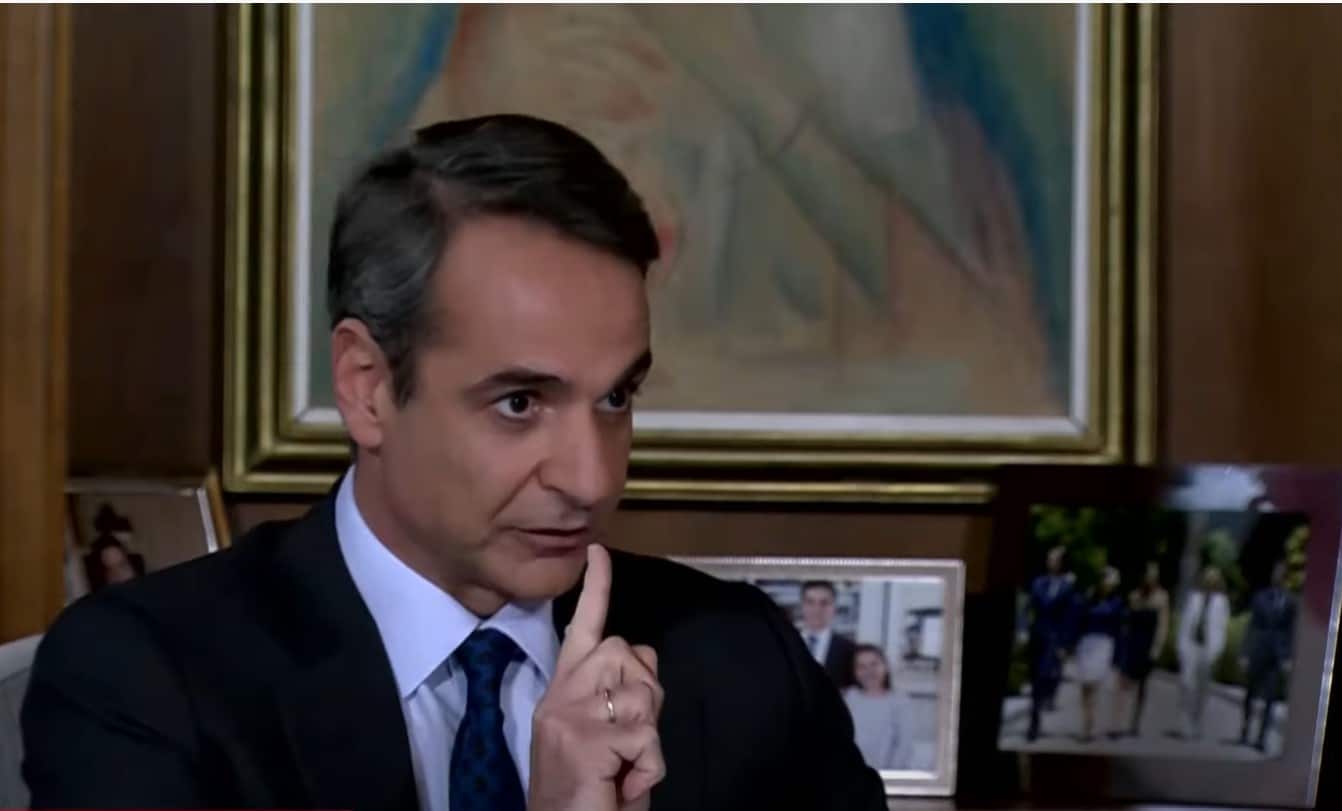
Questioning the sovereignty of a NATO ally is unacceptable and will not be tolerated by Greece, and shows Turkey as a country that is no longer part of the Western alliance, Prime Minister Kyriakos Mitsotakis said in an interview with Bloomberg TV and journalist Caroline Hyde.
Referring to the domestic situation, the Prime Minister said that we will have elections either in the spring or early summer of 2023, while referring to what the Turkish president said at the UN, he said that he will respond tomorrow in his speech, adding that “accusing Greece of crimes against humanity on the issue of immigration is simply outrageous. It is outrageous because it is Turkey that, very openly and very publicly, has been instrumentalizing migrants for the last two years, trying to encourage them, trying to send them to the Greek borders, trying to push them to Europe.”.
He noted that Greece is rescuing tens of thousands of people who were in danger at sea and defending its borders while respecting fundamental rights and should cooperate with Turkey to address this issue “instead of seeing a Turkey “wagging its finger at us”.
The Prime Minister added that “we don't need another source of geopolitical instability in the Eastern Mediterranean when we are waging war against Russia and trying to support Ukraine”, estimating that the Turkish President's attitude is to some extent due to domestic politics, “but that is his problem and not mine”, while sending a message of determination and willingness for dialogue to Ankara:
“Questioning the sovereignty of a NATO ally is obviously unacceptable. It will not be tolerated by Greece, and it basically shows Turkey as a country that is no longer part of what we used to call the Western alliance. President Erdogan is refusing, at this time, to meet with me. I have openly said that I am always open for discussion and I believe that it is in the interest of regional stability to significantly reduce the intensity of the rhetoric. It helps no one, I think, including himself, if he continues on this path,” he said.
Referring to the issue of surveillance, the Prime Minister stressed that from the beginning he had asked for the case to be brought to light, and pointed out that the sale of illegal surveillance software should be banned.
“We must take the lead in ensuring that we ban the sale of this illegal software that allows someone to access your phone without your knowledge. And that needs a European response. This is a serious issue. We have addressed it honestly and transparently, and we want to ensure that we further strengthen the capacity of our intelligence services to be able to do their job, but with the necessary oversight that allows people to feel comfortable with how they operate,” he said.
Mitsotakis stressed that the stability of the government is unquestionable and added that the New Democracy party is implementing long-term reforms that will lead to substantial change in the country.
“I am not only interested in small-scale change, a simple management of the daily political cycle. What we are trying to do is something much more substantial and I think we have laid the foundations,” he said.
Finally, he referred to the energy crisis, pointing out the support of society with 2 billion euros, and added that a message must be sent to Russia that Europe will not accept blackmail on the issue of gas sufficiency and prices, while he stressed that we must turn to renewable energy sources where, as he said, Greece has a leading role.
“We are in the top ten countries in terms of the penetration of renewable energy in the country's electricity generation mix. We plan to add nearly 2 GigaWatts of Renewable Energy in 2022. We continue to invest in our domestic grids,” Mitsotakis said.
The Prime Minister's interview:
Caroline Hyde: The Prime Minister of Greece Kyriakos Mitsotakis is with us. It is a great pleasure to have you with us here in New York.
Kyriakos Mitsotakis: Thank you very much for the invitation.
Caroline Hyde: You're here for the United Nations General Assembly, I'd like you to tell me, Prime Minister, about President Putin's latest rhetoric today. Once again we have, escalation of the situation, concerns about annexations, a nuclear threat and a threat to throw yet more troops into the war. What do you make of all this?;
Kyriakos Mitsotakis: What I can tell you is that we are all united and we support Ukraine in its effort to defend itself against this act of pure aggression, which violates all the rules of international relations.
Speaking as a Greek, but also as a European leader, we know what the stakes are. And it goes beyond Ukraine. And we need to send a message to all leaders of authoritarian regimes who believe that they can change borders through the use of force, that this will not be tolerated by the community of democratic states.
The war is not going well for Russia. That is absolutely clear. And I believe that President Putin will do everything he can to turn the situation around. But I am convinced that he will not succeed.
Caroline Hyde: To a large extent what's having a big impact in Europe, on your citizens, is the increase in costs. The consequences, especially in energy, is something that is felt by citizens, by consumers. I know that Greece has repeatedly supported by spending money, businesses and households. Today you have offered an additional EUR 1.1 billion. How much longer can you do this? You have emphasised the taxation of some of the profits of energy companies.
Kyriakos Mitsotakis: We have to send a very clear message that we will not accept blackmail from Russia when it comes to gas sufficiency and gas prices. We need to do it at the national level, but we also need more cooperation at the European level.
Personally, since March, I have been in favour of imposing a cap on gas imported into the European Union. I am not sure we will get to that point. But we have taken important decisions at European level in terms of reducing our dependence on Russian gas.
At the same time, in order to ensure that we maintain social cohesion, we need to support our societies. And we need to do this both by spending funds from our budget and by “recycling” the excess profits of energy producers and channelling them into a special fund that will help us to subsidise electricity and gas prices.
This is exactly what we have done in Greece and I think we are pioneers in this issue. If you look at the European Commission's proposal to other European countries, it proposes that they follow the Greek model, which has been in place for three months now. And it is really delivering results.
We have “recycled” more than €2 billion of the surpluses that will be channelled into this special fund, which allows us to offer support. I would say support to a significant extent to households and businesses to ensure that they can make it through this difficult winter.
If we do not do that, then there is a real risk that our societies will not go along with our decision to support Ukraine and will start to put pressure on us to make a compromise, which, frankly, is not an option. So we will have to do it.
Also, we should be aware that while the transition period of gas decarbonisation is underway, there should be an acceleration, an even greater acceleration, in the penetration of renewable energy sources. That is what we are doing. Greece has a leading role in renewable energy. We are in the top ten countries in terms of the penetration of renewable energy sources in the country's electricity generation mix.
We plan to add almost 2 GigaWatts of Renewable Energy in 2022. We continue to invest in our domestic grids.
And of course we aspire for Greece to play a key role at the regional level, acting as an energy entry point to the EU.
We are strengthening the LNG infrastructure in the country. We want to import more LNG through Greece not only to meet the needs of the Greek market, but also to support our neighbours in the Balkans.
And of course we want to create electricity networks that will connect Greece with the Middle East, Cyprus, Israel and Egypt.
Caroline Hyde: So could you say that this situation is an opportunity for Greece, economically speaking?;
Kyriakos Mitsotakis: Yes, it is. Every crisis is potentially an opportunity. But again, what we need to do is to make sure that the price of energy that people are paying is not excessive. Of course, now there is an additional incentive for people to make sure that they are saving energy. The way we have scaled up our subsidies encourages people to save energy. So we give them a bigger subsidy if they reduce their energy consumption by 15%. So we measure their energy consumption compared to the previous year, and the more energy they save, the more benefit they get. And they will receive a higher subsidy. We are also implementing programs to replace all appliances that are highly energy intensive. For example, in Greece we have too many air conditioning units. If you compare the energy consumption of an old air conditioning unit with a new one, the savings reach almost 50%. And of course, as you said, we want to be part of the new geopolitical energy map and I think we know how to get there.
Caroline Hyde: What do you think about what the European Commission has announced so far? You have said in some ways that they are following your lead. Have they done enough?;
Kyriakos Mitsotakis: I will be very frank with you. I will continue to support the need for a cap. And every time we talk about a cap, the markets take notice and adjust. What am I talking about a cap in Europe for? Because in Europe the gas market really does not work. You don't need to be an energy expert to understand that there is no real correlation between supply and demand. Gas prices have increased tenfold. We pay much more money for gas in Europe than you pay in the US or than Japan or China pays for gas imports. So I think we need a more drastic intervention that does not just target Russian gas, but imposes a cap on the TTF index. Will we get there? I do not know.
What we have done so far is certainly in the right direction. For example, the imposition at European level of a tax on the windfall profits of refineries. We will use these profits to subsidise heating oil, which is important for people who need heating for their homes during the winter. But again, the big challenge is to understand that the shift to renewable energy is no longer just an economic issue, it is also a geopolitical issue.
Caroline Hyde: Yes. Talk to me about the concern that you have about this winter. You say that you're trying to make sure that you're protecting your consumers, your citizens. What about those who want to come to Greece, who want to spend money in Greece? You are doing incredibly well in the tourism sector. In fact, thanks to that you have increased the prospects for your economy. Are you worried that if Europe has a very bad winter, people won't have the financial capacity to come?;
Kyriakos Mitsotakis: Look, a recession is bad for the economy in general, but I think the Greek tourism industry has recovered impressively and we are probably heading for a record year. I think Greece has become an attractive destination, not just in the summer, not just for the islands. We are very focused on sustainability. And of course, I think we are also bridging that gap between coming to Greece just for pleasure and coming to Greece for work. There are a lot of digital nomads moving to Greece now. We are offering significant incentives. It's a great place, not just to visit, but also a place where you can work from, live from when you retire. It may also be a great place for northern Europeans to spend their winter because they will certainly want to save money on their heating bills. So spend some time in Greece during the winter, you will have a great time and it will probably be cheaper for you.
Caroline Hyde: You are a good “salesman”. Sounds delightful. Prime Minister, talk to us a little bit about some of the concerns in the field of international relations that have been highlighted, to some extent, here at the United Nations. In particular, I'm thinking of the President of Turkey. Once again, we know that the animosity between Turkey and Greece has been going on for a long time and in some areas, but we also know about accusations even of crimes against humanity that Turkey has unleashed against Greece. What is your response? What is the attitude that the United States and Europe have taken in all of this?;
Kyriakos Mitsotakis: I will have the opportunity to respond to President Erdogan when I deliver my speech on Friday. Accusing Greece of crimes against humanity on the issue of migration is simply outrageous. It is outrageous because it is Turkey that, very openly and very publicly, has been instrumentalising migrants for the last two years, trying to encourage them, trying to send them to the Greek borders, trying to push them to Europe. We are saving tens of thousands. We have rescued tens of thousands of people who were in danger at sea. We are defending our borders as we have an obligation to do, but we also respect fundamental rights and we should be working with Turkey to address this issue instead of seeing a Turkey “wagging its finger at us”. In general, we have seen a crescendo of Turkish rhetoric against Greece that is obviously unacceptable. I think this is something that has been pointed out to Turkey by the leadership of the European Union, but also by the United States. We don't need another source of geopolitical instability in the Eastern Mediterranean when we are waging war against Russia and trying to support Ukraine.
Caroline Hyde: Why do you think Erdogan is doing this?;
Kyriakos Mitsotakis: I think, to some extent, because of domestic politics, but that's his problem, not mine. It is our destiny by geography to live together. And as I have told him many times, we should be able to agree that even when we disagree, we should do it in a civilized way. Questioning the sovereignty of a NATO ally is obviously unacceptable. It will not be tolerated by Greece, and it essentially shows Turkey as a country that is no longer part of what we used to call the Western alliance. President Erdogan is refusing, at this time, to meet with me. I have openly said that I am always open for discussion and I believe that it is in the interest of regional stability to significantly reduce the intensity of the rhetoric. It helps no one, I think, including himself, if he continues on this path.
Caroline Hyde: Prime Minister, I'm going to start asking some relatively sensitive questions about your own domestic policy now, because I know there is an ongoing concern about an ongoing surveillance scandal involving your Government. Can you talk to us about that? There are many people who are not aware that your government has acknowledged that there was a wiretap on the phone of an opposition leader. You said it was legal, but perhaps wrong. But this issue has escalated and has caused a lot of controversy. Where is it now and how concerned are you about your own image?;
Kyriakos Mitsotakis: This is a serious issue that I raised very openly from the beginning, courageously admitting that a mistake was made, making changes in people and making sure that we have even stricter filters on the issue of surveillance. At the same time, there is also a much wider problem that needs to be addressed, and that is the spread of illegal spying software throughout Europe. This is something that does not only concern Greece, but also many other European countries. And we have to walk a very fine line between making sure that we protect the fundamental rights of citizens, but not compromising the ability of our security services to be able to do their job. And I think we need to take the lead in ensuring that we ban the sale of this illegal software that allows someone to access your phone without your knowledge. And that needs a European response. It is a serious issue. We have addressed it honestly and transparently, and we want to ensure that we further strengthen the capacity of our intelligence services to be able to do their job, but with the necessary oversight to allow citizens to feel comfortable with the way they operate.
Caroline Hyde: You talked about your courageous attempt to secure transparency by admitting the misconduct. So what about government stability? Do you think it is secure at the moment?;
Kyriakos Mitsotakis: This government is extremely stable and I think that is important because we have managed to implement real reforms in the last three years. We are entering an election year. We will have elections in the spring or early summer of 2023. Our government remains well ahead in the polls and we are aiming for another absolute majority. I think you are right to point out that in these difficult times, political stability is of particular importance. We are also living in a time when many forces may have an interest in destabilising democratically elected European governments. At the end of the day, we have a democracy that is functioning properly and we also have great confidence in the Greek people. We will present our assessment when the time comes. And we hope that the citizens will once again entrust us with the responsibility of governing the country. Because I think they know that we have faced extremely difficult situations, effectively and that Greece is now in a much better position than it was when we took over in 2019.
Caroline Hyde: Fiscally speaking, in terms of debt. So do you think there is an investment grade on the horizon? Do we need an election to make that happen?;
Kyriakos Mitsotakis: First of all, on the fiscal situation, yes, we are in a much better position now than we were. We have fulfilled our promises. We have cut taxes without compromising fiscal sustainability. We have shown that it is indeed possible to reduce taxes, to achieve growth without jeopardising the fiscal path. And this is important for a country like Greece, which will have the most important, the fastest debt reduction as a percentage of GDP of any European country this year.
I would imagine that, yes, the rating agencies will look at the political situation and what will happen in 2023. But I'm convinced we'll get to investment grade. It will be a fitting end to a very painful period that started in 2010. The Greeks have suffered a lot, they have endured a lot. But I think that Greece has proven that also in terms of foreign direct investment, in terms of the real transformation that is taking place, that it can be a pleasant surprise and that it can be in the headlines not for the wrong reasons, but for the right reasons.
Caroline Hyde: You're optimistic at a time when the United Nations is facing major global challenges, but there's really a sense that...
Kyriakos Mitsotakis: ...I think I am a realist. We understand that the challenges are enormous, but at the same time we have an obligation to chart a path through troubled waters. And I think we have proven that we have the capacity to manage crises well, but at the same time to implement the long-term reforms that will allow us to change the country substantially. I'm not just interested in small-scale change, a simple management of the day-to-day political cycle. What we are trying to do is something much more substantial and I think we have laid the foundations. There is still a lot to be done. I fully understand that there are great difficulties, but, yes, I remain quite optimistic about the country's prospects.
Caroline Hyde: Come back and tell us how this process is going. We wish you good luck with Friday's speech as well.
Kyriakos Mitsotakis: Thank you very much