HOMER CODE
KYTHIRA: The island of Homer's Phaeacians and Apollonius Rhodius.
Homer knew the Ionian Islands as well as all the cities and ports of Northern Epirus, Epirus, Western Central Greece, and Western Peloponnese, which were washed by the Ionian Sea, like the fingers of his hand.
Homer was not only a great poet but also an excellent scientist and geographer. In the Iliad and the Odyssey, he made extensive use of the device, or «poetic license,» of naming the places he mentioned with different names each time.
Thus, he gave his listeners the impression that he was referring to the entire known world at the time, even the Ocean—which, in his era, was believed to be a river that surrounded the entire earth and was also the underworld of the souls of the dead.
In his epics, he refers to Troy as Ilion and Corfu as Dolichion, meaning «long-necked,» but also as Aiaia, the island of Circe, which belonged to "Hyperia," the highest point of the Ionian Sea, from which it took the following names: from (Circe-ra) to (Corky-ra), Latin Corfu, and finally to Kerky-ra, where the ending -ra means country – place of origin.
He calls Lefkada, the island of the god Apollo, Thrinacria, Kefalonia as Ogygia, the island of Calypso, and Sami (a settlement on Kefalonia that has retained the same name to this day), and the inhabitants of Kefalonia as the Cephalonians in the Iliad.
He always refers to Zakynthos by the same name.
Kythira, which means "land of Kytheria," where Kytheria means attractive, alluring, from which the goddess Aphrodite took her name -Astarte according to the Phoenicians, who according to mythology was born in Kythira, traveled to Paphos in Cyprus where she emerged and ended up -ra (country, place of origin - Latin TER-RA means earth, soil). It also refers to Kythira as the island of the Phaeacians, which means land of intelligent people (phaeus means bright – enlightened, hence phaeus substance, brain). He also calls them Scheria, which means the lowest point of the Ionian Sea (and today we say ολο-σχερώς, i.e. to the last, lowest point).
It is important to note that in the Odyssey, Odysseus' entire journey was predetermined, with Zeus ordering Odysseus to visit Scheria, the land of the Phaeacians, as the last stop on his journey, from where the Phaeacians they would send him back to his homeland, Ithaca: «He spoke and immediately turned to Hermes, his son:
– Hermes, who is my messenger (postman) in all things, tell the nymph, the fair-haired (Calypso), of our pure intention, that Odysseus, the untamed one, to return to his land, without any god or mortal man by his side, but, after suffering on the much-travelled ship (boat), he will arrive on the twentieth day in Scheria – the land of the Phaeacians – who are god-born, and they will honor him wholeheartedly as a god, and send him by ship to his sweet homeland (Ithaca).» (Odyssey, Rhapsody 29–35)
However, the key to understanding Odysseus' journey from Calypso's island to the southernmost tip of the Ionian Sea is the certainty that Calypso's island is Kefalonia!!!
This is revealed by the type of wood Odysseus used to build his boat (and not a raft as we understand it today, because it had a keel, a rudder, and a tiller).
The wood he used to build his boat included fir trees, among others! Calypso: «She gave him a sharp, bronze knife, which was double-edged and had a tightly fitted handle made of olive wood beautiful, and she gave him a sharp axe and set him off towards a certain part of the island, where there were tall trees (cedars) and poplars and firs, which touched the sky, and from time to time she would lighten them so that they could float easily.» (Odyssey, Raps. 234–240)
The question that arises is: on which Ionian island do fir trees grow? Only on the island of Kefalonia, at the top of its highest mountain, Ainos (1,628 m above sea level), where the dried fir trees roll down the streams to the beach (sand) of Sami, where Odysseus wept as he reminisced about his homeland.
Note: This fixed point on Kefalonia can explain Odysseus' entire journey to Scheria.
So, now that we have revealed Calypso's island of Kefalonia, we must check whether Odysseus sailed north or south, as Zeus commanded, to reach Scheria:
«And he (Odysseus) lies on an island with sorrow and pain in Calypso's chambers, the nymph who holds him captive, and he cannot reach his homeland, for he has neither ships nor companions to carry him across the wide sea» (Rhapsody 13-17).
Calypso also responds to Hermes, who conveyed Zeus's order to release Odysseus:
«Since he (Zeus) commands it, let the unfortunate (Odysseus) go out into the wild seas, but I will not see him off, for I have no ships, nor companions to carry him across the wide sea (Rhapsody 139–142).
Homer also specifies the month of Odysseus' departure from the magnificent cave where Calypso lived (probably the Drogarata cave), because when Hermes arrived there and conveyed Zeus's command to Calypso to let Odysseus leave her, grapes were hanging around her cave, which means that the month was September(perhaps this month the winds are milder:
«A vine (vineyard) surrounded the cave, full of anger (furious), spreading out grapes adorned» (Raps. 68–69)
Calypso guides Odysseus on how to reach Scheria, with the help of the constellations, specifically the Great Bear:
«And the Bear, they call her, and she always turns, watching Orion without fail, the only one who does not know the bath of Ocean, since Calypso had taught her then, her aunt, having her sail the seas.» (Rhapsody 273–277)
To understand this, given that the Big Dipper revolves around the Little Dipper and the North Star, around 1200 BC, when the Trojan War took place, and around 800 BC, when Homer composed the Odyssey, due to the precession of the Earth's axis, the current North Star was then located east of the current North, so the Little Bear and the Big Bear were also located further east in the sky (B – A) at that time.
⦁ Note: I am attaching an official astronomical chart describing the course of the polar star – in red – and therefore of the Bear in relation to the Earth's millennia. The yellow arrow indicates the year 1,000 BC, which is said to be when Homer was inspired to write the Odyssey (attached 1).
Based on this chart, Odysseus had to sail southeast so that the coasts of mainland Greece and the Peloponnese were on his left, where he would spend the night or find refuge in case of stormy seas (sailing from shore to shore, as was customary at that time when there were no compasses).
There is another point in the Odyssey that points south. When Odysseus reached the western coast of Kythira, he was shipwrecked due to heavy seas, his boat was destroyed, and he swam to safety. Then the goddess Athena stopped all the winds and kept only the north wind blowing. So, she sent the shipwrecked Odysseus south, i.e. to the southernmost point. of Kythira, Kapsali:
«And then Athena, daughter of Zeus, thought of something else – she blocked the passages of the other winds – she commanded them to cease and be still – and she set the swift North Wind in motion, and it broke before him – the waves upon the Phaeacian sailors, until it reached them’ (Rhapsody 382–386).
Given that the distance between Kefalonia and southern Kythira is approximately 370 km and Odysseus sailed for 17 days until the 18th day when his boat (with sail) was destroyed, it is reasonable to assume that the speed of his ship was approximately 2 km per hour, sailing 12 hours a day:
«Seventeen days passed, and on the eighteenth day, the mountains of the Phaeacians appeared on the horizon, the land closest to his route, shining like a shield in the dark seas» (Rhapsody 278–281).
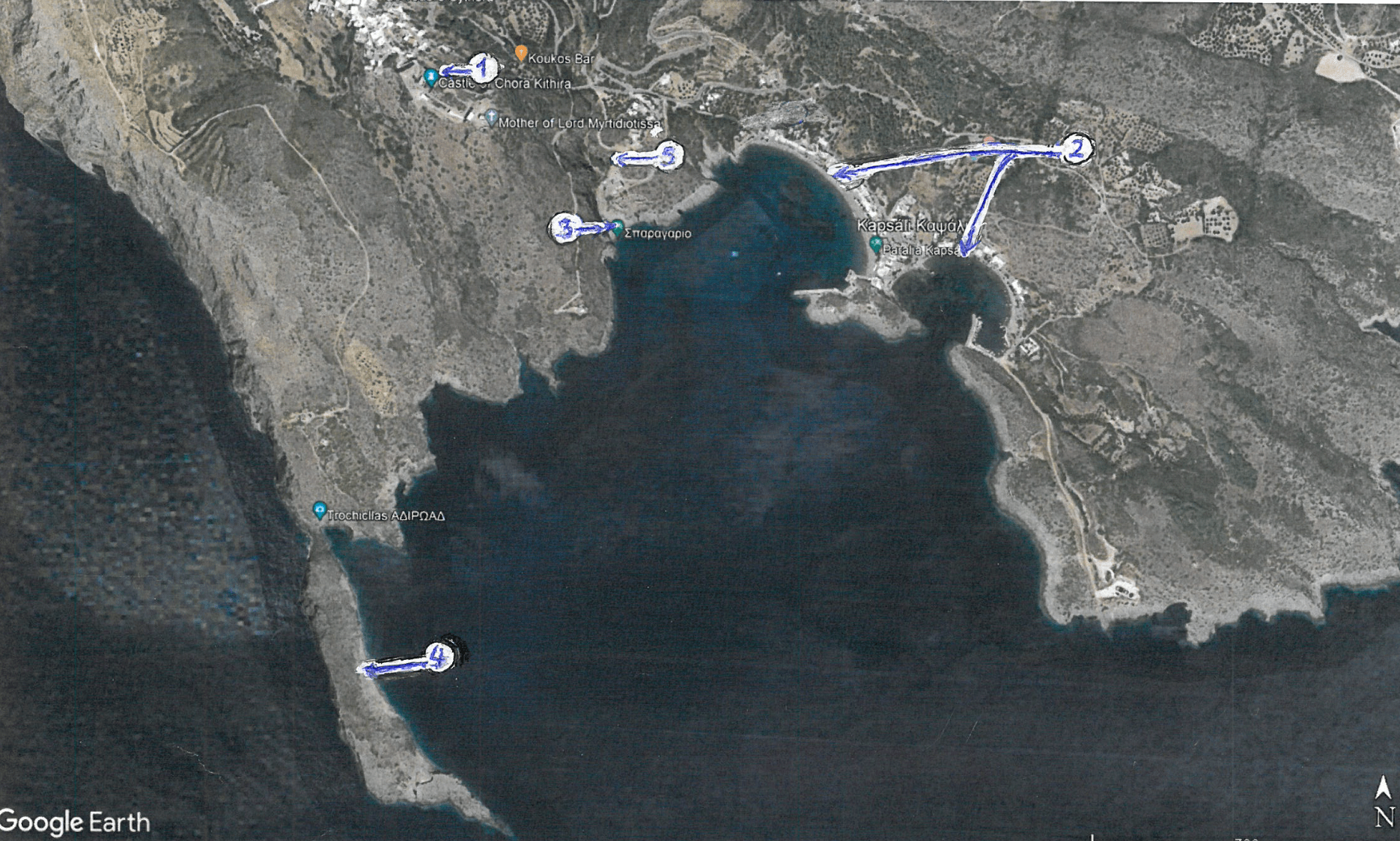
With regard to Kythira, and specifically the location of Kapsali, the port of the current capital, Chora, on Kythira, I am attaching an aerial photograph of the Kapsali area from GOOGLE EARTH. (attached 2.)
This aerial photograph shows the following:
- ⦁ The tower (palace) of Alcinous, king of the Phaeacians (a man of high
intelligence quotient – IQ)
- ⦁ The (twin) ports where Nausicaa, daughter of Alcinous, says to Odysseus:
«Follow me, and I will show you the way, until we reach the city, where the tower stands tall and has two good harbors on either side» (Rhapsody 261–263).
- ⦁ The river where Odysseus was saved and found half dead by Nausicaa: «But when he reached the mouth of the river, which flowed beautifully, the place seemed most beautiful to him’ (Rhaps. 441–442) and where Odysseus says: »Have mercy on me, king, (Zeus) and I beg you – immediately he (Zeus) stops the flow, holds back the waves, – and spreads silence before him and saves him at the mouth of the river.« (Rhapsody 450–453)
- ⦁ The miraculous ship of the Phaeacians, which carried Odysseus to Ithaca, was transformed by the god Poseidon into a mountain that closed off the city of the Phaeacians in revenge, because they had helped Odysseus (whom he hated because he blinded his son, Polyphemus the Cyclops) to reach his homeland, Ithaca:
«And now I want the beautiful ship of the Phaeacians as it returns from its voyage, in the dark seas, and I will strike their city with’ term to close» (Raps.k ́ 149 – 152).
A notable feature of the Odyssey is Homer's reference to the palaces of kings, such as Menelaus' palace in Sparta, which Odysseus' son, Telemachus, saw when he visited Menelaus seeking information about his father: Telemachus, when he visited Menelaus seeking information about his father:
«Dearest, consider, my sweet Nestorides (son of Nestor), in the joyful halls how the bronze glitters, the amber, gold, ivory, and silver. (Rhapsody 71–73).
We come to the present day, where, according to recent excavations in ancient Sparta, the temple of Chalciocous Athena was discovered, which was lined internally with copper sheets (plates). From this, we conclude that Menelaus' palace, which was located next to this temple, had the same copper decoration, as described by Homer.
Homer, however, describes the palace of Alcinous, king of the Phaeacians, in exactly the same way when Odysseus was hosted there:
«Odysseus stood before Alcinous, on the brightly lit roof... in front of the bronze threshold... that the walls were made of solid bronze, above the threshold, as inside, and surrounded them with a steel wreath (a ring of blue crystals all around) the well-built building had golden doors, the doorposts were silver on the bronze threshold, the lintel (transom) was all silver, the ring (handle) was gold’ (Raps. 83-90).
The conclusion that can be drawn is what archaeologists today report, that Kythira, Argos, Sparta, Corinth, and Mycenae shared a common culture and the decorative elements of their palaces were similar, with the predominant feature being the covering of their walls (made of poros stone) with copper sheets (engraved with images) and fastened with bronze nails. All of these were found in the ancient temple of Chalkeoikou Athena.
Let us now turn to Apollonius of Rhodes.
In the Argonautica, Apollonius of Rhodes describes the same route taken by the Argo as that taken by Odysseus' ships from north (Hyperia) to south (Scheria) as follows:
«Passing quickly through the sea waves, they saw the Tyrrhenian coast of Ausonia and arrived at the famous port of Aias, where they moored the ship's oars – on the nearby mainland they found Circe.» (Argonautica, lines 660–663)
Then: «A gentle breeze pushed the ship forward, and soon they saw the beautiful island of Anthemoessa (south of Corfu), where the melodious Sirens, daughters of Achelous, after enchanting anyone who passes by with their sweet songs, they kill them» (Argonautica, lines 891–894)
Then: «Saddened, the men left the Sirens, but other, worse dangers, disastrous for their ship, awaited them at the point where the seas meet. Indeed, on one side loomed the smooth rock of Scylla, and on the other, Harboudis roared, spewing water.» (Argonautica, lines 920–923)
«The men, moreover, as before, quickly passed through the meadow of Thrinakia (Lefkada), where the oxen of Helios were fed» (Argonautica, lines 964–966).
Then: «At the passage (end) of the Ionian Sea there is a fertile island in the Kerunia Sea, with a port on both sides, (twin) and nearby is the sickle, as they say... out of love for Makri° from which it took the name Drepanis, the sacred nourisher (nymph) of the Phaeacians» (Argonautica verses: 982 – 991)
Also, there on the island of the Phaeacians: «Where Jason found his companions armed and alert beside the ship (Argo) in the port of Illus, near the city‘ (Argonautica verses: 1.124 – 1.126)
Then:
Apollonius of Rhodes refers to Scheria as the island of the Phaeacians, where Jason and Medea found refuge on their return from Colchis, where they had taken the Golden Fleece. Jason and Medea were hosted by King Alcinous himself on the island of the Phaeacians, where on the first night of their marriage they «came together» in a cave:
«They prepared the bridal bed of their daughter (Medea) in the sacred cave where the nymph Makri once lived... so she went to stay in the sacred cave of the Phaeacians... the cave where, spreading out the fragrant veils, they united these two is still called today the sacred Cave of Medea» (Argonautica verses: 1.131 – 1.154)
Note: In Christian times, the church of Saint Catherine was built at the entrance to this cave.
A decisive factor, among others, is an excerpt from the Argonautica that provides the final answer as to whether Corfu or Kythira is the famous island of the Phaeacians, where Arete, wife of King Alcinous, says to him:
«Yes, my beloved, save the tormented daughter (Medea) from the Colchians, do the Minyans a favor. Argos is close to our island.»
(Argonautica verses: 1,073–1,075)
Note: This raises the reasonable question: Which island is closer to Argos by sea, Corfu or Kythira?
The final conclusion, therefore, is that the narrative of both Homer and Apollonius of Rhodes about which island hosted Odysseus, Jason, and Medea was Kythira, specifically the location of Kapsali, and not Corfu, as has been erroneouslyand without any evidence.
CONTENTS:
Attached graphs (1) and (2). ⦁ Bibliography:
Odyssey volumes (A) and (B) translated by Iakovos Polylas from National Geographic
Argonautic expedition of Apollonius of Rhodes, published by KAKTOS
Ioannis Sp. Douskos
Civil Engineer – Researcher, Poros – Troizinia
email: douskos_i@yahoo.gr