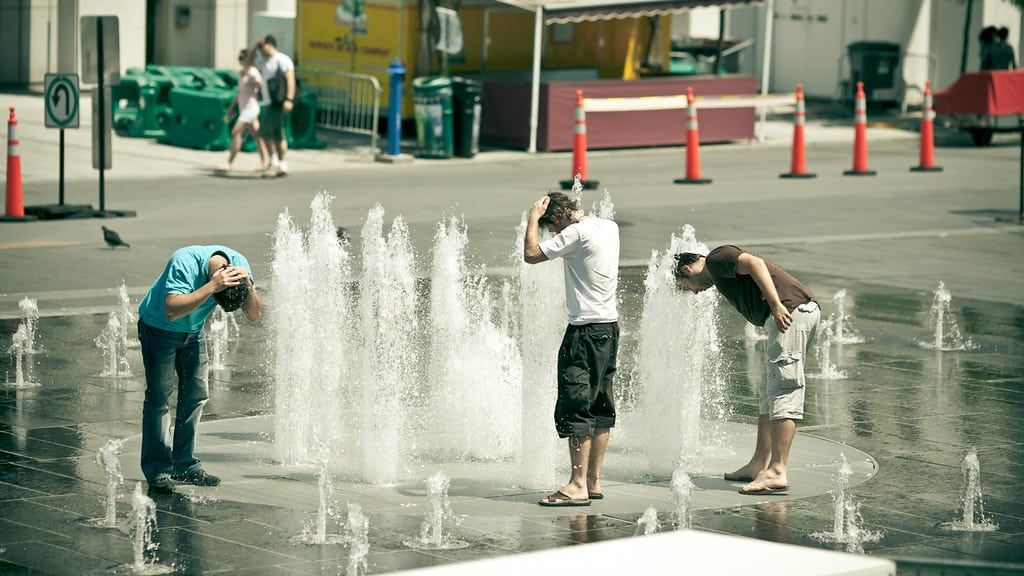
The extended high pressure field covering the coast of Africa and the Central Mediterranean and accompanied by very warm air masses is gradually expanding eastwards and will cause very high temperatures in our country from today until Friday. The highest temperatures will occur in the interior of mainland Greece, mainly in the central and southern regions, in areas not affected by the sea breeze.
According to the Emergency Weather Bulletin of EMY
1. Today, Tuesday, high temperatures will prevail mainly in the central and southern continents. The maximum temperature will reach:
a. in the northern mainland 36 to 37 degrees Celsius and in central Macedonia 37 to 38 degrees Celsius.
b. in western Sterea and western Peloponnese 36 to 39 degrees Celsius.
c. in eastern Sterea, Thessaly and eastern Peloponnese 39 to 40 and locally 41 degrees Celsius.
d. 34 to 36 degrees Celsius in the island country, 37 to 38 degrees Celsius in the Ionian Islands and the Dodecanese and 39 degrees Celsius in the interior of Crete.
2. On Wednesday (12/6) and Thursday (13/6) temperatures will peak both in terms of maximum and minimum values.
α. In the northern mainland the maximum temperature will reach 38 to 39 degrees Celsius and in central Macedonia locally 40 degrees Celsius, while the minimum values will be around 25 to 27 degrees Celsius.
β. In western Sterea and western Peloponnese the maximum temperature will reach 38 to 40 degrees Celsius and in Thessaly 41 to 42 degrees Celsius with minimum values of 26 to 28 degrees Celsius.
c. In eastern Central Greece and eastern Peloponnese 41 to 42 degrees Celsius and possibly 43 degrees in some places, while the minimum values will be around 27 to 29 degrees Celsius.
d. In the island country the maximum temperature will reach 35 to 37 degrees Celsius, in the Ionian Islands, the islands of the eastern Aegean and the Dodecanese 38 to 39 degrees Celsius, while locally in the interior of Crete it is likely to reach 40 to 42 degrees Celsius. The minimum values will be around 27 to 29 degrees Celsius.
ε. In Attica, maximum temperatures will reach 40 to 41 degrees Celsius in the interior and possibly 42 degrees Celsius on Thursday, while in the coastal areas it will be 3 to 5 degrees lower.
3. On Friday (14/6) the temperature will drop in the west, central and northern areas, but in the rest of the regions it will remain at very high levels, while from the afternoon hours a change of weather is expected in northern Greece with thunderstorms accompanied by strong winds.
α. In the northern mainland the maximum temperature will reach 34 to 36 degrees Celsius and in central Macedonia 37 degrees Celsius, while the minimum values will be around 24 to 26 degrees Celsius.
β. In the rest of the mainland the maximum temperature will reach 36 to 38 degrees Celsius, in the interior of Sterea, Thessaly and Peloponnese 39 degrees Celsius, while the minimum values will be around 25 to 27 degrees.
c. In the island country the maximum temperature will reach 34 to 36 degrees Celsius and in the islands of the eastern Aegean, the Dodecanese and the interior of Crete 37 to 39 and possibly 40 degrees Celsius while the minimum values will be around 27 to 28 degrees Celsius.
It should be noted that over the weekend across the country, the temperature will drop by 6 to 8 degrees and will return to normal for the season. At the same time, strong northerly winds will prevail.
Ministry of Interior: Measures for the protection of civil servants
Measures to protect civil servants, as well as the operation of public services, from today Tuesday to Thursday, described in a circular of the Ministry of Interior, after the announcement of EMU for an upcoming heat wave and after a meeting with the General Secretariat of Civil Protection.
In particular, for civil servants belonging to vulnerable groups, teleworking is foreseen. Where this is not possible, due to the nature of their duties, they may not be able to attend their service using special leave.
Their inclusion in the vulnerable groups shall be established on the basis of the relevant data already held on the staff member or in cooperation with the Office's medical officer or occupational doctor or on production by the staff member of a medical certificate from which the condition is clear.
For civil servants who do not fall into vulnerable groups, they will also be able to offer their services through teleworking, and where this is not feasible, flexible working hours will be applied. In particular, staff members whose duties require them to work outdoors will be required to use the personal protective equipment provided, and it is recommended that they avoid working during peak heatwave hours (12.00-17.00).
To avoid inconvenience to citizens, but also to protect their health, it is clarified that any appointments with public services scheduled during the peak hours of the heatwave, should be rescheduled with the care of the services.
In any case, all public services and public bodies must provide uninterrupted services to citizens and ensure their proper functioning.
Ministry of Education: Measures to protect pupils from the heatwave
In a circular sent to all education directorates, the Ministry of Education refers to a series of measures to be taken to protect students from the upcoming heatwave. The measures are addressed to both teachers and parents and aim to prevent health problems arising from children's exposure to high temperatures and the sun during breaks and/or PE lessons.
Ministry of Health: Pathological conditions caused by high temperatures and guidelines for their treatment
The Ministry of Health, in the context of its responsibilities for the protection of Public Health, reminds through a relevant circular with recommendations to citizens, issued on June 7, the necessary precautionary measures, especially for vulnerable people to deal with the heatwave.
When the ambient temperature rises to limits that are not tolerated by the human body in synergy with other factors (humidity, apnea, etc.), pathological conditions of varying degrees of severity are created. The initial symptoms may be: severe headache, weakness, feeling of being overwhelmed, tendency to faint, drop in blood pressure, nausea, vomiting and palpitations.
Heatstroke syndrome is manifested by: a sudden increase in body temperature ( >40.5o C ), red, warm and dry skin (sweating has stopped), dry swollen tongue, palpitations, tachypnea, intense thirst, headache, nausea, vomiting, dizziness, confusion, inability to orientate and speak clearly, aggressive or strange behaviour, convulsions, loss of consciousness or coma.
The treatment of people with the above symptoms, when the ambient temperature is high, should preferably be carried out in hospitals, but as first aid until they are taken to hospitals, body temperature reduction measures should be applied immediately:
Transport the heat stroke victim immediately to a cool, airy, shady place, preferably air-conditioned, complete removal of clothing, placing ice packs or cold patches on the neck, armpits and groin area, immersion in a cold water bath or shower or cold water spray, provision of small gulps of cool liquids (water or diluted fruit juice, 1 part juice to 4 parts water) if he/she can swallow, etc.
Who is at risk from high temperatures:
● elderly people
● babies and young children
● pregnant and breastfeeding women
● people who are overweight or obese
● people who work or exercise intensively in a hot environment
● people with chronic diseases (cardiovascular diseases, hypertension, diabetes mellitus, lung diseases, kidney diseases, hepatopathies, mental illness, dementia, alcoholism or drug abuse, etc.)
● people with an acute illness, such as an infection with fever or gastroenteritis (diarrhea and/or vomiting)
● people who for purely medical reasons are taking medication for their chronic illnesses, such as diuretics, anticholinergics, psychotropic drugs, hormones (including insulin and anti-diabetic tablets). Particularly during the period of high ambient temperatures they should consult their doctor for possible dosage modification.
General precautionary instructions:
● Staying in air-conditioned rooms.
● Dress light and comfortable with light-colored clothes made of porous material to facilitate body ventilation and sweat evaporation.
● Use a hat made of material that allows ventilation of the head.
● Use black or dark-colored sunglasses with lenses that protect against solar radiation.
● Avoid exposure to the sun, especially for infants and the elderly.
● Avoiding heavy physical work.
● Avoid long journeys by means of transport without air conditioning.
● Public transport should ensure that their air conditioning is in good working order to better serve the public.
● Many lukewarm showers during the day and applying cool patches to the head and neck.
● Small and light meals low in fat, with emphasis on fruit and vegetable intake.
● Drinking plenty of fluids (water and fruit juices), especially for infants and the elderly, and avoiding alcohol. If sweating is high, additional intake of small doses of salt is recommended.
● Persons suffering from chronic diseases should consult their attending physician, from whom they will receive additional instructions depending on their condition as well as instructions for a possible change in the dosage of their medication.
● Older people should not be left alone but should be provided with a person for their daily care.
● Work areas should have air conditioning units or simple fans, preferably ceiling fans, and in any case natural ventilation of the rooms. The same applies to institutions caring for newborns, infants, children, the elderly and people with disabilities.
Particular attention when high temperatures are combined with increased air pollution
Particular attention should be paid when high temperatures are combined with phenomena of increased levels of air pollution.
Specifically:
● In case the ozone limits in ambient air are exceeded, the Ministry of Health has issued relevant instructions for informing the public with precautionary measures especially for vulnerable population groups, which are as follows: «Persons with respiratory and cardiovascular diseases and persons sensitive to air pollution in general are advised to stay indoors and avoid movement in the outdoor environment. It is also recommended that these people and children should avoid strenuous physical exercise, which can cause irritation of the respiratory tract and lead to respiratory problems.
● For the protection of public health from particulate matter (PM10), the Ministry of Health has issued relevant circulars. On the following website of the Ministry, recommendations for information and precautionary measures for the public are posted on any day of the year when concentrations of particulate matter are exceeded, from which the public can be informed: www.moh.gov.gr/articles/health/dieythynsh-dhmosias-ygieinhs/ygieinhperiballontos/prostasia-poiothtas-aera/3005-systaseis-gia-thn-atmosfairikhrypansh