The Greek, when he does not know history, he imagines it. And when he imagines it, he wants it to be comforting. To have a good father, a little Panagia, and a lot of national jubilation. This is how the cinematic Kapodistrias emerges, a ruler without a government, a politician without a policy, a European without Europe. No historical narrative is so persistently advertised unless it serves something beyond art. The film Kapodistrias was not just promoted as a film project; it was promoted as a national duty. Its over-promotion, its public appearances, its ritualistic viewings by the political leadership, function not as aesthetic judgments but as political signals. When power goes in an organized way to «see» a film, it does not see, it validates. The Prime Minister's presence in the hall was not of a private nature. It was a symbolic act. The state recognized in the myth itself. Power was bending over the screen and seeing what it needed, a history without social contradictions, a past sanctified, a leader stripped of political conflict. Art, thus, does not control power, it reassures it. And on the other hand, advertising is not neutral, it is a form of producing consensus. The weaker the social narrative of the present, the noisier the idealization of the past becomes. The film doesn't fill a historical void, it fills a political one. And for that it needed state affection, television over-promotion, almost national affirmation.
The Kapodistrias of the film is the ideal leader for any power that fears politics. He governs without society, decides without class subjects, is legitimized not by history but by the transcendent. A leader who is not confronted, not questioned, not explained. He is simply blessed.
The confluence of artistic myth and state projection reveals something deeper, that the film does not address historical memory, but collective insecurity. It does not ask for understanding, it asks for faith. And where it asks for faith, politics has already been withdrawn.
But history does not need prime ministerial visions to exist. Nor does it need advertising campaigns to stand. When a work of art needs the stamp of power to be legitimized, then we are not talking about memory but about ideological use of the past.
Kapodistrias does not belong to any political office, nor to any cinema iconostasis.
It belongs to history and history is not applauded. It is analysed.
The real Ioannis Kapodistrias was one of the most important European diplomats of his time. He was the Tsar's Minister of Foreign Affairs, a man of the Holy Alliance, i.e. the European counter-revolution. And very sensibly so, because people had a habit of overthrowing regimes. He didn't believe in revolts, nor in popular self-activity. He believed in order, in administration, in the state from above. Not because he was «evil», but because that was the political logic
of the class he served He was no more a traitor than he was a hero. He was what we call a practitioner of power.
And the viewer? The viewer is moved. Not because he learned something, but because he recognized what he already believed. That we once had a saint who would have saved us if the evil Greeks hadn't ruined him. An old story. We always tell the same one, so we don't have to explain why our state was born crooked, dependent and fearful.
This is where the problem usually starts, the Greek wants his political heroes to be revolutionaries and his revolutionaries to be politicians. If it doesn't work out, he makes them saints.
Kapodistrias' relationship with the Society of Friends and the Revolution was hostile. He considered it dangerous, premature, incompatible with the balance of Europe. And he was right, not morally, but politically. Europe at that time did not tolerate revolutions.
This is exactly what Kapodistrias knew and this is why they trusted him.
When he came to Greece, he came as a ruler, not as a redeemer. He found a society in tatters, with local interests, armed factions and a non-existent state. He tried to impose centralized administration, to organize the economy, education, and the public apparatus. And to achieve this, it clashed. It restricted, imposed, ignored. He did not rule democratically, he ruled effectively, by the standards of his time.
The state, you see, is not built with incense. It is built with paper, taxes and orders. That's why it's never likeable.
These aspects are almost completely absent from the film. Politics disappears and is replaced by metaphysics. Europe is missing, class conflicts are missing, administrative violence is missing. Instead, we have visions, religious symbols and a narrative that is more like a catechism than a historical work.
But cinema, however, does not love problems. It loves images. So instead of politics, it gives us incense. Instead of European diplomacy, it gives us visions. And instead of history, it gives us national indoctrination. Not because that's the way things were, but because it's easier to digest.
It is not just an artistic choice. It is an ideological function. When history is stripped of its material conditions, it becomes a myth. And myth is always more useful than truth, because it is not disturbing.
The great appeal of the film can be explained right here. The majority of viewers are unaware of who Kapodistrias really was and what his place was in the European political scene. They do not know the Holy Alliance, nor the logic of empires. Thus, the cinematic myth works as a history lesson easy, touching and harmless.
The truth is tiring. It takes reading. The legend is seen in two hours and makes you leave moved.
The political management of the film was no accident. The deliberate distance of power, the absence of which acted as a communication policy, shows that the myth was deemed useful but dangerous if fully adopted. For the film's Kapodistrias is not just a past is a proposal for the present. The stern, paternalistic leader who rules «for our own good» without social mediation.
The Kapodistrias of the 21st century does not need to exist in reality. He only needs to exist as an image. As a reminder that «we were once governed well» and therefore we can govern like that again, if we keep quiet and trust the experts.
The real Kapodistrias, however, was dangerous. Not because he was a saint, but because he was a power. And power always clashes. Anyone who turns him into an icon does not honor him. It disarms him.
History is not written to comfort us. It is written to remind us that nothing was inevitable and nothing was given away. When we turn it into a myth, we do not save the past. We protect the present from criticism.
And that, after all, is the real point of the film.
History, when it becomes an image, ceases to be dangerous. It becomes a decoration.
If Vassilis Rafailidis had written it, he would have said it bluntly:
«when people don't know history, they are served myth. And in HD.».
It would remind us that no ruler falls from the sky, nor does he rule in a vacuum. He governs on social contradictions. He takes a stand. And Kapodistrias' position was clear, with the European conservative order, against any revolutionary dynamics born from below.
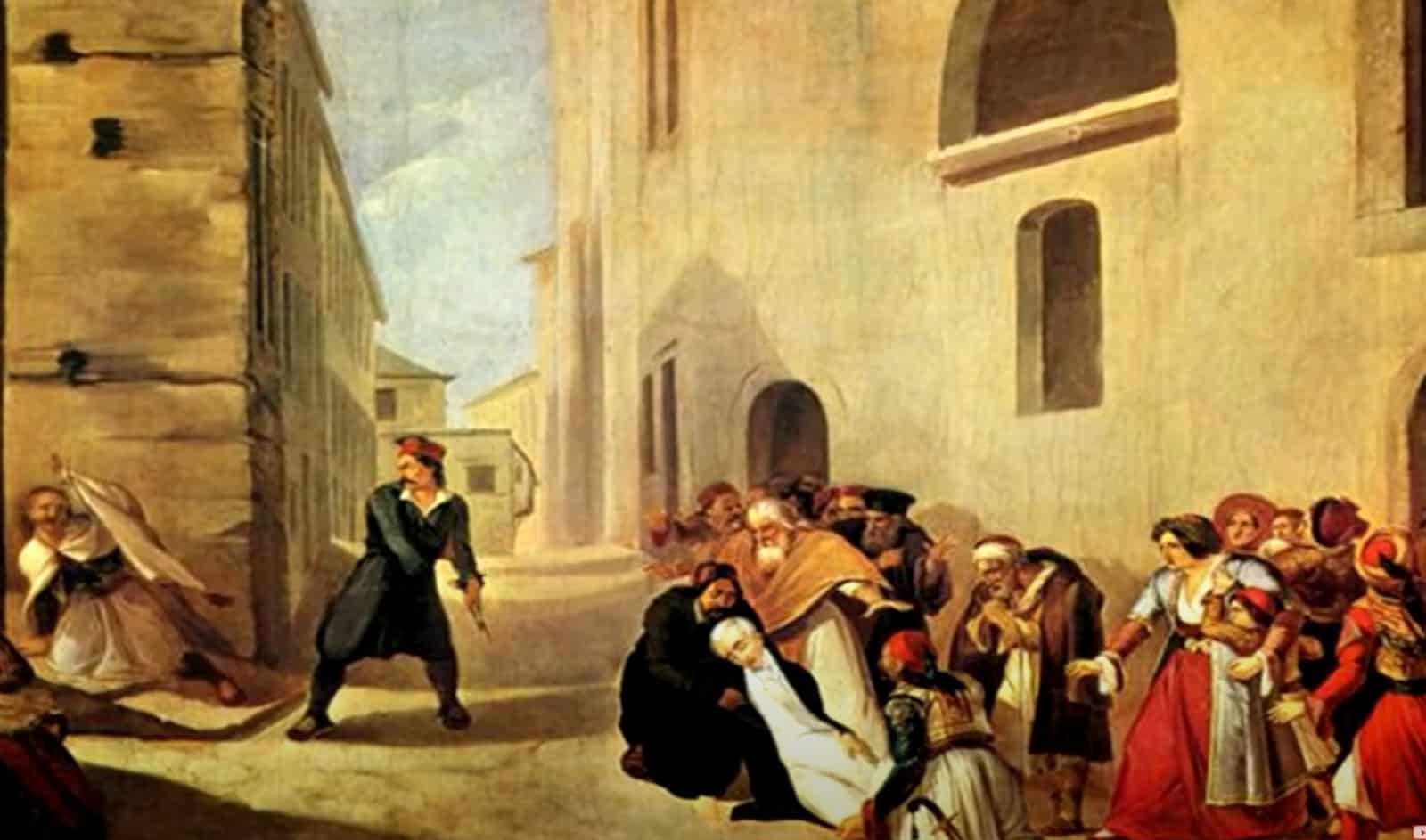
That is why his murder was not just a ’national tragedy“. It was a conflict of interests, a civil conflict of power, the result of a state set up without social consensus, without participation, without political democracy.
But these spoil the narrative.
And the narrative today is valuable. The film about Kapodistrias wasn't just shown. It was advertised. As a product of national emotion, as a safe haven for a society tired, frightened and confused. It was no accident that Mitsotakis went to see it. Nor was it his «personal choice», as the press release would have said. It was a political act. Communicative. Measured because Mitsotakis - and any modern administrator of power - would love to be the Kapodistrias of the 21st century. A leader who “knows best”, who governs with technocratic certainty, who bypasses the popular will in the name of saving the country.
It's not a coincidence. It's political continuity.
The Prime Minister's absence from the real, living society and his presence in the cinema hall is not symbolic. It is a communication strategy. Where history does not answer, only touches. Where there is no contradiction, only background music.
Because the truth is binding. It limits you. It forces you to take a stand. To see who had power, who didn't, who benefited and who paid. But the lie - the well-crafted lie - you can do with it what you will. Dress it up as patriotism. Make it into a movie. Give it a standing ovation. And so, instead of learning what Kapodistrias was, we learn what it takes today for the powers that be to believe he was. History is not a memorial. It is a battlefield. And anyone who presents it without conflict, without classes, without society, is not honoring it - he is using it.
And as Raphaelides would say, with that smile that hurts more than a complaint, «when history becomes a fairy tale, some people put the people to sleep so that they can work undisturbed».