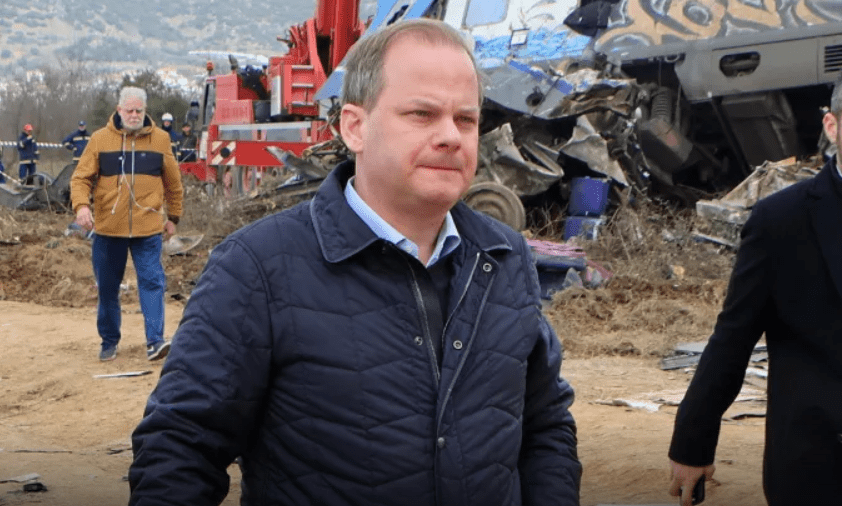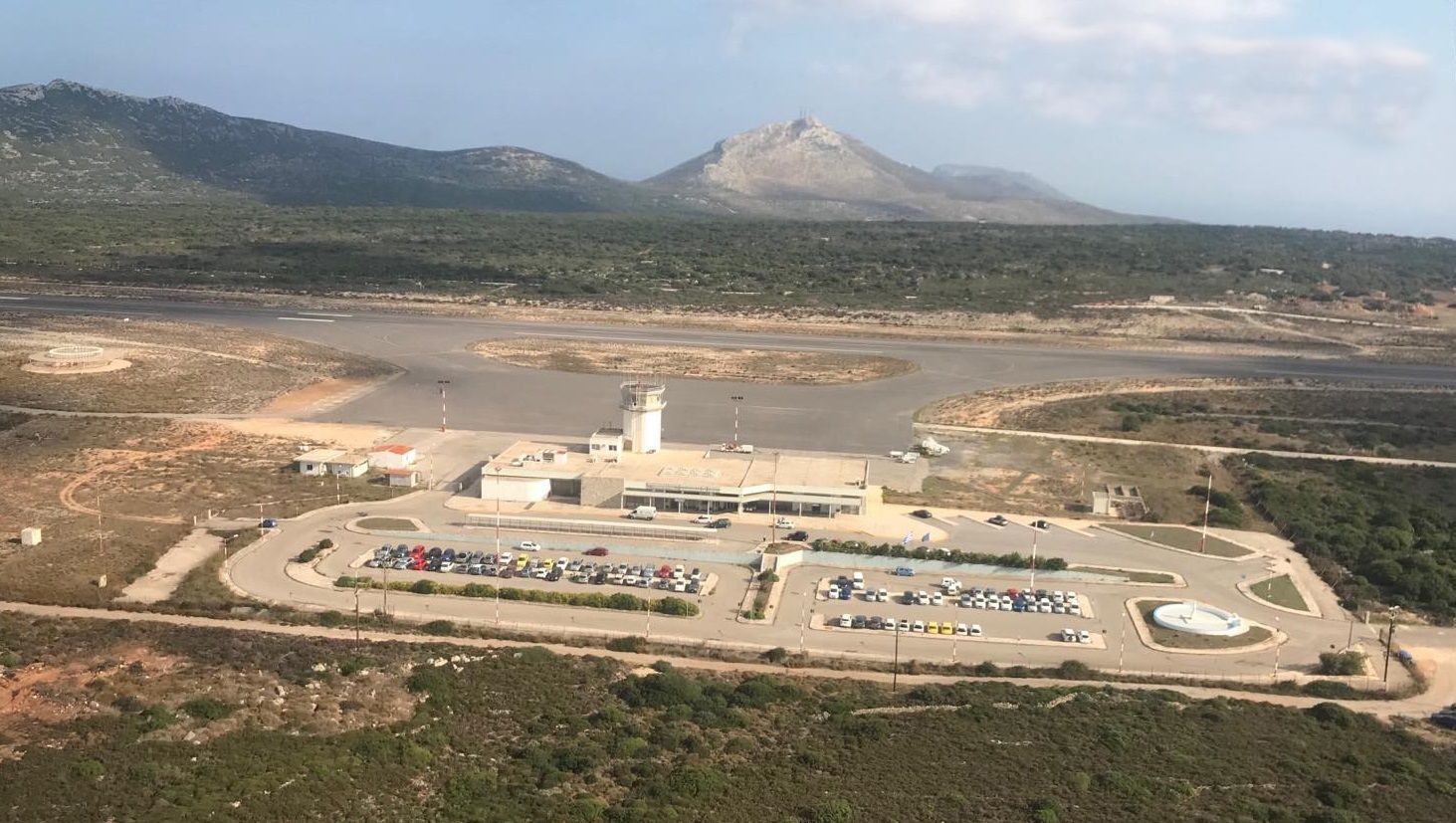
And while we are still counting the victims of the crime on the railway tracks in Tempe, more and more problems, which some people tried to hide under the carpet, are coming to the surface. The regional airports in Greece, owned by the Greek State, are left in the control of a man, aged 60+, whose shift is ... 24 hours a day. The deficiencies are tragic: broken fences resulting in animals walking on the runway at landing time, frequencies that do not work, transponders that are out of order.
of Georgia Kriembardi
The Panhellenic Telecommunications Association of Greece is responsible for the safe operation in 15 airports, so that flights can be made safely to the most remote parts of the Greek territory. There are 15 of the 22 airports that use the AFIS service, but the Association is responsible for controlling the other seven.
The President of the Panhellenic Telecommunications Association (FISO) Y.P.A. spoke to TRP about the understaffing of the sector and the bells that have been ringing for a year and a half with the administration and the ministry turning a deaf ear. The industry, which includes the small-fringe state airports where the AFIS flight information service is provided, is understaffed, «with the result that people are now exercising this responsibility alone 24 hours a day.».
These are the 22 airports under the control of the Greek State, as the largest regional airports have already been transferred to Fraport. These are airports that currently have more traffic than their controlled counterparts. «We are talking about to Paros, Naxos, Milos, Karpathos, Syros...» he points out, explaining the obvious: «It is dangerous that the shift is done by an employee, plus he's doing the activations for the airlifts. His job is similar to that of the controller at the control tower, i.e. he gives instructions on the situation on the airport site, the condition of the runway, the meteorological conditions, etc.».
The shortcomings are many. Shortcomings that make flying dangerous. «The airport perimeter fencing, at many airports, is broken. Think, animals are passing by during landing... Also, in many airports the frequencies do not work and others the transponders are in trouble, as for example at this moment in Leros» he says and explains: «The airport in Leros is in the mountains. In order to be heard by an aircraft that is some miles away, you have to come down a little lower and because the transponder doesn't work in the mountains, you have to have a visual contact to communicate with the plane.».
The problems are well known. «We have mentioned all this many times for a year and a half now the problems in the administration and the ministry. Having an employee on duty 24 hours a day is a ticking time bomb,» he says.
Typical announcements of the Association are the following:
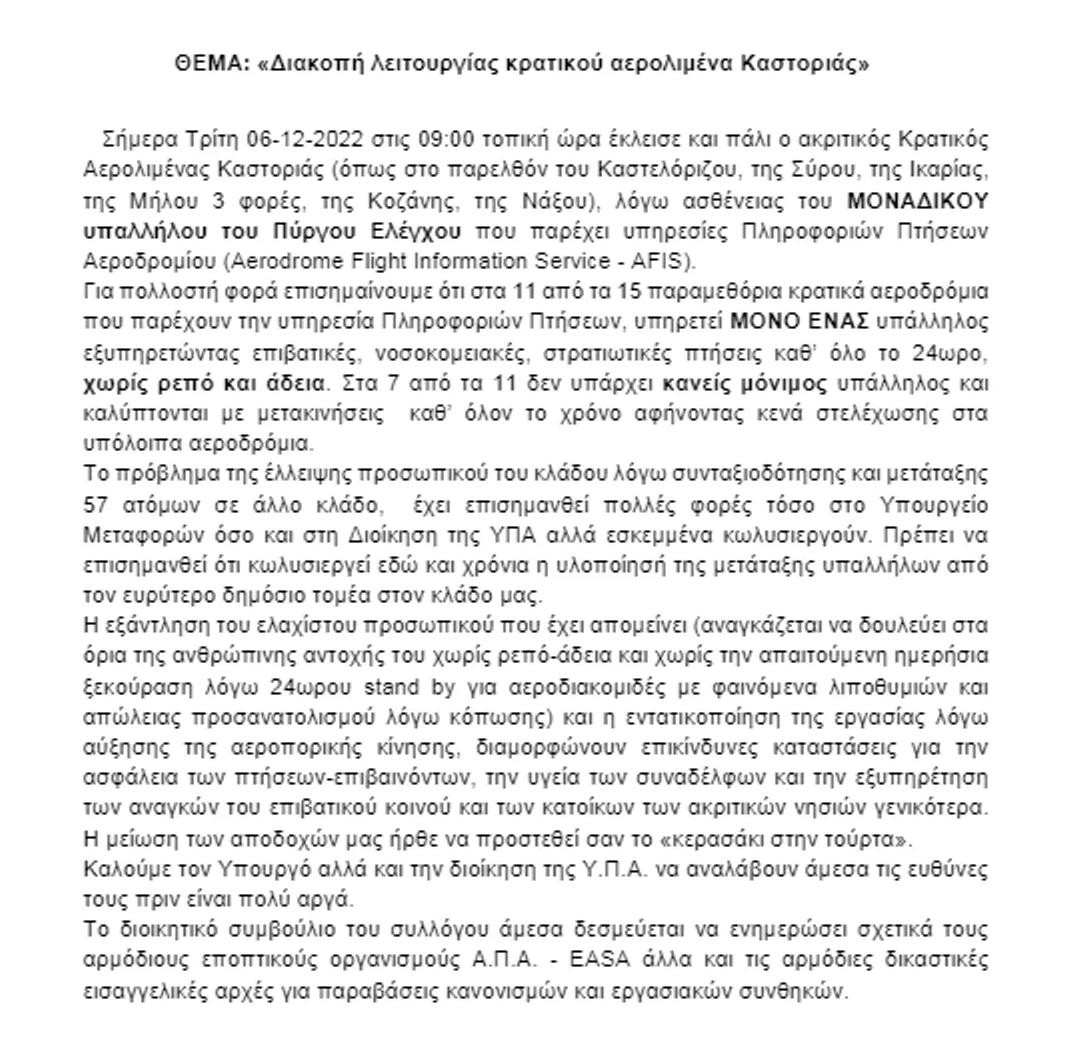
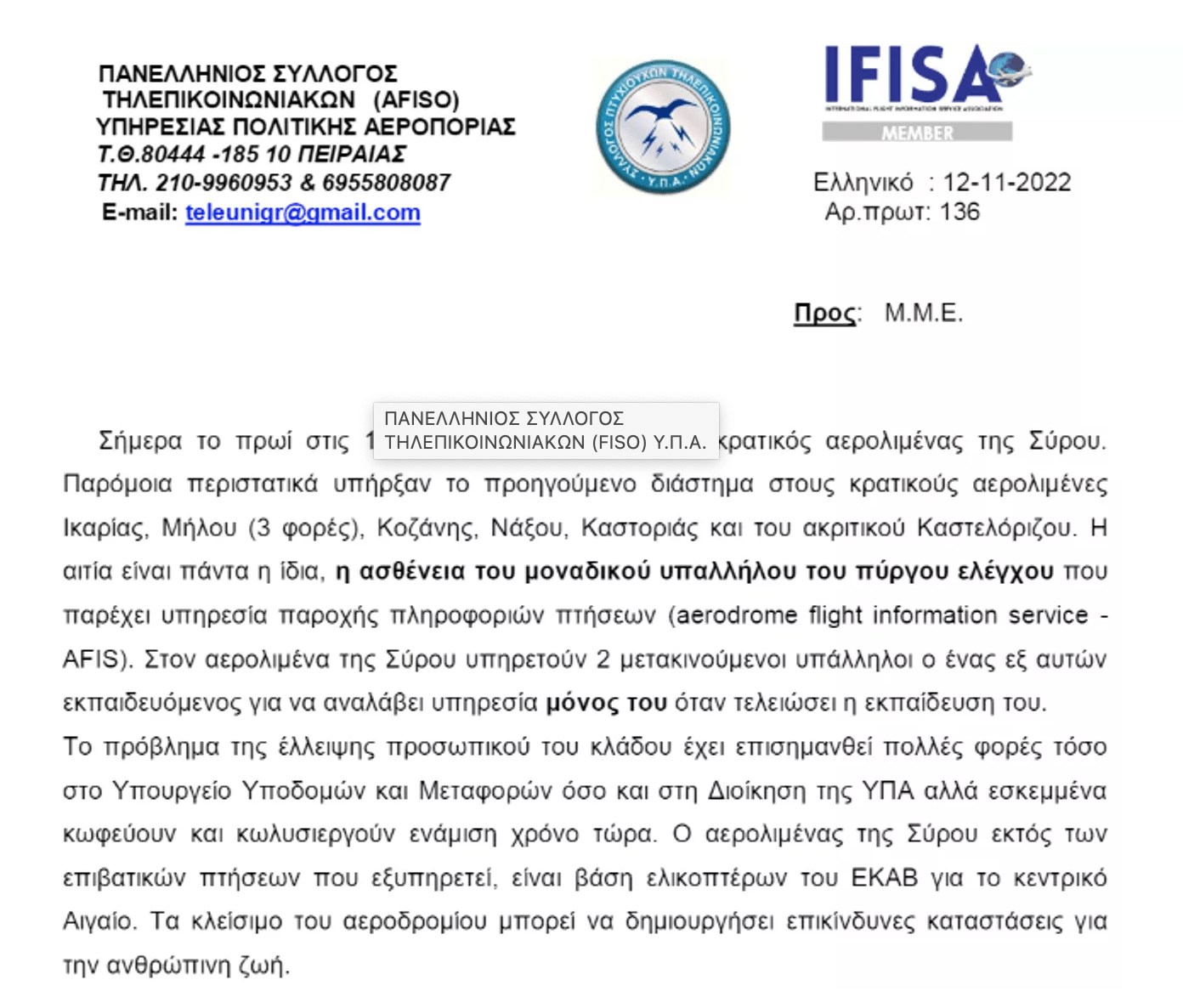
A group of SYRIZA MPs raised the issue with a question in Parliament.
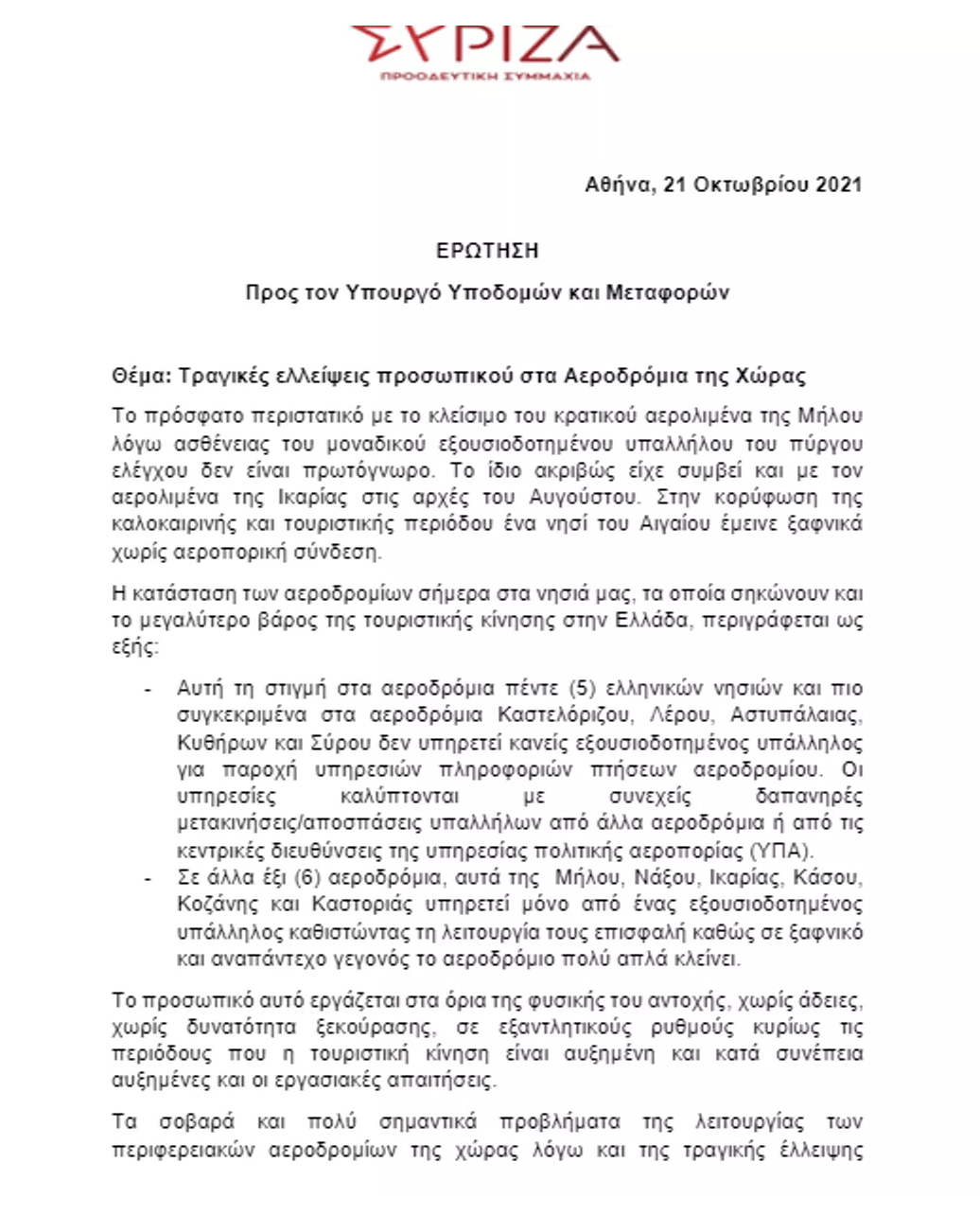
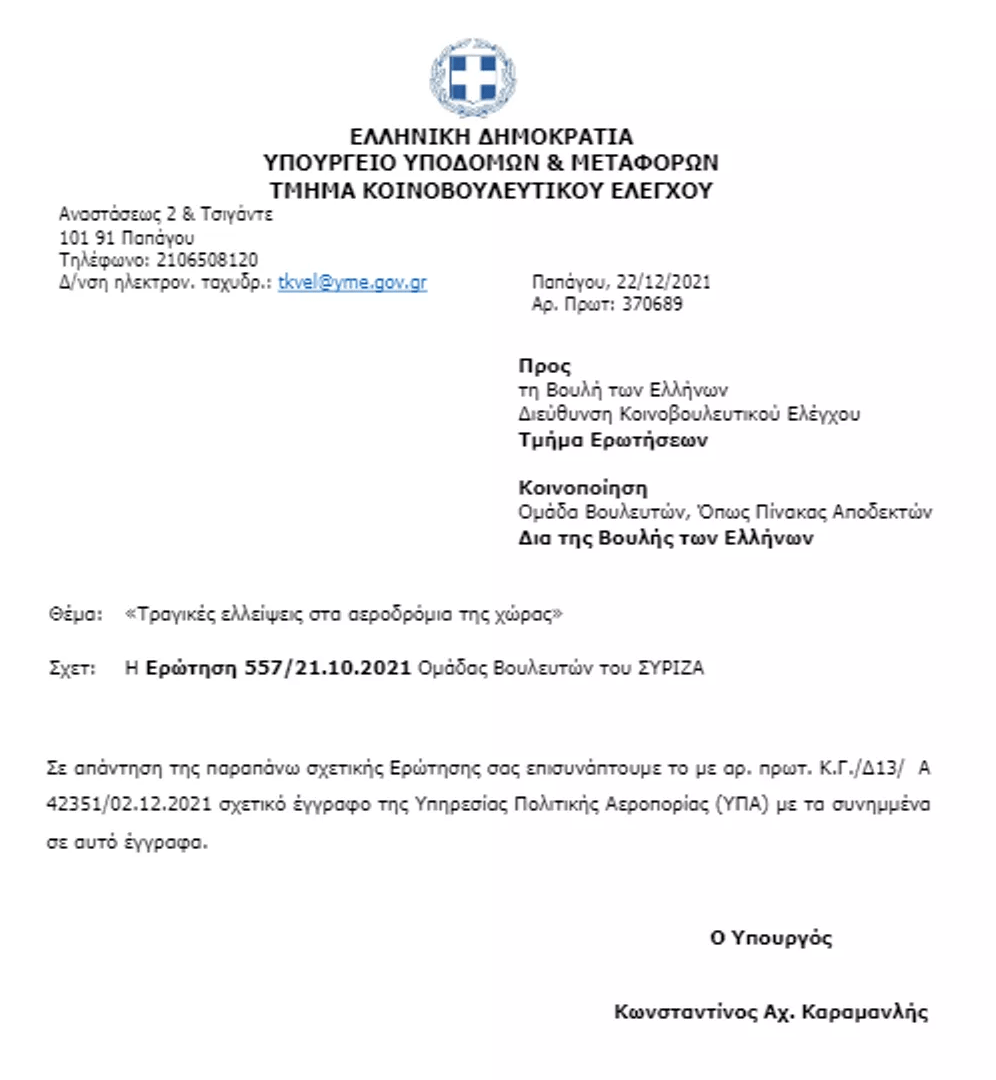
And a group of KKE MPs tabled a question in Parliament in 2021. Here is an excerpt:
«Regarding the understaffing of airports for AFISO, we mention as an example:
- At the airports of Leros, Kastelorizo, Astypalea, Kythera, although the presence of 2 authorised officials is required, none is on duty.
- At Kozani Airport there is no authorised official, while it is necessary to have at least 4 more.
- At Syros Airport, there is 1 employee, while it is necessary to have at least 2 more.
- Naxos and Milos Airports each have 1 employee, while it is necessary to have another 1 employee for the winter months and at least 2-3 others from April to October.
- At Ikaria Airport, there is 1 temporary employee (expected to be transferred to another sector), while two are required.
- At Paros Airport, there is 1 temporary employee (expected to be transferred to another sector), while 2 are required for the winter months and at least 3-4 from April to October.
In all these cases, the needs are covered by the constant movement of staff from airport to airport. Employees are forced every day and without interruption, even on public holidays, to work until they are exhausted, without days off and without leave, to be constantly on 24-hour standby for emergency activations, in some cases even for air ambulances, to the point where they themselves cannot even get sick.
Also, the salaries of AFISO (Airport Flight Information Service) employees with «EUROCONTROL» decreased from 6% to 3%, despite the increase and intensification of employment. Almost all regional airport employees are not granted regular leave.
To ask the Minister what steps the Government will take so that:
- To immediately and permanently reinforce the Airports with sufficient trained personnel to perform the Flight Information task at the Control Towers and with personnel for the other necessary specialties in order to ensure the smooth flow and safety of flights.
- Remove the wage payments for industry workers, as promised from the floor of parliament.
The Members of Parliament - Komnenaka Maria, Manolakou Diamanto, Stoltidis Leonidas»
Misery before privatisation
For seven years they have been increasingly impoverishing the service in order to privatise it. This is what sources in the industry, who wished to remain anonymous, tell us. Since the end of 2022, it is clear that a privatisation plan has been out for the 22 Regional Airports, with a horizon of 2023.
The largest 14 regional routes were transferred to Fraport in 2015. At TPP, from the company's press office, came the following comment: «Within the framework of the signed concession contract, Fraport Greece, as it should, is continuing the projects to further enhance the already high level of safety of the 14 airports, following the new standards set by the European Aviation Safety Agency (E.A.S.A.). Similar works are currently being carried out at Corfu Ioannis Kapodistrias Airport, Santorini Airport, Rhodes Diagoras Airport, etc.» The company added that «these airports owned by our company operate under very different conditions, they are controlled, there are no such problems».
Speaking at the annual conference of the Association of Greek Tourism Enterprises (SETE), the former Minister of Infrastructure and Transport, Costas Karamanlis pointed out «the risk of Greece having two-tier airports», those owned by a private company and those owned by the CAA. «Because this government has no idealism, our intention is that these airports too should be developed and modernised,» he said of the 22 state-owned airports. He had said that the model being considered is that of PPP (Public Private Partnership) as these are airports with less passenger traffic. «We will see which other airports can also be concessioned or use PPPs, where the state keeps the airport and management is given to private parties, so that these airports too can meet the critical work they provide.».
The workers are ringing bells. Misery before privatisation is dangerous. It endangers human lives. For years workers have been talking about the shortages that make flying dangerous and the Greek state continues to turn its back on the problem, leaving them at their mercy, underfunded.
Let's assume that from the beginning the plan was to gradually degrade these airports so that they could be privatized, as a «better solution» and some people would win. Does it have to be done in blood?;
Those who turn a deaf ear to the security issues raised, what do they expect? More accidents, and this time not on rails? And they'll still say they ... didn't know?;