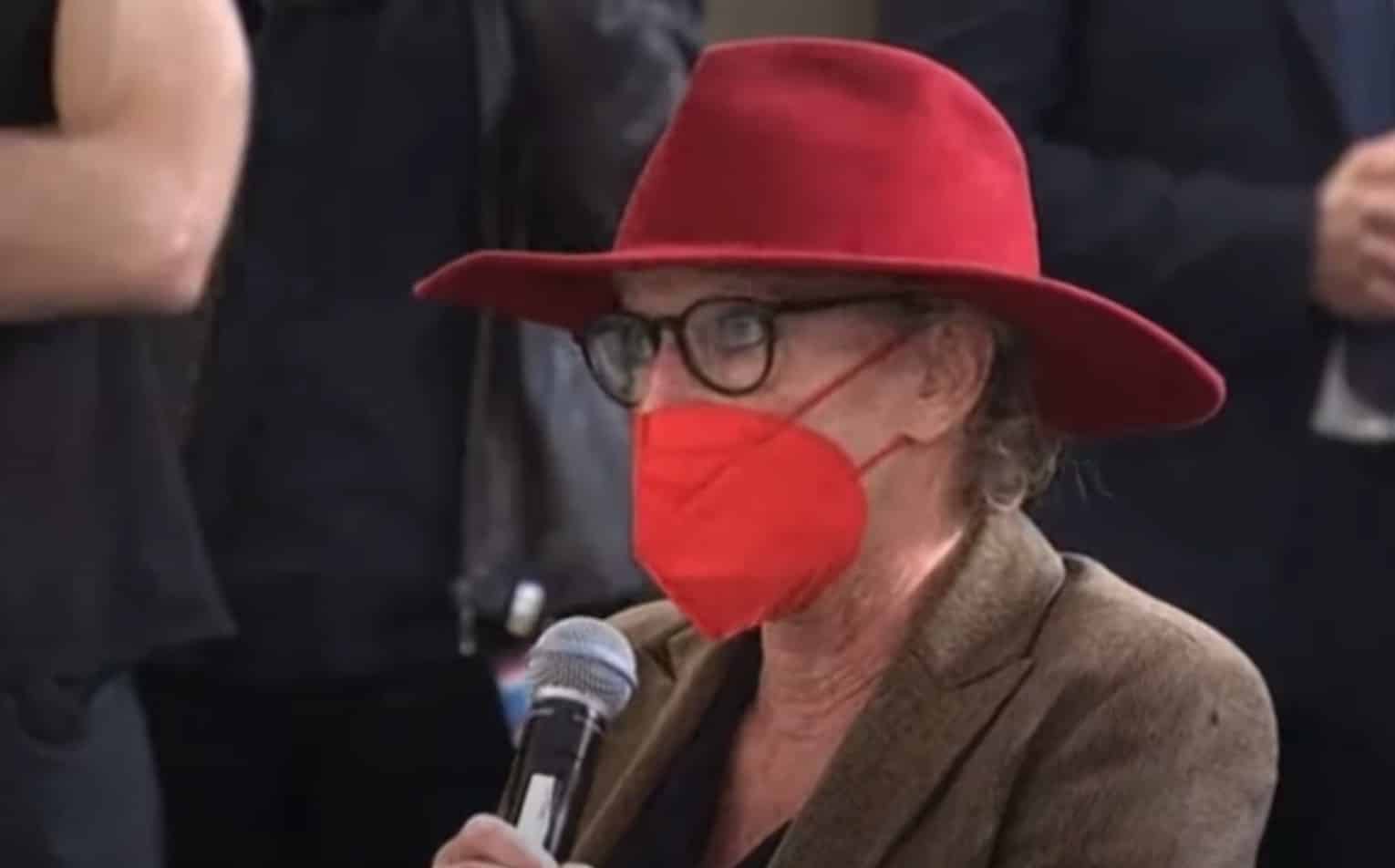
H Ingeborg Beugel is the woman who made us question once again the standard of journalism in Greece, as well as public discourse and its toxicity. In her case, Digital threats did not remain confined to keyboards, but were put into action.
Just a few hours after the question that angered the Greek prime minister, Kyriakos Mitsotakis, at a press conference with his Dutch counterpart, Mark Rutte, a man attacked the Dutch journalist, as she herself confirms in Magazine, After the frenzy of toxicity, threats, and insults against her, she is forced to leave Greece for the time being.
She confirms that her life became very difficult after the incident, which took on enormous proportions.
After her heated exchange with Kyriakos Mitsotakis, during which she accused him of lying about refugee returns, Beugel was at the center of attention for at least two days, with comments continuing and intensifying in recent hours.
As he says in Magazine, «I am leaving, following advice from the Dutch embassy, the Dutch Ministry of Foreign Affairs, and the Dutch Union of Journalists. My decision comes after the threats I have received. Right now, the country is not only engaged in a “postmodern” digital witch hunt, but also in actual witch burning. I couldn't read all the comments about me,“ he tells us, and continues:
“I have experienced incredible hatred and vindictiveness. They sent me personal messages saying they would throw me into the sea to drown like the migrants, or send me to Turkey to be raped. I don't want to read any more of this stuff, it's killing my soul.”.
Regarding the violence against her, she tells us:
«That evening, after the press conference, I hadn't yet read what had been written about me. You know, it was chaos. Everyone wanted to interview me. But I didn't want to read all that poison and sexist drivel on social media. At around 11 p.m., I put on my hat and went for a walk. As I was returning to my apartment in Metaxourgeio, a man recognized me, bent down, picked up a stone, and threw it at me, hitting me in the head. I didn't stop to see who it was. My lawyer has reported the incident to the authorities.
Regarding her hat, she even tells us that “I didn't know it had become such a symbol. On the one hand, a symbol against pushbacks, on the other, of those who call me a Turkophile.”.
Continuing on the subject of the threats she receives, Ingeborg Beugel emphasizes that can no longer go out of her house without fear. «I can no longer go out on the street alone, I can't go to Hydra, to my home. The government is aware of all this, but no one has contacted me. On the contrary, we see a huge smear campaign by the media that is close to the government. They constantly write lies about me, such as that I have Pakistani servants in my house. These are unbelievable lies.».
Then came the lawsuit from the mayor of Hydra, George Koukoudakis. «This is the second lawsuit against me,» says the reporter. “What is worrying here is that the lawsuit is based on the grounds that he is allegedly anti-Greek.”.
She also states that, being in Greece, her question should, according to etiquette, concern the Greek government.
«In Turkey, Turkish journalists and foreign press correspondents must do their job by monitoring the government there. The same should apply in Greece. After all, we have known for years what Turkey is doing in terms of migration, exploiting people; it is not a taboo subject. On the other hand, what the Greek government is doing in terms of migration is a taboo subject. And the greater the taboo, the greater the reaction you will face when you break it.», he reports.
«Unfortunately, lies are currently ruling Greece, with very aggressive results.. However, there are also Greeks who saw me on the street and thanked me for what I did, encouraged me, and told me well done.
Finally, she refers to another Dutchman, her distinguished colleague, cameraman Albert Courat, who captured footage of the tank invasion of the Polytechnic on the night of November 17, 1973.
“At the Polytechnic, there was a Dutch journalist who captured images of the tank. At that time, there was no social media, but these images went around the world and made people outside Greece understand what was happening, weakening the regime and ultimately bringing it down. Older people who have met me remember this and come and tell me about it. They tell me that, in a way, what has happened to me now reminds them of the events of that time, when a Dutchman showed what was really happening in Greece.
Reporters Without Borders on Ingeborg Beugel: «Mitsotakis must condemn attempts to slander her»
The Reporters Without Borders denounce, for their part, the campaign being waged by pro-government media, which is even taking place on social media, against the Dutch journalist.
«When will you stop lying about pushbacks? Don't insult our intelligence. These are violent, barbaric pushbacks,» the journalist noted, among other things, in her question to Mr. Mitsotakis, and wondered «why Greece is not telling the truth, which is that Brussels has left it alone and that is why it is carrying out barbaric pushbacks?» and «why Athens is no longer knocking on the EU's door asking for the distribution of refugees?» She even noted that Greece and the Netherlands should be sanctioned for human rights violations.
After his initial surprise at the journalist's question, Kyriakos Mitsotakis denied what she had said and responded sharply: «You cannot come here and insult me. Am I clear?».
Following the intervention of the International Press Institute, Women in Journalism, and the Mapping Media Freedom observatory, Reporters Without Borders has urged Kyriakos Mitsotakis to “condemn the attempts to slander Ingeborg Beugel.”.
#Greece: @RSF_inter denounces the campaign on social networks & in pro-government media to discredit the Dutch journalist @IBeugel after she openly questioned @PrimeMinisterGR on migrant pushbacks. RSF urges Prime Minister Kyriakos Mitsotakis to condemn the attempts to smear Ingeborg Beugel. pic.twitter.com/aEpIB2T6kv
— RSF in English (@RSF_en) November 15, 2021
Finally, it is worth mentioning that in his response to Ingeborg Beugel, Kyriakos Mitsotakis avoided speaking openly about “pushbacks,” but admitted to the practice of “interceptions.”.
Ingeborg Beugel spoke of “lies about pushbacks,” stating her position as follows:
«Prime Minister Mitsotakis, when, at last, will you stop lying. Lying about pushbacks, lying about what is happening with the refugees in Greece?» referring to a report by the UN High Commissioner for Refugees from last June, which took a position on 21 incidents involving approximately 1,000 people.
In response, Mr. Mitsotakis said that the Coast Guard “intercepts” ships carrying migrants in the Aegean Sea, and that Greece has granted asylum to 50,000 people, including Afghans.
The prime minister used the word “intercepting,” and then insisted that the Dutch reporter had never been to Samos, even though she said otherwise.
In the transcript that was made public, the prime minister's statement is quoted as follows: “We are saving people at sea while at the same time, yes, we are not allowing boats coming from Turkey to enter our territorial waters, as is our right under European regulations, and we are waiting for the Turkish Coast Guard to come and pick up these people and return them to Turkey.”.
And I was the very first journalist with Dutch MEP @Tineke_Strik to visit the dreadful New Camp Zervou on Samos 🙂 Haha, in May 2021, with a photographer who took the first pictures ever: https://t.co/chp4o6BnVr Google Translate. This strange Denying, Lying, and Attacking: Narc Abuse ... https://t.co/NgcZSvXWWW
— Ingeborg Beugel (@IBeugel) November 9, 2021
About interceptions
We would like to remind you that the EP report on the protection of human rights and the EU's external migration policy specifically mentions interceptions at sea:
«It stresses that the EU's external policy on migration should not support interceptions at sea that result in people being returned to unsafe ports...
Calls on the Commission and the Member States, given the serious human rights violations against refugees, asylum seekers, and migrants in Libya, including those intercepted at sea, to urgently review all cooperation activities with the «Libyan Coast Guard» and to suspend them until there are clear guarantees of compliance with human rights.
Stresses the seriousness of the allegations of illegal actions carried out by Frontex vessels and condemns any possible illegal behavior in forced return operations at sea; Calls on the Commission, as guardian of the Treaties, to explicitly demand an investigation into these allegations and into how Frontex operations are monitored, to ensure compliance with international law and the principles and values of protecting those in danger at sea; Expresses, furthermore, concerns about the transfer of Frontex aerial surveillance to third countries for the purpose of intercepting persons fleeing torture and inhuman and degrading treatment; Recalls that, in accordance with Article 46 of Regulation (EU) 2019/1896, the Executive Director of Frontex must suspend or terminate any activity, in whole or in part, if he or she considers that there are violations of fundamental rights or international protection obligations that are serious in nature or likely to continue.
The role of Frontex
It should also be noted that, since 2019 and based on the new regulation on the European Border and Coast Guard Agency, Frontex is gradually becoming stronger and better funded by the European Union with the ultimate goal of continuously increasing Frontex's autonomy and limiting its operational dependence on EU Member States. To this end, under the regulation, Frontex hires and develops its own legal staff.
It is also envisaged that by 2027, this personnel, with the assistance of Member States, will ensure a stable and permanent staff of 10,000 border guards who will be responsible for border surveillance and the “interceptions” that have been the subject of so much debate in recent hours. Frontex's activities will continue to be monitored by the EU institutions.
It is noteworthy that the control policies applied at the borders of the European Union and its member states are contrary to the principles proclaimed in the European Charter of Fundamental Rights. In theory, border controls must be carried out with “respect” for Articles 2 and 3 of the Charter, and are judged on the basis of these articles.