Interview in tvxs.gr and Nicole Livadari
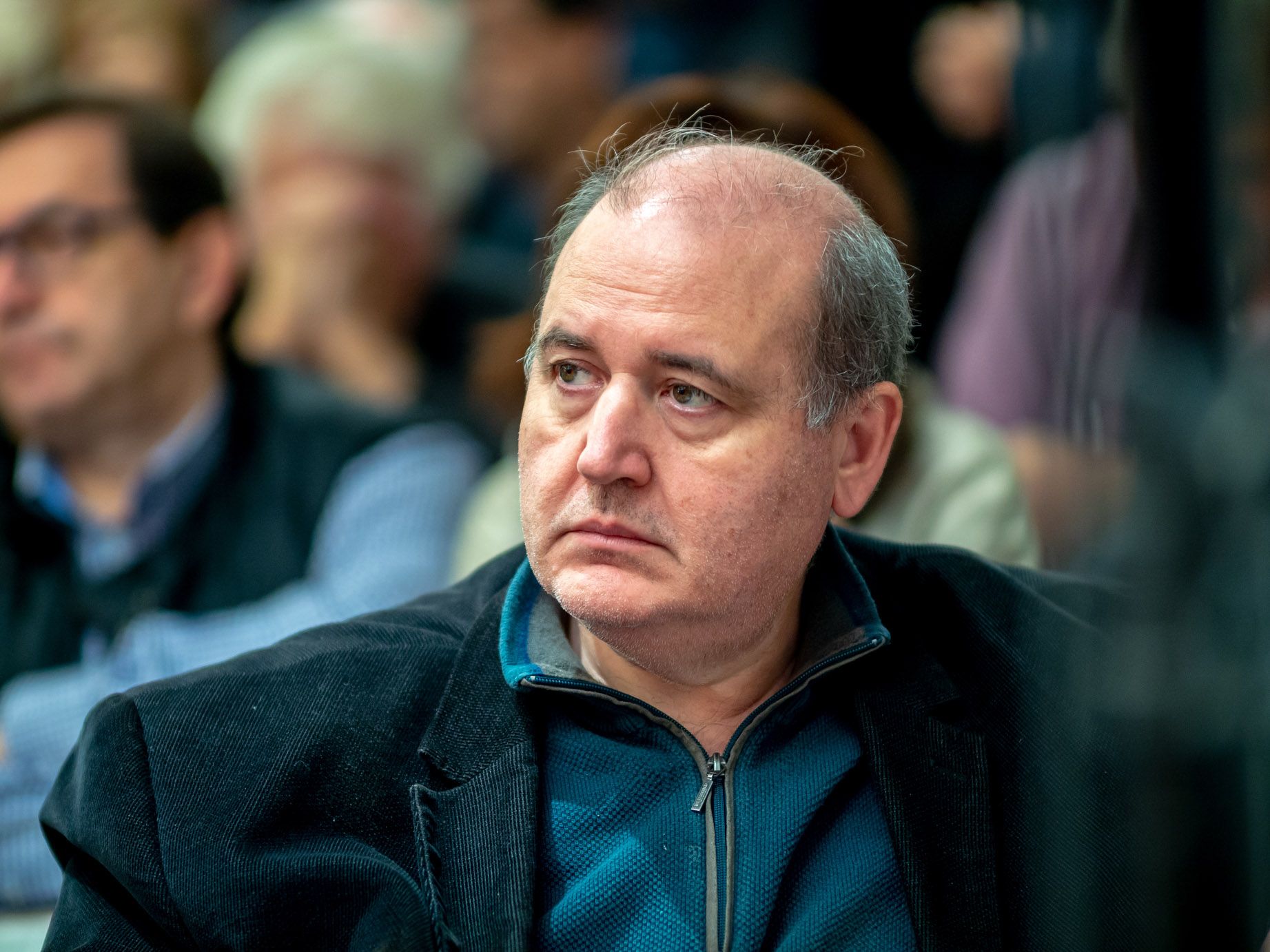
At a warm moment for the Education, with the establishment of «University Police», but also at a time of intense mobility within SYRIZA, Nikos Filis talks to tvxs.gr for all major political challenges: He talks about «re-founding the Security Studies Department» - but also responds to «Umbrella», the new internal party initiative in which he participates together with Euclid Tsakalotos, Nikos Voutsis and Panos Skourletis, for the «sectarianism» and «leadership» in the party, for the Alexis Tsipras, progressive governance and the political alliances that SYRIZA must seek:
The government establishes university police and student disciplinary boards. You say that the Student Security is being re-instituted - why?;
In the midst of the pandemic, with universities closed and young children at home, the government is making a surprise move: Despite the opposition of the university community, it brings a bill to establish a university police force, after having earlier formed a slanderous image in public opinion that lawlessness is prevalent in universities.
The real picture, through police statistics, is that crime in universities is lower than in most social spaces, and certainly not high intensity. The swelling of marginal incidents of violence, always reprehensible, does not overturn this picture.
With the proposed legislation, the Student Security Department is re-instituted, in essence, police departments are established within the universities, in which, as we read, there will be weapons. Such a development will trigger reactions of indeterminate magnitude. Perhaps even tragedies. Universities need security, which can only be achieved under the responsibility of the competent university authorities, that is to say, with respect for the constitutional imperative of self-governance.
Let us recall that under the government of Samaras and the then responsible minister Kyriakos Mitsotakis, 1,349 administrative employees were dismissed from universities in 2013, including many security guards, as was the case with school guards. They were of course reinstated by the SYRIZA government.
Today, the Southwest is not funding the universities to hire guards, but is proceeding to hire a thousand special guards, who will belong to the ELAS. It is noteworthy that even the national organization of police officers has reacted to the establishment of a university police force with accusations of the usurious nature of the recruitment and the risks to public safety and order. Yet the government insists on sending 1,000 of its own people to universities because it wants to instil the doctrine of «law and order», diverting public debate from the major social problems caused by the pandemic.
This is a repressive measure in view of the social mobilisations that will follow the pandemic. It raises a major issue of democratic order, as it even abolishes a conquest of the post-independence period, which was the abolition of the Student Council.
The bill also provides for student disciplinary action and expulsions for political and trade union reasons. We are going full speed back.
Why do you say «no» to the minimum university admission standards...
But the government wants to reduce the number of admissions and push thousands of young people into college. But because it fears the political cost, it shifts the blame to the universities themselves. The schools will set the admissions standards, which under the government's regulation will always be higher than today's standards. Based on the 2020 results, it is estimated that 20,000 children would have been left out of higher education.
All these children are pushed into colleges, where there will of course be no entrance exams with a minimum basis, and after three years they will get a degree professionally equivalent to 4-year and 5-year public university degrees. Such hypocrisy when they talk about meritocracy!
But all these measures will be met with social reactions. They are aspects of the same problem: the government's plan to close universities. This is why SYRIZA supports the initiatives of the university and students to prevent the bill from being passed, to prevent it from being implemented in practice if it is passed and, of course, to abolish it when the right-wing falls. We also support the need to immediately address the problems of understaffing and underfunding of universities. By increasing, not reducing - as is the case this year - public spending.
On the political scene: The polls show that the government is suffering attrition but SYRIZA is not collecting. Why? Is there strategic embarrassment, as Elias Nikolakopoulos recently described in Epochi?;
The polls reflect the fact that social disapproval of crucial government choices is indeed developing. However, it does not seem that, for the time being, SYRIZA has created a current of political subversion. The reasons are due to the objective reality and to the weaknesses of SYRIZA. Do not forget that throughout the world, even in the midst of the pandemic or even because of the pandemic, conservative dominance is being strengthened, especially with the fear and social distancing that create the regime of post-democracy, i.e. the even greater distance of the citizen from political and social processes and his or her entrapment in the controlled television universe.
Obviously, at the same time, cracks are being created and depending on the evolution of the crisis, they will manifest themselves. And this is where the need for strategic and programmatic preparedness of the progressive - left forces emerges, in order to overcome the situation described by Elias Nikolakopoulos. It is necessary for Syriza to speak reflectively about the past of its term of government in order to convince that it has received the message of its electoral defeat and that it is regrouping to immediately claim the popular mandate to govern again.
What political need gave birth to the «Umbrella», the new trend in Syriza? And what is its political proposal?;
The «Umbrella» is not just another trend, but an open political initiative that aims to revitalize the political dialogue and the programmatic renewal of the party, at a time when the party phenomenon in general, even on the Left, is going through a deep crisis. In the new circumstances, where everything is changing due to the pandemic throughout the world, it is necessary to clarify the party's physiognomy, its ability to rally on the basis of a value message and not to succumb to an insipid or even uninspired polysyllabism.
You see that the Southwest is attempting a furious ideological attack. This is not met with a political response of «average». «Umbrella» formulates a political plan in order for SYRIZA - Progressive Alliance to respond to the new challenges from the ground of the radical left: climate change and the environmental crisis in general, the emergence of digital capitalism and the new threats against work and income, the surveillance state, the continuous degradation of the future of the new generation.
That is, it is a contribution to the formation of an alternative production model. It is positive that similar proposals are being formulated from other sides within the party. Such a political dialogue adds strength and reinforces the necessary extroversion of SYRIZA. I stress again that the «Umbrella» is an open political initiative, which brings together members from a broad spectrum.
In the text of the «Umbrella» you say that opposition tactics «should focus on strategic issues» and not on «communicative and polarising rhetoric». What do you define as communicative and polarising opposition?;
On all issues: labour, health, education, but also where one can see hesitations or wavering, either for fear of political costs or in order not to break away from the «national core», as defined by the systemic forces and the Right. I am referring to problematic or contradictory aspects of our positions on Greek-Turkish relations, on armaments (such as the recent purchase of Rafale aircraft), on immigration and the events in Evros, on our relations with the Church, on environmental issues (see for example hydrocarbon extraction) that blur our stigma and create confusion.
The Right will not fall as a ripe fruit, not even if Syriza says yes to every pressure from society. We must build an alternative political governance. The fight against the pandemic must be linked to the fight against its causes, and to the need for public policies, not the market, to determine the policies of health, education and social and economic development in general.
The fight for rapid vaccination against Covid must be combined with initiatives to abolish the vaccine patent. Tackling a global problem highlights the need for new global regulations, the defeat of neoliberal globalisation, and the rebuilding of Europe by raising the demand for a new debt regulation, starting with the one created during a pandemic. And all of this, with the promotion of immediate social relief measures, which do not mean bidding, but are part of a plan to reorganise the economy and society. Only in this way will we reconnect with society and create the conditions for social and political alliances.
You also call for more collegiality and democratic functioning in the party. Meaning? Are you asking for collective leadership? - Do you see «leadership» or «leaderships» in the party?;
The tradition of the renewal and radical Left sees the democratic functioning of the party as a necessary condition for the democratisation of society and the realisation of a vision of the continuous expansion of democracy and freedom. If a party does not function democratically, how can it convince of the goal of democratising society?;
The issue is not the party of leadership, but the party of democratic participation, at least if we insist on the goal of democratic subversion and social change. Leadership parties, even in the conservative world, let alone in our own, which has other traditions, do not at some point avoid a party crisis. In SYRIZA there is a tradition of democratic functioning and collectivity. This tradition must be strengthened by the collective functioning of the organs, but above all by the functioning of the member organisations, so that each of them can once again become a «party» in the neighbourhood, in the workplace and elsewhere.
There is no question of questioning the leadership, Alexis Tsipras marks a successful course, always within the context of the left-democratic tradition.
Progressive governance: On what terms and in what alliances? In the last decision of the Political Council there is an invitation to KINAL, KKE, and MERA25. Is this realistic?;
The demand for progressive governance responds to the need to get rid of the Right before it causes irreparable damage to society and at the same time to create the political - social conditions to address the great social discrimination caused by neoliberalism, as well as the nationalist, anti-refugee, anti-religious, misogynistic ideologies and practices that pervade society.
That is, progressive governance is not identified with a change of government but raises the major issue of change in politics and society. It is a social necessity that does not only concern our country. The bet remains open whether the cracks in the conservative dominance will widen after the pandemic, whether the popular - democratic dynamics will be strengthened.
It is the duty of SYRIZA-PS to take political initiatives for programmatic convergences towards the other opposition forces, which, among other things, will also confront the anti-SYRIZA current. In front of the people, not behind the scenes! We cannot prejudge the attitude of the other parties, what matters is what we are aiming for and what the social impact will be.
If we accept that general programmatic convergence is difficult, why is ad hoc cooperation not possible, as was the case, for example, with the ban on the celebration of the Polytechnic, or as should be the case with the struggles to prevent the establishment of a university police force? In any case, it must be understood that one-party governments of self-reliance cannot deal, and indeed from the point of view of the Left, with the successive crises that are sweeping the modern world. What is needed instead are political, even governmental, partnerships based on an alternative programme and social activism.
Governing left or radical left? What comes first - the alternative proposal for governance or the political and ideological redefinition of the left?;
They are not conflicting directions. For the left to govern, it needs a values-based programme, i.e. a message to change the world. It is necessary for the radical Left to govern, society demands it, as a response to the neoliberal juggernaut. And now, without the constraints of the memorandum, but given the international correlation, we are called upon to re-establish ourselves in society as a party of governance and struggle. This is how we understand the ruling radical left, far from sectarianism but also far from the governmentalism of co-management.
A Left that does not shy away from talking about socialism, not only from the point of view of morality, but also as an inspiration for alternative policies that will address the explosion of inequalities and change the world. This, moreover, is also pointed out in the SYRIZA-PS declaration that we unanimously adopted immediately after the elections. It is a direction that defines the party's physiognomy, which must form consciences and not be subordinated to poll findings. After all, SYRIZA's launch from 3% to 36% was achieved through radical choices that shaped a new composition, not by adapting 3% to 36%!
The Archbishop of Athens stated in an interview that «Islam, its citizens, is not a religion, it is a political party, it is a people of war». How did you see this statement?;
Obviously it is extreme and problematic and that is why Mr.Hieronymos himself tried to refute it. While he had clearly referred to Islam in general, he clarified afterwards that he was talking about the fanatics of Islamic terrorism.
The important thing is that the Archbishop's statement goes beyond the competences of the church and the declared policy of dialogue between religions. It is another sign that the church seeks to function as a political party. For it is obvious that this statement affects both the exercise of foreign policy and issues of internal democratic order, as it incriminates by implication thousands of migrants and refugees living in our country and the Greek Muslim citizens of Western Thrace. It should not be lost on us that Islamophobia, often motivated by governments, is a major factor in the growth of the far right throughout the world, as was the case with anti-Semitism in the past.