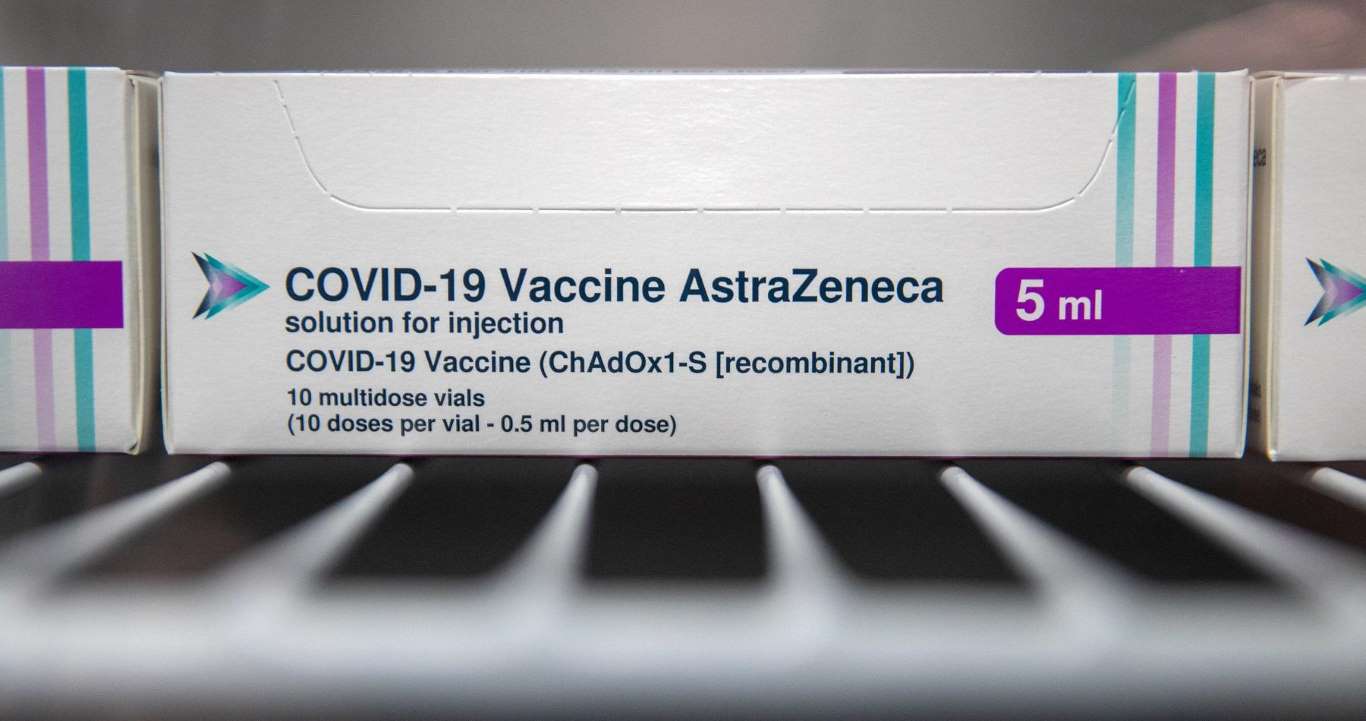
European Union Member States consider taking legal action against AstraZeneca for breach of supply contracts in the event that the company fails to comply with the COVID-19 vaccine delivery schedule, Latvian Foreign Minister Edgars Rinkevics told a local radio station on Tuesday morning.
The minister told the radio station that EU countries will only take legal action as part of a coordinated action, as reported by the Latvian news website Delfi. Each EU country has a separate supply contract with the company. Η AstraZeneca, which developed its vaccine with Oxford University, informed the EU on Friday that will not be able to meet the agreed targets for the supply of vaccines by the end of March.
After Monday's talks with AstraZeneca, the Cypriot Commissioner said in a post that «the discussions with AstraZeneca ended in unsatisfactory results due to lack of clarity and insufficient explanations. EU Member States are united: Companies developing vaccines have social and contractual obligations that they must fulfil.».
Discussions with @AstraZeneca EU Member States are united: vaccine developers have societal and contractual responsibilities they need to uphold.
- Stella Kyriakides (@SKyriakidesEU) January 25, 2021
Sweden: Stops payments for vaccines to Pfizer
The Swedish Health Service has stopped payments for vaccines against COVID-19 to Pfizer and is seeking clarification on the doses available in each vial, the Swedish newspaper Dagens Nyheter said on Tuesday.
Sweden requests clarification on the number of instalments charged, as Pfizer charged six doses per vial even though it had agreed to charge five doses. Sweden now wants the European Commissionor Pfizer to reach an agreement on how many doses are contained in each vial. «Until then, we have told the company that we will have to wait in terms of the tariffs that are available until we get clarification on what applies,» the country's chief epidemiologist Anders Tegnel told Dagens Nyheter.
Pfizer Sweden declined to comment to Reuters on this report, but told Dagens Nyheter that it had charged for six doses per vial. The EU and Pfizer had originally agreed that each vial contained 5 doses, but it was later discovered that 6 doses could be extracted if a special syringe was used. «This is unacceptable. If a country can only afford to put out five doses, it has received fewer doses for the same price,» said Sweden's vaccination coordinator Richard Bergstrom. A spokesperson for the Swedish Health Service said it was not in a position at this time to comment on this publication.
Germany supports restrictions on vaccine exports
Ο German Health Minister Jens Spahn today backed European Union proposals to introduce restrictions on the export of Covid-19 vaccines from the EU, as Tensions rise with AstraZeneca and Pfizer over sudden cuts in vaccine supplies just a month after the EU started vaccinating its citizens. The EU has proposed to set up a register for vaccine exports as frustration grows over delays in deliveries of its vaccine AstraZeneca against Covid-19, as well as other problems in the supply of vaccines.
«I understand that there are problems in production, but they have to affect everyone in the same way,» Spahn said, speaking to ZDF. «We are not saying Europe first, but that Europe should have its fair share», he said, adding that it is therefore logical to have restrictions on vaccine exports.
AstraZeneca told the EU on Friday that it cannot meet targets set by March for supplies of its vaccine - which is a further blow to the EU's efforts against the pandemic as Pfizer announced in January a temporary slowdown in supplies. AstraZeneca said on Tuesday that its chief executive had told the EU that the company is doing everything it can to bring the vaccine to millions of Europeans as soon as possible.
An EU official told Reuters that AstraZeneca received an advance payment of €336 million when the EU sealed the deal with the company in August for at least €300 million in tranches and an option for another €100 million. The agreement was the first signed by the EU to secure vaccines against Covid-19. This came after the US secured 300 million doses in May for up to $1.2 billion and the UK, also in May, secured 100 million doses for £84 million ($114 million).
British vaccines minister Nadeem Zahawi said he was convinced that the Pfizer, AstraZeneca and Moderna will honour their commitments. Spahn declined to speculate on media reports that AstraZeneca's vaccine is not very effective in people over 65, saying he expects European authorities to approve the third Covid-19 vaccine on Friday. AstraZeneca has dismissed this information.
London warns the EU against «vaccine nationalism»
The government of UK assured on Tuesday that the covid-19 vaccination campaign in the country will not be affected by delays in vaccine deliveries in Europe and warned against «vaccine nationalism» after Brussels threatened to control vaccine exports.
«I am convinced that AstraZeneca and Pfizer (...) will deliver the quantities of vaccines we need to meet our target in mid-February», said the British Minister of State responsible for the covid-19 vaccination campaign, Nadhim Zahawi, speaking to Sky News. «I am confident they will deliver (vaccines) to the EU, Britain and the rest of the world,» he added, referring to US drugmaker Pfizer, whose vaccines supplied to Britain are produced in Belgium.
Following delays in the delivery of covid-19 vaccines by Pfizer, a similar announcement by AstraZeneca on Friday sparked EU outrage. The British drugmaker noted that its deliveries will be lower in volume than projected in the first quarter of the year due to a “reduction in production” at a European manufacturing centre for its vaccine.
The European Commission yesterday, Monday, proposed to member countries “a transparency mechanism” which would force pharmaceutical companies to inform the European authorities in advance of vaccine deliveries, produced within the EU, to countries outside the Union.
This mechanism may affect exports to Britain, which imports its vaccine Pfizer/BioNTech from Belgium. «Vaccine nationalism is not the right way to go,» Zahawi assessed, speaking to Times Radio. «No one will be safe until the whole world is safe,» he said. The British government has announced that it intends to administer the first dose of the covid-19 vaccine by mid-February to 15 million people over the age of 70 and healthcare staff. So far nearly 6.6 million of them have been vaccinated.