A country can either be mutilated by military means, or... parts of it can be legally bought. In Ukraine both are happening, thanks to the policy Kiev chose long before Russian troops invaded.
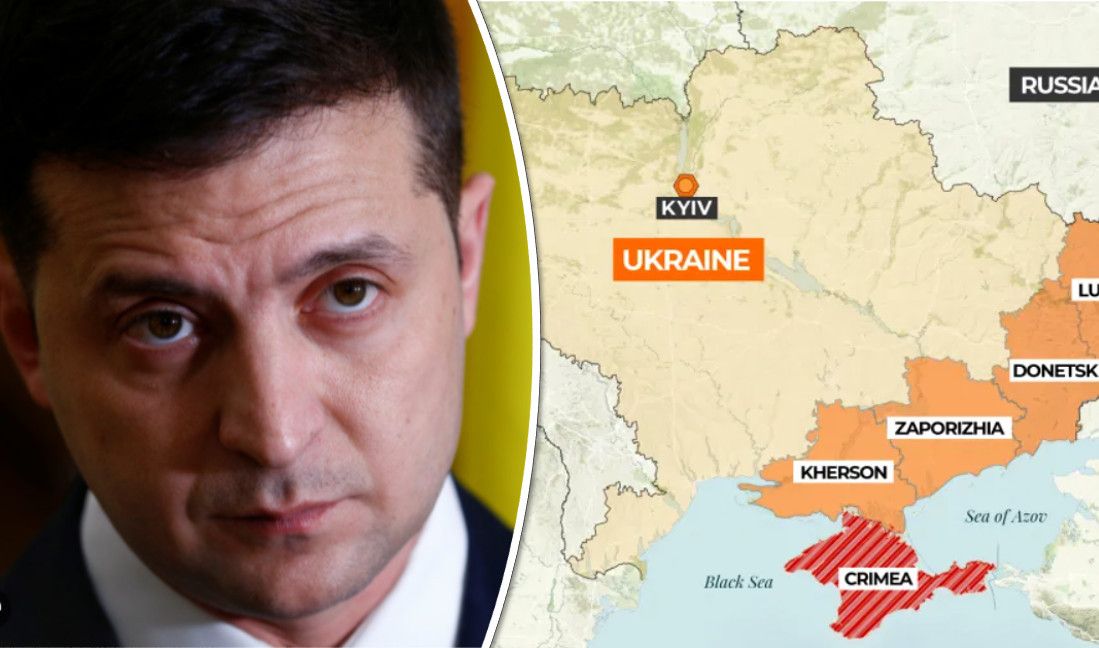
During the two years of war, the militaristic westerners (EU and USA) have provided €205 billion worth of aid to Ukraine and more to come. Officially, this money is intended to help the Ukrainians regain the territories conquered by Russia, i.e. 20% of the country.
But according to a 2023 report by the award-winning American Oakland Institute, when the war is over and the Ukrainians return from the front, they will not have much land left, as Kiev has sold it to a constellation of oligarchs, Western institutions and businesses!
Η report describes how Western aid has been conditional on a programme of drastic structural adjustment, including austerity measures, cuts in social safety nets and privatisation of key sectors of the economy.
The central premise was the creation of a [land] market, which was made law in 2020 by President Volodymyr Zelensky, despite opposition from the majority of Ukrainians who feared it would exacerbate corruption in the agricultural sector and strengthen its control by powerful interests.
Unfortunately, the report's findings confirm these concerns, showing that the creation of such an ultra-free land market will likely further concentrate agricultural land in the hands of oligarchs and large Western corporations.
According to the Ukrainian government, two «Ukrainians» have been «stolen» by private interests.
The latter have already begun to expand their access to the land. For example, food chain Kernel has announced plans to increase its land holdings to 700,000 hectares, up from 506,000 hectares in 2021. Similarly, MHP, which currently controls 360,000 hectares of land, is seeking to expand its holdings to 550,000 hectares.
MHP also allegedly circumvented land purchase restrictions by asking its employees to buy land and lease it to the company.
Thus, by 2023, the total area of Ukrainian land controlled by oligarchs, corrupt individuals and large agribusinesses is over 9 million hectares, exceeding 28% of the country's arable land.
The remainder is used by some eight million Ukrainian farmers.
It all started after 2014
The government's privatisation agenda includes the highly controversial 2021 land reform as part of the structural adjustment programme launched under the auspices of Western financial institutions, following the positioning of a pro-European government in Kiev in 2014.
The West knows that Ukraine, with 33 million hectares of arable land, has some of the most fertile agricultural land in the world. Europe's hawks are already eyeing the country's mineral wealth. If the peace-loving EU wants to complete the energy transition, it needs Ukraine's lithium deposits.
The German Christian Democrat MP Roderick Kizewetter and retired colonel has also state that the lithium deposits in the Donetsk-Luhansk region also played a role in the Ukrainian war, which both Russia and Europe want to secure for the energy transition.
Some 4.3 million hectares are subject to large-scale agriculture, with the bulk, 3 million hectares, in the hands of just 12 large agribusinesses.
In addition, according to the government, about 5 million hectares - the equivalent of two Ukrainians - have been «stolen» by private interests.
Even American universities «tear up» Ukraine
As the report states, the largest landowners are a mix of oligarchs and a variety of foreign interests - mainly European and North American - including a US-based private investment fund and the Saudi Arabian sovereign wealth fund.
All but one of the 10 largest land companies are registered abroad, mainly in tax havens such as Cyprus or Luxembourg.
Even when largely controlled by an oligarchic founder, some companies go hand in hand with Western banks and investment funds now controlling a significant part of their shares.
The report identifies several prominent investors, including Vanguard Group, Kopernik Global Investors, BNP Asset Management Holding, NN Investment Partners Holdings owned by Goldman Sachs and Norges Bank Investment Management, which manages Norway's sovereign wealth fund.
Other institutional investors include prominent US pension funds, such as the General Electric Pension Trust, the Dow Chemical Company Pension Fund and the Lockheed Martin Pension Plan, as well as prestigious academic institutions such as the University of Michigan Endowment and Harvard University investing in Ukrainian land through NCH Capital - a US-based private investment fund, which is the 5os largest land owner in Ukraine!
Indebted to European and US institutions
Most of these companies are substantially indebted to Western financial institutions, notably the European Bank for Reconstruction and Development (EBRD), the European Investment Bank (EIB) and the International Finance Corporation (IFC). Together, these institutions have been major lenders to Ukrainian agribusinesses, with nearly $1.7 billion to just six of Ukraine's largest landowners in recent years.
Other key lenders are a combination of mainly European and North American financial institutions, both public and private.
This debt not only gives creditors a financial stake in the operation of agricultural enterprises, but also provides the possibility of strong leverage in them.
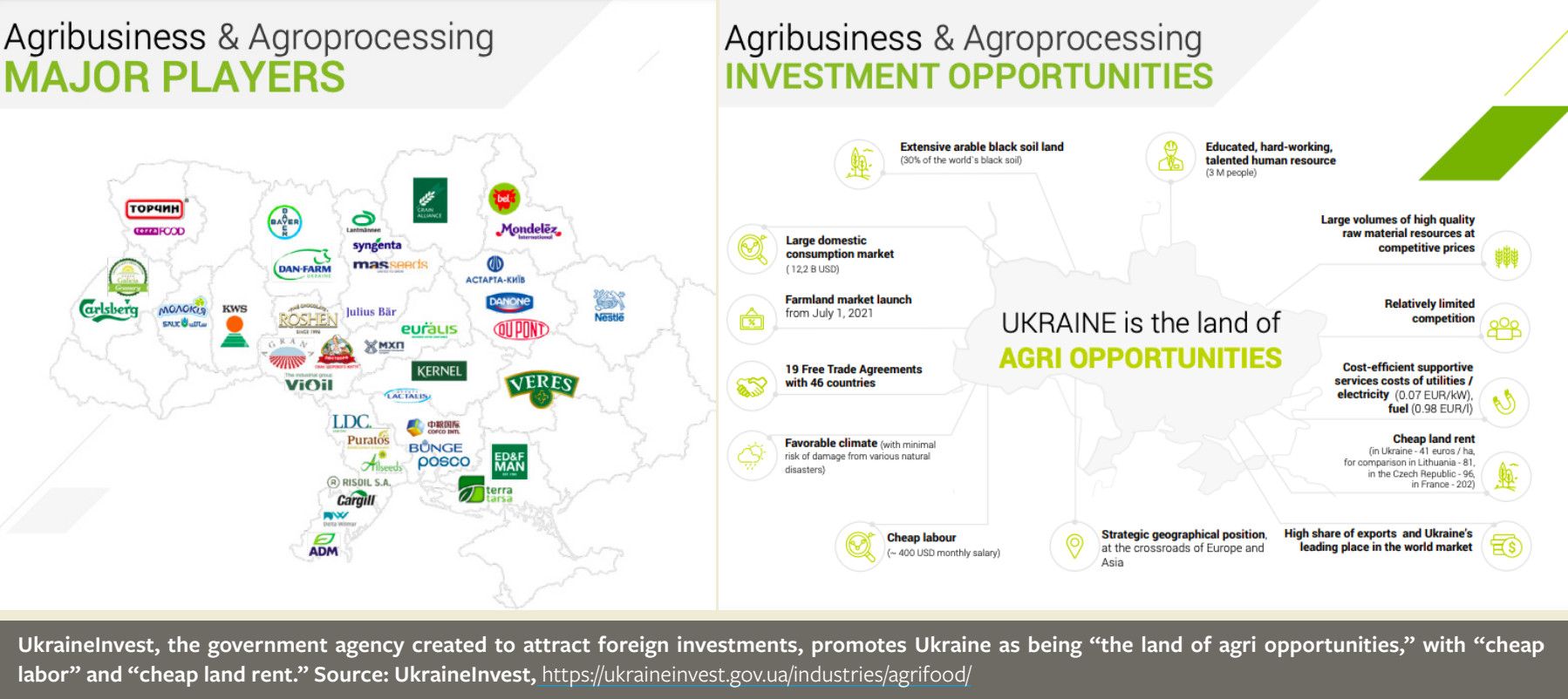
According to the Oakland Institute report, this was demonstrated by the debt restructuring of UkrLandFarming, one of Ukraine's largest landowners, which involved creditors - from the US, Canada and Denmark - leading to thousands of redundancies.
This international financing directly benefits foreign funds and companies - linked as shareholders or creditors - and of course the oligarchs, many of whom are facing charges of fraud and corruption.
At the same time, the poor Ukrainian farmers - many of whom are on the front line - have had to work on very little land with limited funding, which is why they are now on the verge of poverty.
The data show that these farmers receive virtually no support compared to agribusinesses and oligarchs.
As an example, the Partial Credit Guarantee Fund established by the World Bank to support small farmers is only US$5.4 million, a negligible amount compared to the billions channeled to large agribusinesses.
We're going to privatize you!
Moreover, according to the report, by supporting large agribusinesses, international financial institutions are effectively subsidising land concentration and an industrial model of agriculture based on the intensive use of synthetic inputs, fossil fuels and large-scale monoculture. But these have been accepted as environmentally and socially destructive practices.
In contrast, smallholder farmers in Ukraine are showing resilience and great potential to lead the expansion of a different production model based on agroecology, environmental sustainability and healthy food production.
It is Ukraine's small and medium-sized farmers who guarantee the country's food security, while large agribusinesses are geared towards export markets, reports Oakland.
Zelenski is unmoved
Seeing all this sell-out, in December 2022, a coalition of farmers, academics and NGOs called on the Ukrainian government to suspend the 2020 land reform law and all land purchase transactions during the war and post-war period, «in order to guarantee national security and preserve the country's territorial integrity in wartime and post-war reconstruction».
«Today, thousands of rural boys and girls, farmers, are fighting and dying in the war. They have lost everything. The procedures for free sale and purchase of land are increasingly liberalized and advertised. This really threatens the rights of Ukrainians to their land, for which they give their lives,» explains Professor at the National Academy of Sciences of Ukraine (NASU) Olena Borodina.
The report raises major concerns about the future of land and food production in the country, which is likely to become more entrenched and controlled by oligarchs and foreign interests.
These concerns are exacerbated by Ukraine's staggering and growing external debt, which has shrunk at the expense of the living conditions of the population as a result of the measures required under the structural adjustment programme.
Ukraine is now the world's third largest debtor to the International Monetary Fund (IMF) and its debt will likely lead to additional pressure from creditors, bondholders and international financial institutions on how to implement post-war reconstruction, amounting to some $750 billion,
These powerful actors have already made it clear that they will use their leverage to further privatise the country's public sector and liberalise its agriculture.
A cliff in front and a stream behind?;