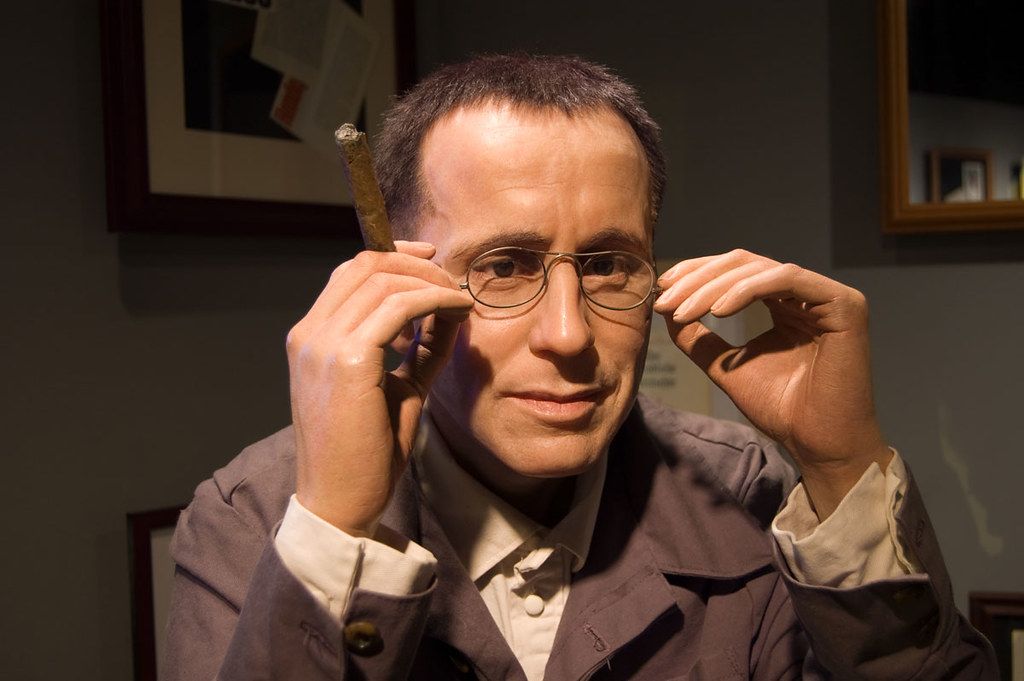
He was born in February 1898 in Augsburg, Bavaria. He grew up «like a rich kid. My parents put a collar on me, taught me to have servants and taught me the art To I give orders. But when I grew up, and looked around me, I didn't like people of my order, nor to give orders and be served. Then I renounced my order and took humble men for companions.’
He marched all his life on the side of the unjust, the humble, the oppressed “The worker, the peasant, the intellectual in Brecht are human beings in flesh and blood, who tread their difficult path, disbelieving, doubting and crystallizing their final stance, maintaining their vigilant sobriety.” had stated the theoretician of the theatre Alexis Salmon.
He marched all his life against them “who grab the food off the table. They preach austerity. They call for sacrifices.’.
He studied medicine and philosophy at the University of Munich, only to choose drama and poetry.
With the rise of Nazism, he went into self-exile, first to Denmark, Finland and later to the United States. In the United States during the McCarthyism era he experienced unbearable persecution.
Wherever he went, as he says in a letter, he always heard the same phrase: «Please spell your name». The answer was always the same sarcastic, «This name once belonged to one of the great». And literally, because at the age of 35, he was already recognized on the European continent as a thinker, poet, playwright and director.
At the end of World War II he returned and settled in East Germany, where he and his wife founded the Berliner Ansabl Theatre, an integral part of socialist cultural life.
Brecht's work as a whole reflected his Marxist ideology, as the themes had deep socio-political references always on the side of human values, of suffering people.
His most important works were “The Opera of the Five”, ”The Rise and Fall of Mahogany City”, ”The Chalk Circle”, ”Mama Courage”, ”The Good Man of Szechwan” ...
Always and in all his works he denounced social injustice, war, poverty, unacceptable political and class racism, the impunity and callousness of the bourgeoisie.
His words were prophetic about tolerance and detachment from the political and cultural situation in which the citizens of a country are pushed into.
“The worst illiterate is the political illiterate. He does not listen, speak or participate in political events. He doesn't know the cost of living, the price of a bean of shoes and medicine, it all depends on political decisions. He is so stupid, he is proud and puffs out his chest saying he hates politics. He does not know that from his political ignorance is born the prostitute, the abandoned child and the worst thieves of all, the bad politician.”.
He was equally scathing about the bodies of Culture and Art, noting that “the art mcan deliver man to confusions, illusions and miracles. It can increase ignorance, but it can also increase knowledge.”.
So don't ”Say pYou've been hoping for a long time. You can no longer hope.
You were hoping what? That the fight would be easy? It's not. Our position is worse than you thought...It is such that if we do not achieve the impossible, we have no hope.
If we don't do what no one can ask us to do, we will be lost. Our enemies are waiting for us to tire. When the fight is at its hardest. The fighters are at their most tired.
The tired ones lose the battle.”.
Bertolt Brecht