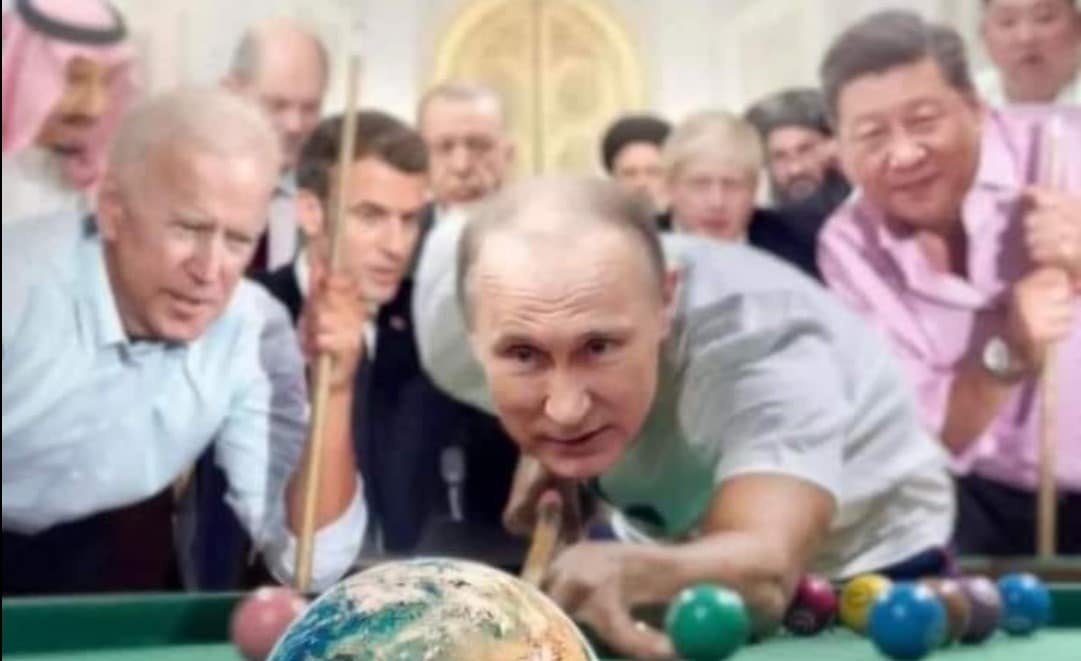
Data:
🔸The abject failure of neoliberal globalisation ver1.0 to solve critical problems led to the formal acceptance of its end by the G7 at their summit in Cornwall in June 2021.
But this was accompanied by an aggressive plan to limit the global influence, mainly of the rising China, and secondarily of Russia (as critical to China's economy for energy and raw materials), by the exclusion of Russia from the G8, and by a new strategic doctrine of maintaining the power of the dollar as a global reserve currency with the famous (but controversial) “Green Growth”. The “West” is playing defence with a hard offence and a clear confrontational mood.
🔸The expected reaction from the threatened Russia was not long in coming. The invasion of Ukraine and the acceleration of the creation of the digital “antidollar” led to the well-known sanctions against it, which in turn accelerated the near-zeroing of the geo-economic importance of the euro and the revival of the BRICS project aimed at wresting the entire economic South from the influence of the dollar enforcement mechanisms in place during the previous globalization. The IMF, the World Bank and the World Trade Organization, with the creation of new ones under Russian-Chinese supervision.
You call it offense playing defense.
The BRICS project first emerged in 2001 through a study by Goldman Sachs with the aim of maintaining the basic structure of the current banking system until 2050. This basic plan to rescue the banking system envisaged the splitting of the world currencies' power zones into two. This idea serves as the core of the basic architecture of a global system to preserve the money issuing privileges of commercial banks to prevent it from collapsing. The 5 emerging economies of the time - Brazil, Russia, India, China and South Africa - would be the core of the implementation of this plan.
🔸But the collapse came unexpectedly and early. In 2008 with the Leman Brothers financial crisis, which led to 13tr$ of the “bursting” of 600bn mortgages in the US. These were made up for over the next 10 years with state lending and PSI-type schemes in the economic periphery, further exacerbating economic inequalities.
And things got worse with the trade war that Trump declared on China with his alienating policies, which also had strong elements of industrial isolationism, but without touching the financial status quo in the slightest, respectively. This contradiction, in turn, led to an unprecedented supply and demand crisis that began in 2018. The Coronavian came along and made it worse by also “covering up” the real causes of the chain crises that followed. Energy, in logistics/transportation, manufacturing and food.
✔️Η The emerging conflict of the two “worlds”, the “West” under the USA and the “East” under China-Russia, thus appears, at first and on superficial analysis, as inevitable. Usually it is analysed in terms that were either valid in the colonial era or in terms of what we learned to say during the previous Cold War. Sometimes confusing again Hardington's doctrines and his applications of Kissinger's prescriptions for how the dynamics of the external relations of states should be understood.
But nothing that was valid then as a basic parameter is valid now! Any attempt at interpretation using the same methods and interpretive tools as then leads to unproductive absurdities.
There are two reasons for this:
🔹The BRICS/G8/BRICS+ system is undermined by the individual serious bilateral differences of its members (China-India, India-Iran, Turkey-India, etc.) which drags the whole model into crippling practices. These also reflect the different strategic choices of the individual domestic elites in their efforts to survive. Of course, the fact that countries with harsh authoritarian regimes (by Western standards) are centrally involved in this pole.
🔹All these geo-economic/geopolitical plans are missing the significant impact of the internet and digital services on global trade and financial systems.
✔️Με In short, the world is now being led into a bipolar conflict, designed by a bank in 2000 with the original purpose of avoiding it! And in the absence of modern methods and tools of analysis eventually, many are also led to conclusions with an obvious absence of a strategy to solve any problem!
This is very reminiscent of the eve of the First World War, again with the same issues: everyone now, not only Kaiser's Germany, is looking for “a place in the sun” of the economic South. For its raw materials, the energy or metals that renewable energy sources require, and cheap young hands in abundance.
Some playing defense and others playing offense with zonal press systems.
So, in this rather gloomy picture, the upcoming G20 (i.e. the most important countries of the South) meeting in Bali this autumn is of particular importance for what will follow. A foretaste of it was expressed at the last session of the Shanghai Consensus Organisation which concluded last week in Uzbekistan with the participation of the same people who will be the protagonists of the G20 meeting in Bali.
And as is always the case in two-pole conflict systems, there is always an intermediary as their balancer (in politics we used to call him the “centrist”, and he was usually the one who tipped the scales depending on who was the worst off). This was confirmed by India's attitude and by China's cautious attitude to follow Putin's extreme confrontational tactics with the West.
The Indian strategy is formed under the acronym IBIS (India, Brazil, Indonesia, South Africa), which as a “faction” and within BRICS+, tries to play the role of “bridge” or if you like the geopolitical “centre”.
The interesting element of this new initiative is the “equal distances” from the Anglo-Saxons of the West and the Beijing-Moscow axis (e.g. with the participation of the two Is in the QUAD initiative and three of its members in BRICS) but also the “open door” left for France and Germany to participate in this new geopolitical coalition. But now with a role of “second fiddle”.
Lula's imminent victory in Brazil on 2 October seems to be the catalyst for this ambitious project of India, which is feverishly preparing its own digital currency.
Thus, the experienced China, alarmed lest the “centre” be lost, seemed to follow the same tactics as India: “We buy cheaply what Russia has, but we keep as obvious reactions and differentiations from the fast pace that Putin wants to impose in the conflict with the West”. The digital antidollar designed by Sergei Glazyev can wait a while. It is not yet time for a head-on confrontation, especially before the November mid-term elections in the US. Beijing does not want to risk now an Iphigenia role for a few seats up or down in the US Senate.
🔸 But this leaves Erdogan uncovered, who, pressured by his own internal and economic problems, quickly moved towards the Eurasian zone with a request to join the anti-NATO organization of the Shanghai Conference as a full member.
This was applauded with a generous cash facility of 20bn euros from Putin along with a serious discount on the rouble purchase (by 25%) of discounted gas from Russia in return for a compromise in Syria. As for the remaining 75% payment in inflationary pounds, which the Central Bank of Turkey is now printing in droves.
But he was just as warmly applauded by Germany's far-right, who continue to sell their anti-globalist image to Germany's more backward political audiences. For the far-right the new “demon” is now called “Greens” as the ones mainly responsible for the EU's subservience to Uncle Sam's strategies on energy and the Ukraine crisis.
So Erdogan is now badly exposed between the two partners, Uncle Sam and Putin, who put the EU in the “middle” by reducing the Euro to a prefat stew, and Putin shows that he still controls the game with his carousing (right-wing-technically I would say).
🔸 Of course, all of the above have and will have a strong impact on our domestic political scene. It seems that we are now fast running out of the time available for our guverno to “close” the deals and commitments to its key donors that are still outstanding. Mitsotakis is being led to the same meteoric step of the stork as Erdogan! The only difference is that this is more like elementary school level punishment from the 70s.
It is now impossible for him to adapt to the new circumstances and priorities, if we are to survive this winter. The alley that was played in our area had a backwards falsetto.
These things happen...
By Yannis Hadjichristou