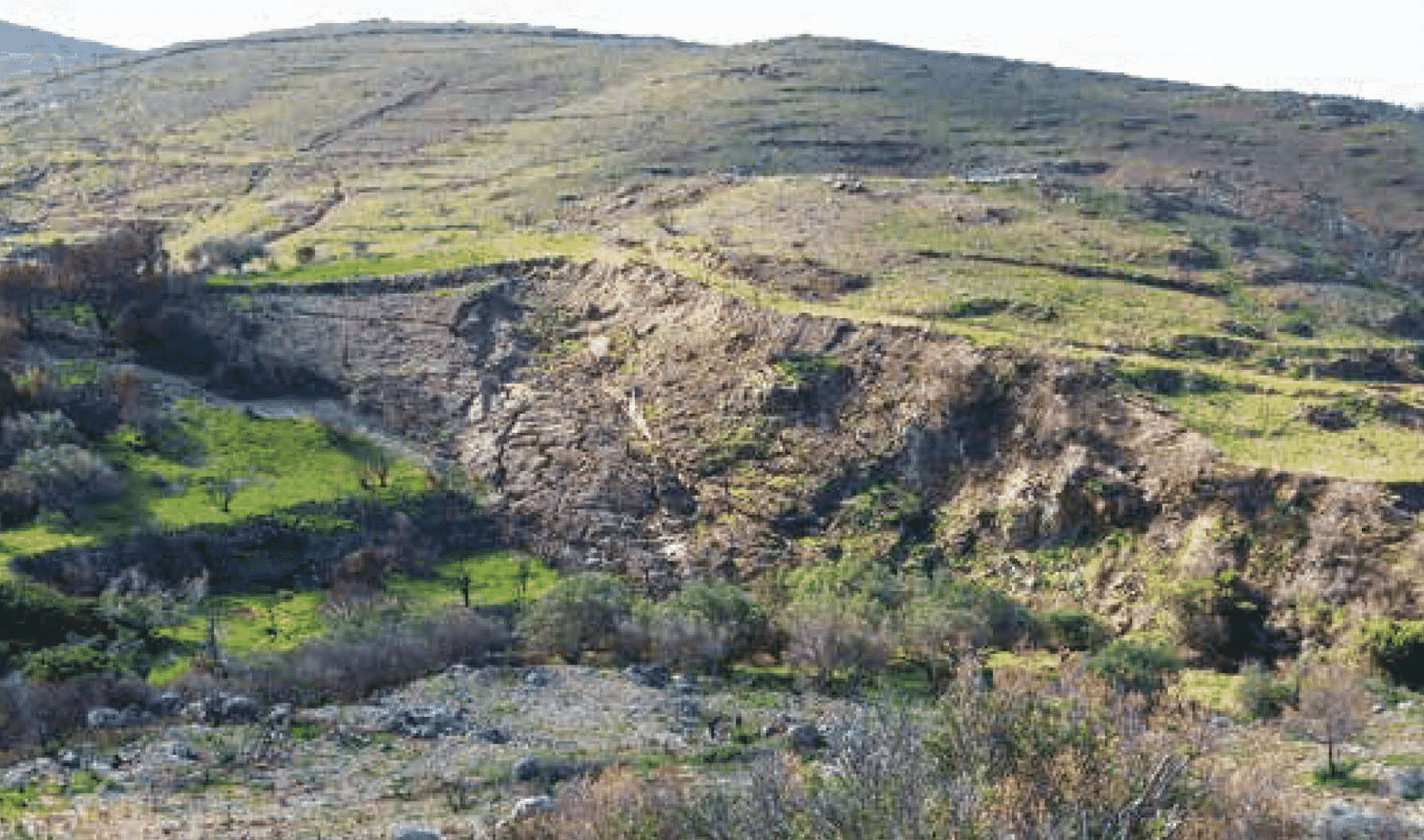
by Dr. Konstantinia Tsangari
Climate data
For the climatic investigation of Kythira, data from the EMY meteorological station, which is located at an altitude of 321 meters, at 36.28° N and 23.01° E, were used.
These data cover the period 1964-2017, with a small percentage of missing data. It is therefore possible to draw conclusions about the prevailing climatic conditions on the island.
The station data refer to daily values of air temperature, relative humidity, precipitation, and wind speed, and the analysis was performed on a monthly and annual basis.
Air temperature
Analysis of temperature data shows that average monthly temperatures are generally high throughout the year. The average annual temperature is 18.0 °C, varying seasonally from 11.6 °C in winter to 25.4 °C in summer, with intermediate values during the transitional seasons of spring and autumn (15.5 °C and 19.6 °C, respectively).
On a seasonal scale, the warmest season of the year after summer is autumn, and there is a smoother transition from winter to spring than from autumn to winter.
On a monthly basis, the warmest months of the year are July and August, with average temperatures of 26.4 °C and 26.2 °C, respectively, while January and February are the coldest, with almost the same average temperature (11.0°C).
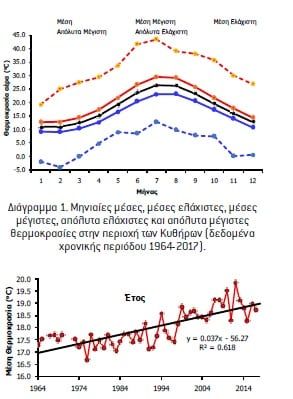
The monthly average fluctuation in temperature conditions in Kythira is shown in Figure 1, which also shows the average maximum and minimum values as well as the extreme conditions recorded throughout the study period from 1964 to the present.
Temperature conditions on the island have varied significantly since 1964, and in general, warmer conditions prevail compared to the past, both on an annual and seasonal basis, as shown in Figure 2 for average temperatures.
On an annual basis, the average temperature has been increasing at a rate of 0.37 °C per decade from 1964 to the present. This rate of increase is highest (0.67 °C per decade) in summer and is minimal, although positive, in winter (0.10 °C per decade), with intermediate values in spring and autumn (0.39 and 0.23 °C per decade, respectively). On a monthly basis, the most significant increase in average temperature is observed in August, at a rate of 0.74 °C per decade.
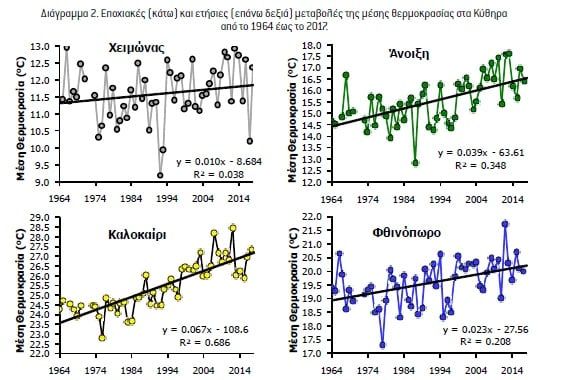
Similar statistically significant variations are also recorded for extreme temperature values. The average maximum annual temperature is significantly higher today than in 1964, with an increase of 0.31 °C per decade, which varies seasonally, mainly in summer (0.54 °C per decade) and spring (0.35 °C per decade), but does not appear to have changed in winter and autumn.
Similarly, the average minimum annual temperature has been increasing since 1964 at a rate of 0.22 °C per decade. The largest increases are also observed in summer (0.43 °C per decade) and spring (0.27 °C per decade), while winter and autumn show no significant changes.
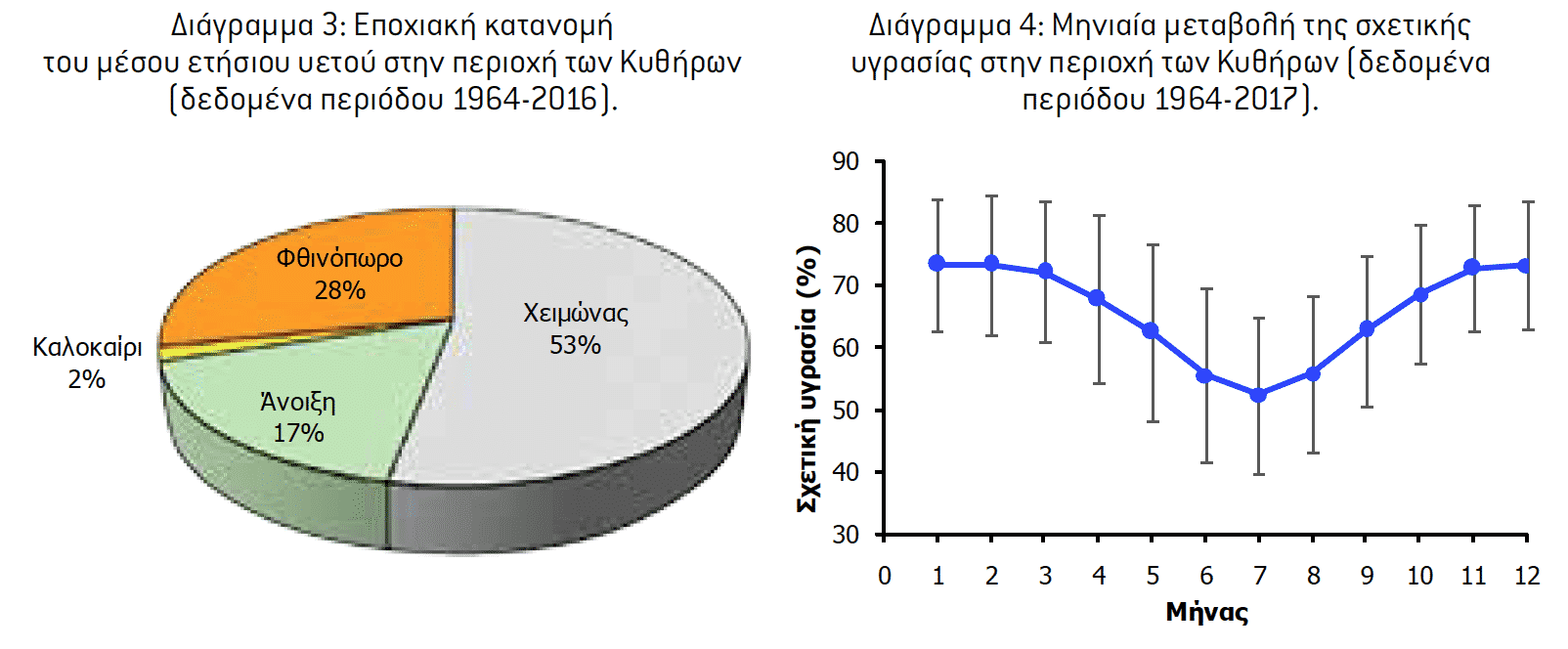
From the processing of monthly rainfall data for the period 1964–2016, it can be seen that, in the Kythira region, the volume of atmospheric precipitation is quite limited, with an average annual rainfall of 495 mm, with 531 mm falling in winter, followed by autumn with 281 mm, spring with 171 mm, and finally summer with only 21 mm, confirming that the summer season is particularly dry, as is the case in much of the Mediterranean zone. The rainiest month of the year is December (110.5 mm) and the driest is July (1.2 mm).
The change in annual precipitation values in the region does not show statistically significant variations, indicating that the rainfall regime in the region has remained unchanged from 1967 to the present.
Relative humidity
The average monthly relative humidity values for the region are shown in Figure 4. On an annual basis, the average value is 66%, varying seasonally and ranging from 54% in summer to 73% in winter, while in spring and autumn it is almost the same, 68%. Even during the summer, relative humidity remains relatively moderate.
Wind speed
On an annual basis, the average speed reaches 20.2 km/h, but with significant fluctuations (standard deviation 14 km/h). The strongest winds occur during the winter months, while in summer, wind speeds are significantly lower.
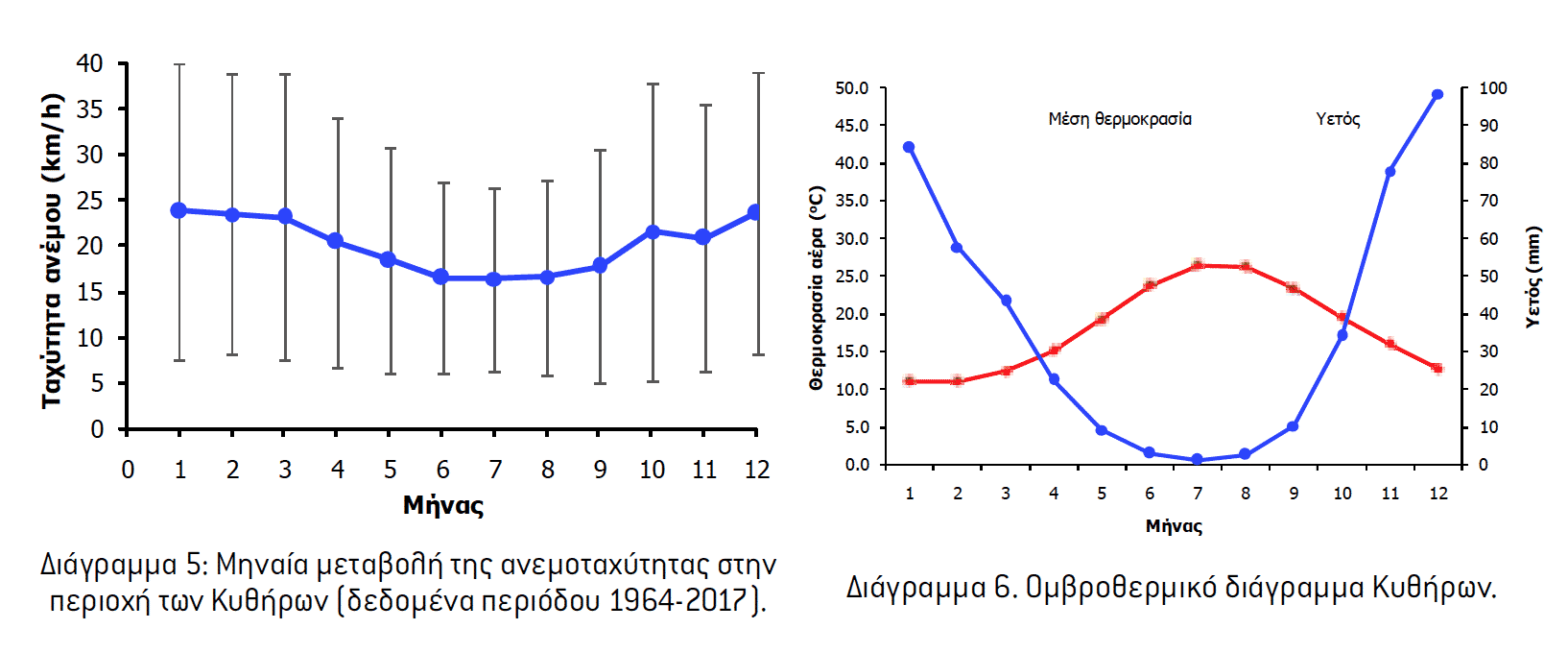
Ombrothermic diagram
From the ombrothermic diagram according to Bagnouls – Gaussen, which allows the dry season for a region to be identified, the intensity of the drought in the region is immediately apparent, as intense dry conditions prevail for a period of 6 months or more.
The dry period is the area enclosed by the two curves of the two intersection points (P=2T) and indicates the duration and intensity of the dry period. A month is classified as dry when its total precipitation is equal to or less than twice its average temperature (Pmm ≤2T°C).
Bioclimatic classification
According to Koppen, the climate of Kythira is classified as Csa: that is, maritime with a distinct dry and very hot summer (pθ 22 C). Bioclimatic research shows that the prevailing vegetation on Kythira corresponds to the thermo-Mediterranean formations of the Eastern Mediterranean. The area belongs to the subhumid bioclimatic zone with warm winters, and there are two Mediterranean zones, the intense thermo-Mediterranean and the weak thermo-Mediterranean.
* Dr. Konstantinia Tsangari is a forestry scientist, and Dr. Nikolaos Proutsos is an agronomist at the Forest Research Institute of the Hellenic Agricultural Organization «DEMETRA.».
The text is a reprint from the magazine «Nature» published by the Hellenic Society for the Protection of Nature (Issue 160), which features the special section: «The journey towards the rebirth of Kythira.»