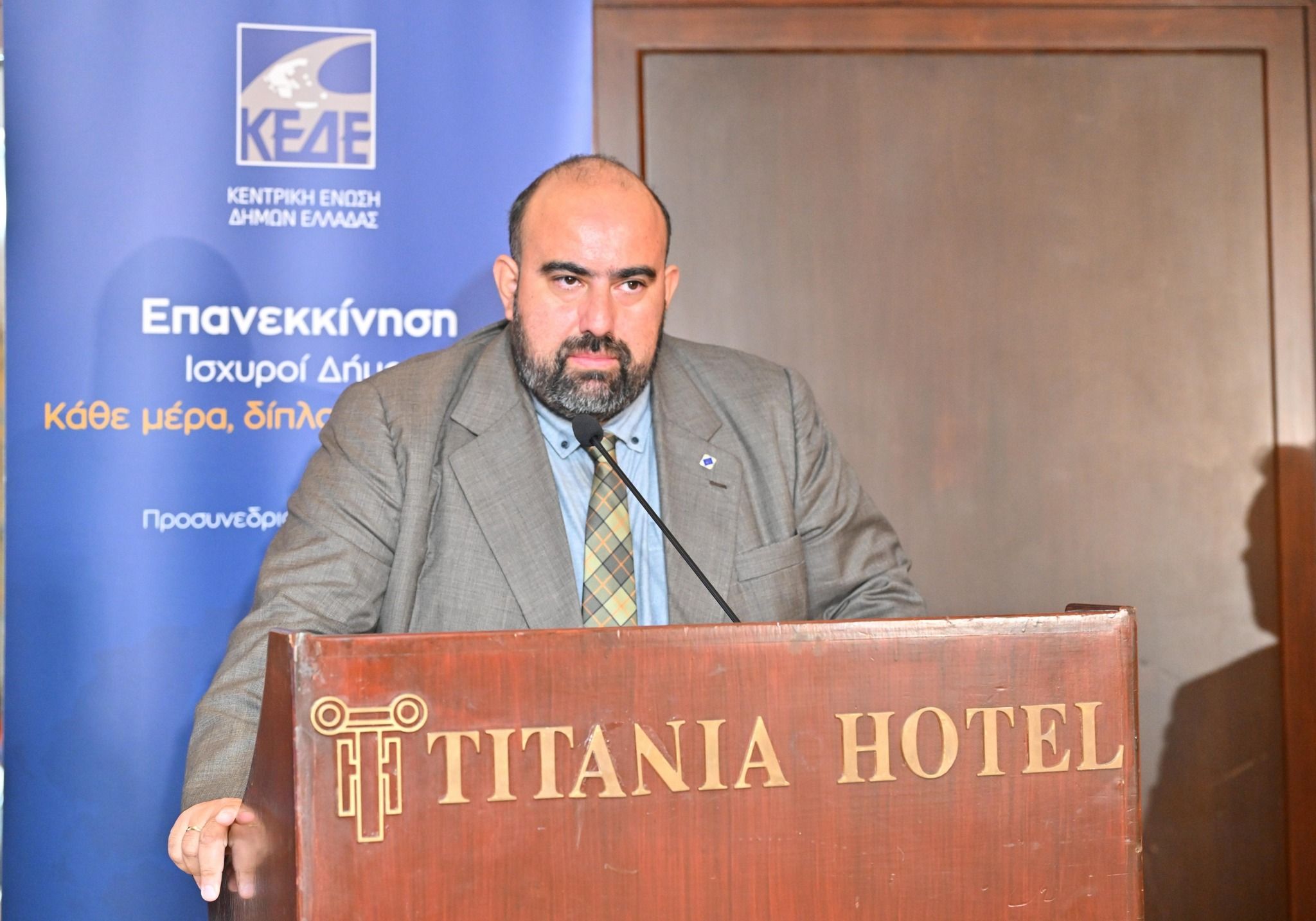
The Mayor of Kythira, Efstratios Charhalakis, spoke at the KEDE Pre-Conference in Athens, highlighting critical issues facing island municipalities and calling for immediate action. In his speech, Mr. Charhalakis focused on the demographic problem, which is exacerbated by the trend of population flight to cities and the decline in births. He also criticized the legal uncertainty that prevents local authorities from implementing social policies, such as housing or birth allowances.
At the same time, he stressed the need for more stable and targeted recruitment, as well as a review of the exemptions that allow newly recruited employees to be dismissed quickly. Finally, the Mayor highlighted the significant burden on island infrastructure due to overtourism and announced the organization of a conference in Kythira in April 2025 on the carrying capacity of public infrastructure in relation to tourism. Read his speech.
KEDE PRE-CONFERENCE – ATHENS 23-10-2024
SPEECH BY THE MAYOR OF KYTHIRA – CHAIRMAN OF THE ISLANDS COMMITTEE
& POLITICAL COHESION Mr. EFSTRATIOS HARHALAKIS
Dear President, distinguished colleagues, ladies and gentlemen,
The institution of pre-conferences is important in order for our annual regular Conference to be conducted in an organised and methodical manner, with positions, opinions and, above all, proposals in every sector and at every level of policy. Moreover, through KEDE and PED, local government has demonstrated that it has feasible proposals in every direction.
In this context, representing all the island municipalities of the country, I will present today some thoughts and concerns, which I will develop in more detail at the Rhodes Conference, where there will be a special session for island municipalities.
European experience has shown that there can be no balanced and sustainable economic development without substantial provision for the regions, especially the most remote and inaccessible parts of the regions, which are the islands and isolated mountain areas. The ongoing migration of the economically active and productive population to cities, combined with the Europe-wide problem of a rapid decline in birth rates, is leading to the most significant problem currently facing island regions, which is none other than the demographic problem.
Many grand words have been spoken. Once again, however, it was the local government that presented, a few days ago in Xanthi, the comprehensive demographic study conducted by Professor Psycharis' scientific team on behalf of the Institute of Local Government of the Central Union of Municipalities of Greece, on whose board I had the honor of serving during my previous term as mayor. I believe that this is the first time that such important in-depth primary research and analysis of a series of scientific and social data has been carried out at the municipal level, with the result that we now have at our disposal an important scientific tool that does not simply exhaust itself in dry conclusions, but goes even further by proposing specific and, above all, implementable policies to tackle the problem.
Unfortunately, however, the numbers are not on our side. Even if all these proposals were to be implemented today, the likelihood of halting the country's demographic collapse would not yield results before 2035-40! From the preliminary research I have done, especially for the islands, the following emerges: from the 1951 census to that of 2021 (however it was conducted, correctly or incorrectly), only 19 inhabited islands increased their population, including Crete, Rhodes, Corfu, and Euboea. On the contrary, in more than 100 islands inhabited in 1951, there was either a huge decrease in the permanent population or a complete decline to zero, meaning that they ceased to be inhabited altogether!
KEDE must be at the forefront of national action on demographics. That is why we must insist on the need to set up a national demographic committee, headed by the Prime Minister himself and with the active participation of both KEDE and ENAE.
Municipalities want to implement policies such as social housing or childbirth allowances. Unfortunately, current legislation not only casts doubt on the legality of municipalities implementing these policies, but essentially prevents them from doing so, as we have a series of decisions by the Court of Auditors that have ruled, for example, that rent subsidies for doctors or teachers to be illegal. That is why we, as a committee, have proposed the adoption of an amendment that will explicitly and categorically give municipalities the right to implement such social policies, such as the birth allowance, without fear of future recriminations against elected officials and employees.
And since we are talking about accountability, there is an important issue that many colleagues have faced and which has also been addressed by our Committee. The experience of continuous audits in municipalities, by at least six different authorities (Court of Auditors, National Transparency Authority, SDOE, Financial Police, General Accounting Office, Decentralized Administration, etc.) has shown that the findings of one auditing authority are not binding on the next auditing authority, even if they concern the exact same payment order! Worse still, there are cases where colleagues are being unjustly harassed by the courts because expenses that had been considered and audited as correct by the Court of Auditors itself in previous years have been deemed unlawful! This is completely absurd! What was the point of the preventive audit if the seal of the country's Supreme Court of Auditors does not bind future audits? I wonder, in what serious country does something like this happen?;
And this is where the issue of the suspension of elected officials comes in. Suspending an elected official, according to Article 236/A/N.3852-10, directly violates the constitutional presumption of innocence and is not practiced in any other EU country or in the Western world in general. I suppose we all know of cases of colleagues who were referred to criminal trial, suspended from office in accordance with the letter of the law, and then, after lengthy legal proceedings, were triumphantly acquitted. but the stigma and stain of suspension remained, their political standing was shattered and tarnished! How does this honor local government and the legislator himself? How much longer will we accept this? There is a legal order, there is a presumption of innocence.
A major issue that concerns us all is understaffing. Island municipalities are now severely understaffed. The image of colleagues driving garbage trucks is neither institutionally correct nor does it honor local government. The announcement of the points system for recruitment in island municipalities and the 15-year non-transferability is positive. However, I have several reservations, especially regarding the 15-year non-transferability. This is because we have not heard of any provision for the dozens of exceptions that remain in the legislation and which bend the general provisions, such as joint service, election to collective bodies, etc. As a committee, we have made a specific proposal: that no exceptions (except for health reasons) should apply, at least for municipal staff in mountainous and island areas as defined by Government Gazette 667/B/1992. This would be a start. In the Municipality of Kythira, we recently had two special cases: in the 2018 competition, we hired a civil engineer and an architect, critical specialties for staffing the Technical Service and, above all, for creating a Building Service, a burning issue that we are struggling with. On the day she was sworn in, the civil engineer applied for and received nine months of parental leave. So far, so good, and all legal. Fifteen days before her leave expired and she was due to return to work, she RESIGNED from the civil service! In other words, she received 9 months' salary and allowances, did not show up at her office for even half an hour, and resigned! And I ask: does the law provide for any kind of penalty or punishment for this behavior, which, although legal, is morally reprehensible? It does not! Her colleague, the architect, was appointed to the municipality and, because she was elected to a local government body, she was immediately transferred to her place of election. And she was elected not to the administration, but to the opposition! And she was elected not to the administration, but to the opposition! The relevant law, especially in the era of electronic meetings, is anachronistic and needs to be changed. Elected officials should continue to be entitled to two days' special leave to participate in person in a board meeting, but they should not be entitled to transfer or secondment if all meetings and procedures are now conducted electronically, especially when they are not elected to an administrative position. There are dozens of such examples of exceptions, which cause hardship to our municipalities, especially regional and island municipalities.
I also believe that we must push hard for permanent recruitment to the Municipal Police and «Help at Home» for those municipalities that have not been included to date, which are many. There should be a special announcement with fast-track procedures. These are two areas which, if properly staffed, will give us a lot of breathing space, especially in small municipalities.
A specific issue that causes enormous problems for all municipalities that receive tourist arrivals is their temporary overpopulation. Kythira has 3,500 residents, but 110,000 arrivals during the season! What water supply and sewage networks, what roads, what landfill sites can bear the burden of this population increase on the islands? Here, however, a first step has been taken: the redistribution of CAPs, an issue on which KEDE took the lead, and I must congratulate the President and the entire Board of Directors. It was a courageous decision with a strong element of healthy collegiality. Is it enough? No! A study of the carrying capacity of public infrastructure for all island municipalities is required, which will identify the necessary infrastructure projects to prevent overtourism and the inability to manage it from destroying the natural, built and man-made environment that we are trying so hard to preserve. In this context, I am pleased to announce that on April 28 and 29, 2025, in Kythira, we will organize a two-day conference on the relationship between infrastructure carrying capacity and tourism development, which has already been placed under the auspices of KEDE and many ministries, with the aim of laying the foundations for the sustainable and not reckless development of our regions through in-depth scientific presentations and examples of good practices from across Europe.
Since 1999, when I became actively involved in local government at the age of 18 – I have been involved in local government, and now that I am in my third consecutive term as mayor, I regret to say that the absurdities that govern the functioning of the institution remain strong and unshakeable. From the fact that fire safety contracts are only allowed for 5 months (until last year they were for 4!) while firefighting lasts 6 (!), to the administratively problematic fixed advance payment of the Communities, which we have requested to be institutionally updated and, above all, to be optional, since it is clear from the provisions governing it that it is in direct conflict with the Principle of Economy that we are obliged to comply with by the Court of Auditors.
Above all, however, and I will conclude with this, we all recognize the extreme absurdity that governs our constitutional position as elected officials, as elected officials who represent the level of administration closest to the citizen. One need only compare the situation of mayors in other EU countries with our own. The conclusions of this comparison are disheartening and confirm what an old colleague of mine always said, that mayors are the «scapegoats of the state.» Because in every developed country, the mayor has the institutional, legal, and financial tools at his disposal to implement the program that the citizens have ratified through the election results. The mayor must have support, institutional, legal, financial, and administrative support. When, for example, the mayor's salary is much lower than that of the municipal secretary general, then what constitutional position are we talking about, dear colleagues? Or when the State itself distinguishes between mayors based on the population of each municipality, while the powers and responsibilities are the same whether one is mayor in Athens or in Sikinos, then what is the point of the constant struggle of our collective bodies for a bold horizontal institutional improvement of the statutory position of elected officials? Either certain long-standing misconceptions will change, or we will have to think of more dynamic ways to respond.
Dear colleagues,
When the problems of large urban municipalities become overwhelming, consider what we have to deal with on the islands or our colleagues in remote mountain municipalities. We are forced to take responsibility even for the problems and outages of the Public Power Corporation or the Hellenic Telecommunications Organization, for ship and plane schedules, in other words, for issues that are not within our remit and which, I am sure, sound strange to our colleagues in large urban municipalities and prefectural capitals. A few days ago, journalists kept calling me about the shortage of teachers in schools, which is, of course, the exclusive responsibility of the Ministry of Education. They only stopped when I asked them the following question: «When there is a shortage of teachers in the schools of Grava, do you ask Mr. Doukas for his opinion?» In any case, for the record, as we speak, there are still shortages of teaching hours and teachers, even for basic subjects!
Dear Mr. President,
I don't want to go into detail. We will discuss this in more detail at the Rhodes Conference. Our islands have terrible problems. The island municipalities are no exception. We all look to the President of KEDE and all his colleagues on the Board of Directors to ensure that in 12 months' time, i.e. before the 2025 Conference, we will not be discussing the same issues we are discussing today. We hope that certain immediate interventions will have been made that will solve our problems, at least in part. Otherwise, the island region and, above all, its heroic inhabitants will judge us all very harshly in the foreseeable future.
Thank you!