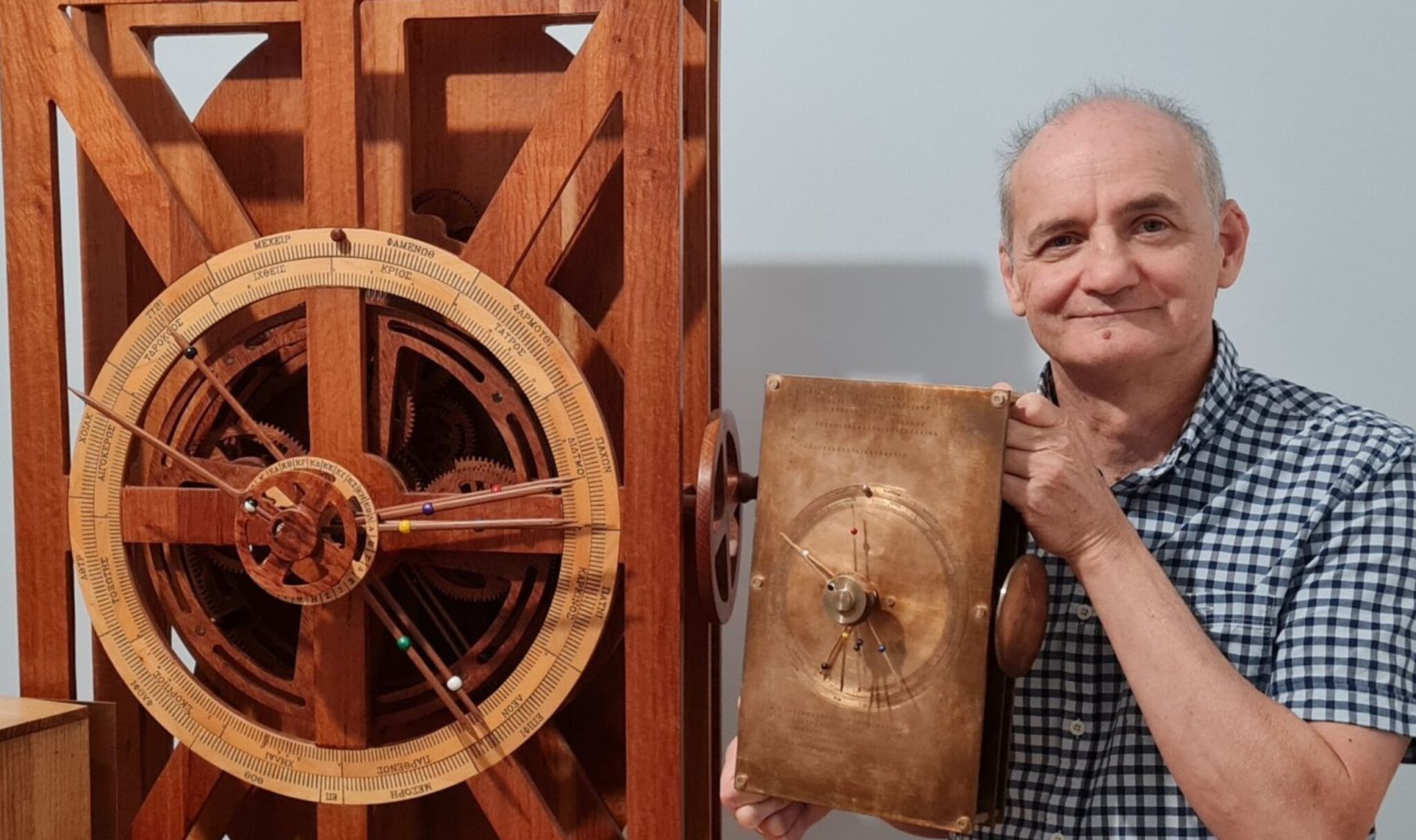
At a time when a team of researchers from the University of London caused a sensation in early 2021 by presenting a three-dimensional rendering of Antikythera Mechanism, a Greek-Australian living in Perth, had already begun building his own version of this famous structure.
Dr. Nick Andronis constructed the mechanism, initially from wood and in larger dimensions, before implementing it in bronze, following the specifications of the original., and then posted his detailed diagrams online so that anyone who wanted to could build it..
Speaking to Neos Kosmos, Dr. Andronis PhD CPEng, a «semi-retired» certified software engineer, electrical engineer, and mechanical engineer, stated that the famous mechanism, whose operation has preoccupied the greatest minds in science since it was excavated by the Greeks spongers open Antikythira in 1901, it is «an ancient Greek portable planetarium dating back 2,200 years and the first known analog computer that marked the beginning of modern computing».
The wars that followed, invasions, and looting interrupted the continuity that this achievement represented by the Antikythera Mechanism, before we reached the technological revolution of the last 300 years, which culminated in the «computer age.».
There is a thousand-year gap in ancient Greek technological development, which has been preserved largely thanks to fragments of writings by Arab scholars. We do not know the full extent of ancient Greek technology, and the Antikythera Mechanism offers a tantalizing glimpse of what it may have been.
Dr. Andronis said that the Roman politician and philosopher Cicero, had referred to the Greek mathematician Archimedes and the fact that he had a device to track the course of the five known planets of the solar system at that time.
Although this reference is not conclusive, it suggests that there was more than one Antikythera Mechanism in existence at that time.
«Scholars have devoted their lives to studying the 57 gears of the mechanism and how they work,» said Dr. Andronis.
Dr. Andronis began reconstructing the Antikythera Mechanism five years ago. For him, what interested him was the process of its construction, rather than its use, a pursuit that cost him dearly.
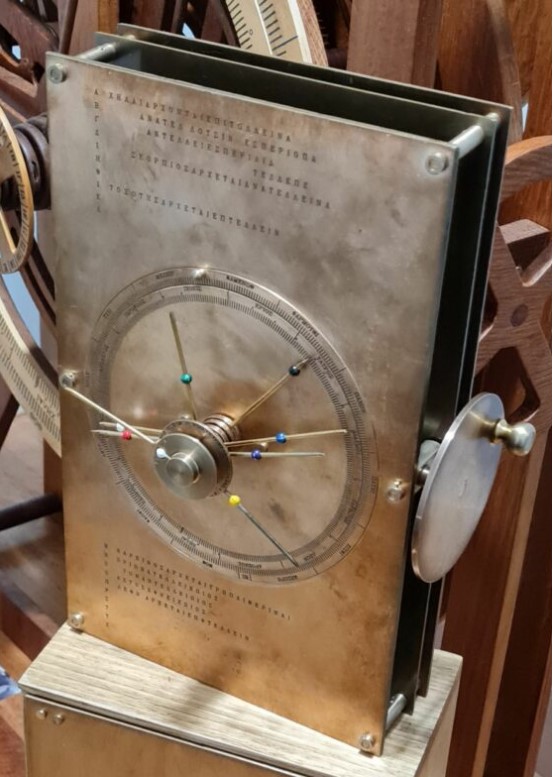
«I stopped calculating the cost when I exceeded $10,000. For me, the mystery lies in the construction of the original mechanism, whose parts are numbered, suggesting that more were made.».
He believes that one of the reasons why no other mechanism has been found to date is because it was made of bronze. Bronze was often melted down to be reused for other purposes. The ancient Greeks were masters of bronze. Most of the statues they made, said Dr. Andronis, were made of bronze rather than marble, but very few survive today because over the centuries they were converted for other uses.
«The Antikythera Mechanism is the result of 500 years of (astronomical and mathematical) knowledge and skill.».
It is the result not only of high technical skills but also of planetary observations and mathematical calculations and methods.
«Only when you build it and try to operate it do you understand the complexity and genius of this ancient Greek design. But it is impractical as a scientific tool.»It would have been easier for scientists of that era to rely on diagrams on papyrus, which were more accessible and less likely to deteriorate,« says Dr. Andronis.
At first, he constructed a larger version of the mechanism out of wood, so that he could understand how to reproduce it in bronze without the gears jamming.
«Copper is a terrible material to work with; it breaks like marble, which is probably why the Greeks were so good at using it. It is also a natural lubricant and is still used in bearings in modern machinery.’.
Having worked on and designed several complex tools, Dr. Andronis was more interested in the process of constructing the mechanism than in its uses.
He adds that it is very likely that the mechanism was intended for wealthy customers who wanted to impress with their knowledge of ancient Greek astronomy. The front and back plates of the mechanism itself have the instructions for use engraved on them.
«It could have been part of a commercial venture—intended to be sold as an impressive instrument to wealthy individuals. If it were a genuine scientific tool, it would have to be ten times larger so that there would be no risk of its gears breaking.
«If one wanted to build an authentic mechanism (like the one found on Antikythera), one would need hand tools and also a metalworking lathe to construct gears capable of holding the component with an oscillation of less than 0.1 millimeters.. I deliberately used a low-quality lathe to build my own to see if it could be done.
The question, then, is what kind of tools did the ancients use to achieve this kind of precision in the construction of the necessary components?.
«Multiple craftsmen would be required: a scribe for the instruction manual and a scribe to engrave the instructions on the front and back plates. There would be specialized craftsmen to process the various components.
Different types of copper were also used: softer copper for the dial so that it could be engraved, and harder copper for the gears. This means that an entire enterprise was involved in its manufacture.
«Looking at this machine, I feel a tremendous sense of loss, as it is part of our cultural heritage that has been lost. We must raise awareness in society about the role of Greek science in our lives.
When we send our children to high school, the mathematics and sciences they learn today originate from the Ancient Greeks. They had tremendously independent critical thinking, and that was the key difference that set them apart from other civilizations of the time,» said Dr. Andronis.