The issue that continues to be at the center of the political debate is the Sewer system project in the southern part of Kythira, following a post by Mayor Efstratios Charchalakis and a statement—a response—from the «Free Kythira» political faction.
In a new statement, the mayor responded to the allegations of overpricing, emphasizing that the comparisons carried out by the opposition along with other works, there are «misleading», since—as he notes—this is «projects that are not alike and have different parameters». He argues that the unique characteristics of Kythira—such as its geomorphology, the high percentage of rocky terrain, the long distances between settlements, and transportation costs, justify the increased expenses. To substantiate his position, he cites the Spetses sewer system project as an example, which—according to the data he provides—cost more per meter than the corresponding project on Kythira.
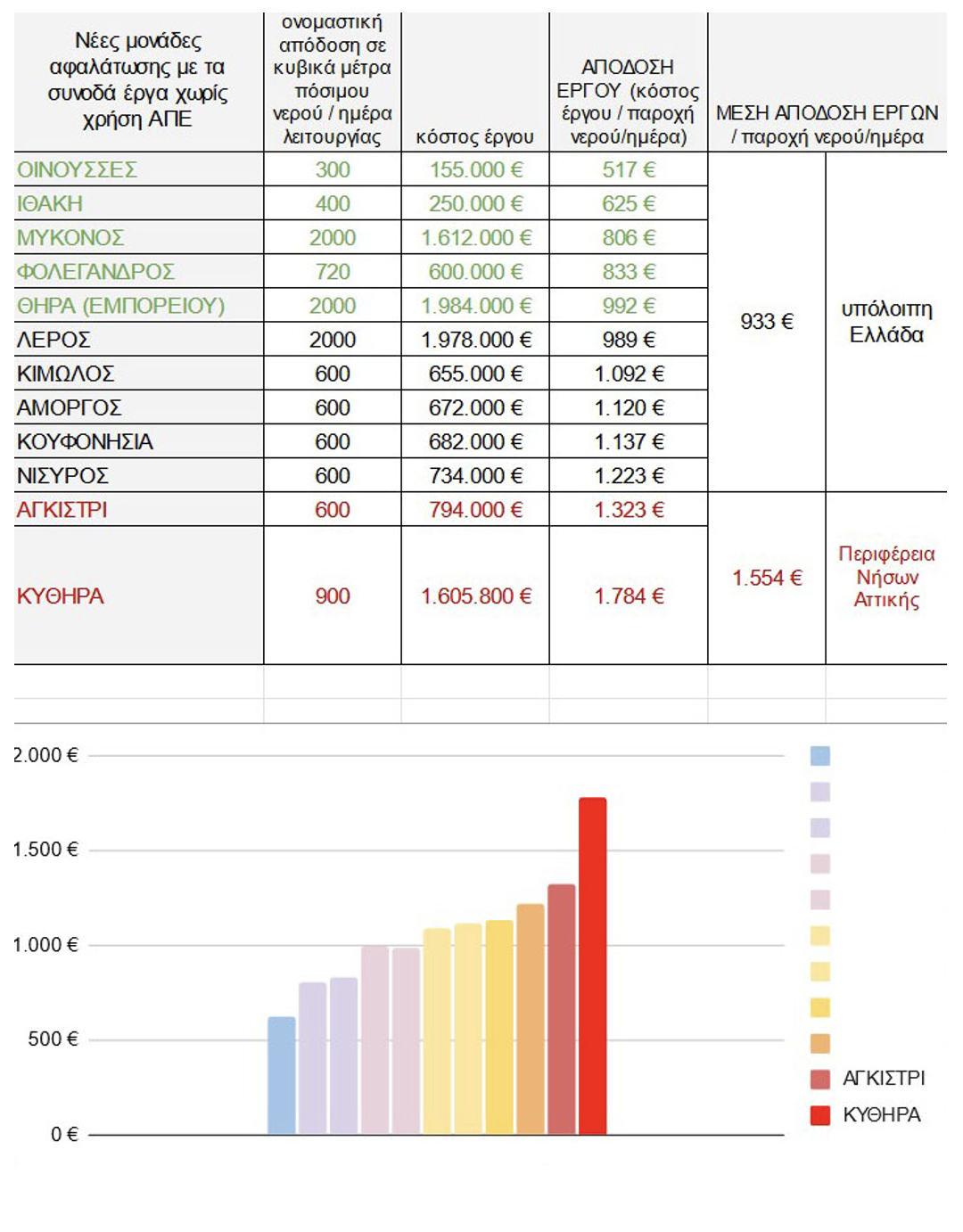
On the other hand, the minor opposition party «Free Kythira» is denouncing lack of transparency and failure to publish complete studies. It refers to «overpricing» and provides comparative data from other islands, such as those regarding the new desalination plants, where – according to the table they have published – the cost per cubic meter of water in Kythira is nearly double the national average.
The debate brings a broader issue to the forefront: How are public works projects in island and geographically challenging areas evaluated, what factors are taken into account when calculating costs, and how is each decision documented?.
For the reader’s convenience, both the post by the Mayor of Kythira and the statement by the «Free Kythira» political faction are reproduced here verbatim.
The press release from «Free Kythira» on Monday, August 18:
What do you want, Mayor?;
(When you're guilty, «it's better to remain silent than to speak,» as you say)
On August 15, after two years of silence regarding the overpricing of the sewer project, the mayor attempted to justify himself by posting as evidence a (carefully cropped so that the comments would not be visible) stating that… there is no obstacle to signing the contract with the contractor.
It's like, you're charging me 50 euros for a country-style dish, and when I tell you it's expensive, you show me the… chef's salary.
However, what lies beneath is more important back from the words. Instead of publishing studies1 With data on «rock content» and soil «hardness» (we’ll have to take his word for it on those), what did he do? He compared the project to a «similar» one on Spetses. Not in Messenia, not in Corinth, not in Spercheios, where the soil is «soft.» In Spetses.
Yes, the ones located (what a coincidence!) once again in the Islands Regional Unit. And in fact, at that time (another coincidence!), St. Veiyoglou, the mayor’s current special advisor, was working in the Regional Authority’s technical services.
Look at that—Spetses turned out to be even more expensive than Kythira! Maybe some people2 Here, they feel like they've been cast aside—that's what's unfair…
To keep this from getting too long in the summer, we’re attaching once again the table from two years ago showing the comparative costs of (prefabricated) desalination units in the Regional Unit Is the … uniquely harsh terrain of Kythira also responsible for the cost of the containers being more than double?;
- For many years now, projects have been carried out either without any studies or with inadequate ones (based on an unsupported, undocumented budget). The practice of not publishing design studies was already adopted following the first scandal of the Harhalakis administration in 2014, when the design studies for the town’s redevelopment and the daycare center in Karvounades—signed by St.Veiyoglou—came to the attention of the engineers in Kythira—at which point he was forced to withdraw them hastily.
- Among those «some people» is, of course, the other Cappadocian, who’s all talk when it comes to airplanes and ships but goes radio-silent and says «yes» to everything regarding public works (he, too, recently voted in favor of the “quality acceptance” of the black water pipe in Agia Pelagia that was stuck in the asphalt among the dry grass). Perhaps he was relieved to be rid of the only engineer in his political faction. Really, think about it: the ruling coalition (the parties trusted by three-quarters of the voters) has only one engineer: Stavros Veioglou. They do, however, have quite a few contractors.
Free Kythira
The Mayor's post on Thursday, August 14, 2025:
Continued: Evidence-Based Answers (Vol. 2)
This is not the first time that the «Free Kythira» (EK) faction has attempted, through lies and logical leaps, to mislead citizens for its own petty political gain. In response to every such desperate move, the Municipal Authority always responds with evidence and facts—something that does nothing to support EK’s narrative.
Speaking of the «misuse of public funds,» the MEPs seem unaware that such serious allegations carry extremely grave criminal consequences, since they are neither proven nor documented beyond a reasonable doubt.
The comparisons presented by the EK regarding the construction costs of networks and connections for the project «Sewer System for the Southern Part of the Island of Kythira» are highly misleading. The comparison is completely unfounded, since it compares UNSIMILAR PROJECTS with entirely different parameters.
The article does not take into account the specific characteristics of Kythira, particularly the large number of settlements, the distribution of the population and the long distances between them, as well as the island nature of the region and the high cost of transportation.
They highlight the difference in cost per connection (€177.00 in the rest of Greece versus €404.00 in Kythira), citing the corresponding project in the «Spercheios Basin.».
Is this really the only comparable project, or is that just a convenient excuse?;
Regardless of whether the two projects «have similar population densities,» other, equally and/or more significant parameters affecting cost, such as, for example, the topography of the project’s construction site (the percentage of rock in the «Spercheios Basin» project is just 4.95%), the transportation costs that the State itself acknowledges in its 2004 Ministerial Decision, etc.
Our fellow islanders are well aware of the higher prices on the island due to shipping costs.
If the project’s cost were to be verified, it would have to be done using another PROJECT UNDER SIMILAR CONDITIONS, such as, for example, the «SPETSES SEWER SYSTEM,» which shared the same characteristics as the Kythira project (island location, high transportation costs, rocky terrain, etc.).
Phase 1 of this project, which has been completed and accepted, included the following elements:
• Length of network constructed (including unfinished pumping stations and excluding private connections): 23,436.65 m
• Actual expenditure (from final statement): €9,896,029.49
• Cost per running meter: 9,896,029.49 ÷ 23,436.65 = 422.25 €/m
This cost, as it appears, is HIGHER than the cost of our own project and DOES NOT INCLUDE THE CONNECTIONS, and it was built four years ago at the lower prices that were in effect at that time compared to today.
It also overlooks the fact that, in the Kythira project, the settlements are very far apart from one another. For example, the settlement of Mylopotamos, with its small population and consequently few connections, is located approximately 6,000 meters from the main sewer line. As can be seen, this factor increases the cost per meter of project length or per resident.
However, the inclusion of the village of Mylopotamos—and, in essence, that of Kalamos as well—in the project’s design is a significant achievement.
In this way, the nearby settlements (Araioi, Kato Chora, Piso Pigadi) as well as other settlements in the southern section (Fratzia, Manitochori, Xeroniamata, etc.) will be able to easily and at relatively low cost connect to the sewer system currently under construction, as the necessary provisions have been made in the cross-sections of the main pipes.
Another factor that is DELIBERATELY OVERLOOKED is the extremely rocky terrain in our region. The topography of Kythira is considered «mountainous,» since only 5 of the 68 settlements are located along the coast, while the rest are at an average elevation of 300 meters. This fact alone highlights the «harshness» of the terrain, in contrast, for example, to the Spercheios Basin, where the soil is primarily loamy.
In sewer projects, the focus is on connections or equivalent residents. To compare two projects based on a single parameter (e.g., the budget), they must be exactly the same. Otherwise, you must also take into account other parameters, such as network length, pumping stations, construction difficulty, facilities, modifications to existing facilities, etc.
Our project includes a 48-kilometer network, 13 pumping stations (14, including the major renovation of the main station in Kapsali), pipe diameters up to Φ500, a complete sewage treatment plant located 19 km from the wastewater treatment plant (WWTP), renovation, expansion, and upgrading of an existing WWTP, and a route topography that requires pipeline depths of 6.00, 7.00, and 7.50 meters!
Therefore, a comparison must be made between the budget and the connections, taking into account network lengths, the number of pumping stations, pipe diameters, construction and modifications to facilities in order to reach a reasonably reliable conclusion.
In any case, however, the project’s financial data, as included in its approved study, were also included in the Technical Data Sheet accompanying the funding application, and which, following a positive evaluation, was approved and accepted by the funding authority, which also had at its disposal the financial data for the other projects cited in the article.
It goes without saying, therefore, that the mere approval of the study by the funding authority of the Ministry of Energy, by officials of the Recovery Fund (EU), and subsequently by the relevant panel of the Court of Auditors, refutes all malicious allegations regarding the «misappropriation of public funds,» , while the success of this project’s inclusion in the program and its current implementation should be credited to all those who worked and toiled on this project, which will now be an asset for the island’s residents.
The rest from this week.
May the Virgin Mary bless you!