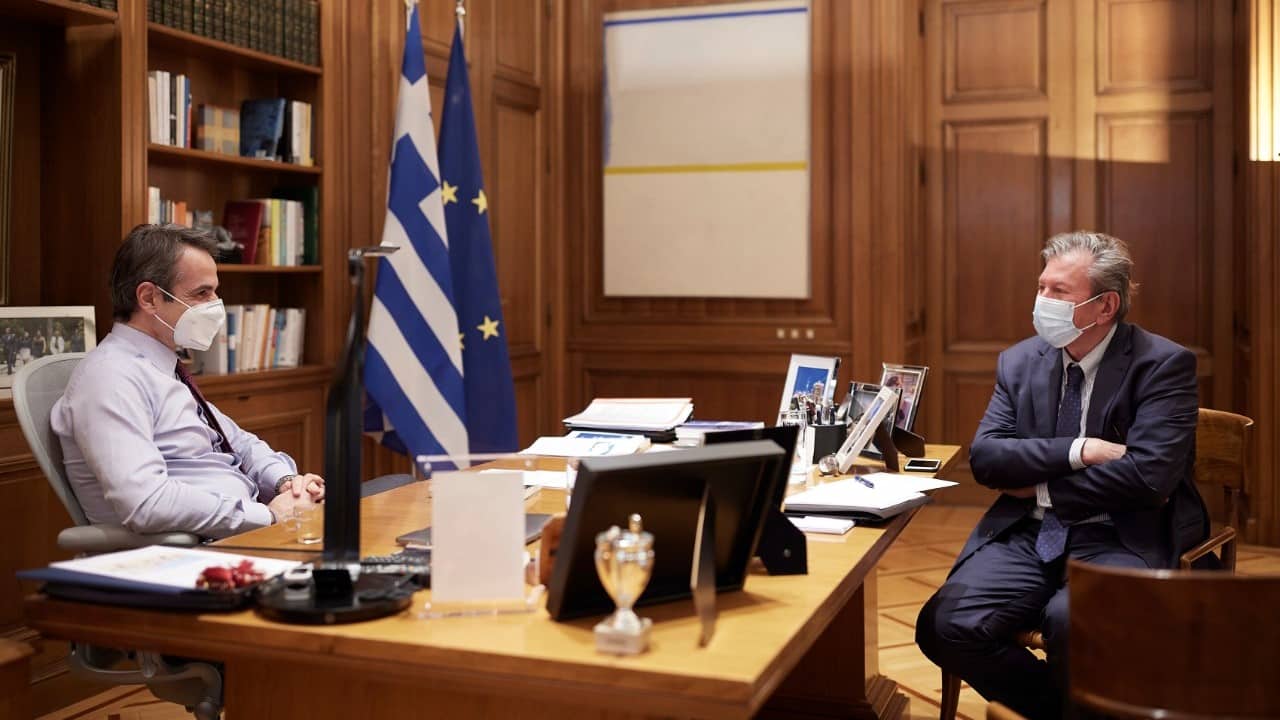
Prime Minister Kyriakos Mitsotakis sends a message of optimism.In an interview with Vima on Sunday, he stresses that after the pandemic - which he describes as the “last bend of the adventure” - the country will make a ten-year leap in the field of development.
At the same time, Mitsotakis categorically states that elections will be held at the end of the four-year term, as his aim is for the government to be judged on its overall policy and on the specific “deliverables” concerning the country's recovery.
The Prime Minister accused the President of SYRIZA of “preferring the street to the law”, while on the issue of the convicted terrorist he stressed that “democracy did not give in to the blackmail of Koufontina”.
Mitsotakis says that the main objective remains that by the end of April all citizens over 60 years of age and those suffering from a serious disease will have been vaccinated with at least one dose, and expresses his optimism that “we are reaching the end of the war with the coronavirus and in the end we will emerge victorious”. He believes that “despite the difficulties, the country has done much better than other countries” and adds that “if Greece had the average European casualty rate per million inhabitants, today we would be mourning twice as many victims”.
The prime minister defends his policy choices on the issue of the private medical sector requisition, saying that “if we had rushed to do what the opposition had been demanding since last April, we would have made requisitions without needing them then, spending tens of millions. But now that the private sector's contribution is required, we are moving forward in partnership with the private sector in the first instance.”.
The Prime Minister explains that the strategy for dealing with the pandemic is based on two pillars: First, further strengthening of the Health System by tackling the spread and increased testing, and second, partial decompression “with measures that will give citizens a breathing space”. It also announces arrangements for a gradual opening of the retail sector as a first step towards the liberalisation of economic activity.
Mitsotakis also says that he sought a mild political climate, making self-criticism, but - as he notes - “in our country the pandemic and the mockery were instrumentalized, identified with the government, instead of being what everyone understands, an unprecedented health crisis that strikes the whole world”. He accuses the opposition of “inserting covid into the agenda of partisan fighting” and Al. Tsipras of pursuing a “health and social sabotage”.
Referring to Greek-Turkish relations, he notes that the government has managed to turn them into Euro-Turkish relations, and stresses that on the refugee issue, Greece allowed Europe to negotiate with Turkey from a position of strength by holding its borders on the Evros River a year ago.
The Prime Minister's interview with Vima on Sunday
Antonis Karakousis: Mr. President, for a year now we have been facing an extremely difficult situation. The long duration of the health crisis has obviously affected citizens. Everyone is feeling tired. At the same time, the strength of the health system is being tested. What are the prospects? How optimistic are you?;
Kyriakos Mitsotakis: I sincerely believe that we are going through the last difficult step of the adventure. Why do I say this? Because we now know that vaccinations are both safe and effective. Every week 200,000 of our fellow citizens are vaccinated. And that number will more than double from April onwards, when we will have many more vaccines.
Antonis Karakousis: So the target of 5 million vaccinated at the beginning of July exists?;
Kyriakos Mitsotakis: Our goal remains that by the end of April, all people over 60 years of age and those suffering from a serious disease will have been vaccinated, with at least one dose, by the end of April. Many of them, in fact, with the second dose. This will de facto reduce the pressure on health structures, allowing us to move towards a freer adjustment of economic and social life. After all, we are already seeing the first effects of vaccination: Hospitalization data show that older people who have been vaccinated are much more protected than those who have not been vaccinated or younger people whose turn has not yet come.
I am optimistic that we are reaching the end of the war with the coronavirus and that we will finally emerge victorious. Let us not forget that, despite the difficulties, our country has, on the whole, done much better than others with better organised and well-funded health systems. If Greece had the European average in terms of losses per million inhabitants, today it would have twice as many victims. And we have avoided this because citizens, despite any relaxation and fatigue we have seen in recent weeks, have followed the instructions of the experts. And, of course, the State strengthened the National Health System, which was carrying many pathologies. However, this has exceeded all expectations, possibly even our own, by dispelling many stereotypes.
Antonis Karakousis: You mean the stereotypes between public and private.
Kyriakos Mitsotakis: I mean the stereotype of the «lazy» civil servant, which has been shattered, as our doctors and nurses, our Civil Protection and security forces, our teachers and so many others have fought a great battle with dedication and efficiency. And that is a major achievement for the day ahead. Just as the stereotype of the «callous» private sector has been dispelled. Because hundreds of institutions, companies, and individuals have turned to and supported the National Health System with donations. At some point, therefore, we must realize that the public is not the same as the state. But with the national, which all our forces serve.
Antonis Karakousis: Now that there is a lot of pressure on public hospitals, would it be beneficial to use the private sector more?;
Kyriakos Mitsotakis: But this has already been done. The public and private sectors are working together under the guidance of the Ministry, with a single purpose: To protect the health of our fellow citizens.
Antonis Karakousis: I guess you are also listening to the request of the requisition...
Kyriakos Mitsotakis: The reality is this: If we had rushed to do what the opposition had been asking us to do since last April, we would have made requisitions without needing them then, spending tens of millions. But now that the private sector's contribution is required, we are moving, in the first instance, to work with the private sector.
Let me give you an example. Last week the Henry Dunant went into the National System on-call for non-covid incidents and coped very well. And, the other day, other private hospitals joined the fray. We always prefer collaboration as a first step. Because you also understand that an order can be a legally powerful concept. But when we ask a doctor to provide his services, it is not enough just to oblige him. We must also inspire him to do so. But if I need to use the last constitutional tool at my disposal, that of the personal services order, I will not hesitate to do so.
Antonis Karakousis: I just think that logically everyone has an interest in a quick return to normalcy, even the private sector...
Kyriakos Mitsotakis: Our strategy, now, is based on two pillars. The first is the further strengthening of the Health System, addressing the diaspora where there is an outbreak of the pandemic and an even more extensive testing strategy. The second pillar is the partial decompression of society with measures that will give citizens a breath of freedom. And then with regulations that will carefully free up economic activities. First step, the gradual opening of retail trade.
I believe that citizens will appreciate this release valve and thus be persuaded to return to compliance with the rules that have been weakened. In other words, to do the basics: to keep our distance, to avoid confusion and transmission within the family home. And wear a mask. The weather helps us, and vaccinations help us.
Antonis Karakousis: The 7 p.m. curfew measure Saturday and Sunday no longer makes sense. It obviously did not work.
Kyriakos Mitsotakis: Indeed. That's why, as spring comes, it's better for citizens to have access to more open spaces. This is what the experts are suggesting to us. With small and familiar compositions, so as to avoid gatherings in homes. However, this fatigue of society is not a Greek phenomenon. When I talk to my colleagues in Europe, we all see it everywhere. Therefore, I believe that this approach will have a positive impact. And it will help us to better adhere to those minimum measures that we know will definitely accompany us for some time to come.
Antonis Karakousis: I understand that you are attempting a chain of combined positive options, alongside vaccinations, that will make it faster and safer to open up tourism as well. But this chain, which I think makes sense, would not be supported by the whole political system? I mean, to call for a political moratorium, so that everybody can contribute, in the next quarter or six months, to make things a little bit calmer. Would you attempt something like that?;
Kyriakos Mitsotakis: I have sought a mild political climate many times through a public speech that was not only political. It has always been based on facts. And often, indeed, it was self-critical of any mistakes made. However, this approach also requires a minimum of agreement on the facts on the other side.
But, unfortunately, you see, in our country the pandemic and the coronavirus have been politicised. They have been identified with the government, instead of being what everyone understands, an unprecedented health crisis that is hitting the whole world. This was done to target the government and me personally. So this does not create conditions of synthesis. Because while the government is appealing to science and common sense, the opposition is putting Covid on the agenda of partisan fighting.
Antonis Karakousis: Are you referring to the demonstrations?;
Kyriakos Mitsotakis: Of course, and to them. In the face of the pandemic, we took decisions from the very first moment that restricted important individual and social freedoms. Trusting in the responsibility of all political forces, we did not ban demonstrations. We made an exception because such a move would have been easily misunderstood. Although, personally, I do not consider the right to assemble to be necessarily more important than the right to work. We relied on the logic and goodwill of the parties not to encourage people to participate in something that poses a serious health risk.
Unfortunately, however, Mr Tsipras was the first to give the signal for the demonstrations, saying that he «accepts the risk» of the virus being transmitted by the rallies. A health sabotage thus ensued. Because mass confusion is proven to spread the virus. But also a social sabotage. Because it sends a message of collective violation of protective measures. Insulting not only the patients inside the ICU and the doctors who are fighting. But also the millions who discipline and endure the restrictions.
Because the citizen wonders: When others go to a demonstration, why can't I go to another house? The «so-will» of the few, therefore, breaks the relationship of trust between the many and the State. So it is a corrosive and divisive behaviour.
Antonis Karakousis: Yes, but the virus is not only transmitted at demonstrations...
Kyriakos Mitsotakis: So what? So? There are conditions that cannot be changed immediately. But the decision not to have a march at the peak of the pandemic is only in our hands. So this is a cynical choice that subordinates public health to partisan interest. For there to be new «outraged» let the intubated multiply. This is what SYRIZA's policy means in practice.
Antonis Karakousis: However, just recently Mr.Tsipras proposed a moratorium.
Kyriakos Mitsotakis: The term itself refers to a warlike climate and to opposing parties. I recently said to Mr Tsipras in Parliament «you are not my enemy. It is the coronavirus». Even today, unfortunately, he does not distance himself from the slogan «Either we finish them or they finish us», as I called him. He does not do so because that is what he ultimately believes.
Besides, nowhere in the world does an opposition party call for mass meetings. Only extreme parties, such as the AfD in Germany, do so. And, of course, the Trump supporters who stormed the Capitol. What Tsipras means by a moratorium is that the parliament should not legislate and the government should not make decisions under the threat of demonstrations. In other words, he says «yes» to the street, but «no» to the law. Not passing bills that the government has voted for and not running the state. In other words, he wants democracy quarantined. Something that cannot happen.
Antonis Karakousis: Recently, however, especially after the events in Smyrna, the pressure has obviously increased...
Kyriakos Mitsotakis: Yes, but it wasn't just these events. I recall that there had been about 150 demonstrations in support of Koufontina. The hunger striker, of course, backed down. But the responsibility strikers remain.
Antonis Karakousis: One could tell you that people from the broader liberal party also took a position not in favour of Koufontina, but in favour of his right to be treated like all other prisoners.
Kyriakos Mitsotakis: But the government never said anything different. The government never said anything.
Antonis Karakousis: I think this claim mobilized many people.
Kyriakos Mitsotakis: I don't think so. I don't think so. Because Kufodinas, in the end, took on democracy and its expression, which is the rule of law. And he adapted precisely because democracy did not give in to his blackmail. Otherwise, we would have had a significant discount on egalitarianism and the rule of law. Something I personally would never allow to happen.
Antonis Karakousis: From there, however, we moved on to the broader demonstrations on police brutality issues. With the event first on Sunday, in Nea Smyrni Square, and what followed. Around police arbitrariness, so to speak, there is sensitivity. Which stems not only from the behaviour of the Greek police, but also internationally. Similar issues have arisen in America and in Britain recently.
Kyriakos Mitsotakis: Let's reflect a little bit on why it's coming up now. I think one reason is the particular psychological burden on all societies. So in conditions of tension, it takes a spark to cause incidents to break out on one side and the other. And I agree that the phenomenon is not only Greek. I would say that in our country we have not had so many incidents of police violence. One could possibly make a legitimate criticism that even these few incidents were not adequately investigated. It is something that I pledged in Parliament that I would change. I would say, therefore, that in Greece we had rather the opposite problem: a systematic retreat of the state in the face of violence in the name of the «right-wingism» of some.
That has changed under our watch and I think it is a good thing that it has changed. And one cannot equate some isolated and reprehensible incidents of police violence with the tolerance of organised violence that has plagued the country for decades. Nor can one equate the police with the hooded man who throws the Molotov cocktail.
Antonis Karakousis: They take on, however, greater dimensions because they evolve in a very specific time.
Kyriakos Mitsotakis: They are getting bigger for two reasons. The first has to do with the situation we are experiencing, which, as I said, is not normal. There is accumulated tension and fatigue, especially among the youth, who feel, justifiably to a certain extent, that they are losing a part of their lives. I fully understand both the anger and the questioning. After all, I was the first to tell you that I am not lifting a finger, but I am opening my ears to listen to young people. To welcome their fruitful questioning. But not destruction and blind violence.
The second reason, unfortunately, is that this approach has become a party banner by the opposition as a so-called anti-government protest. But it is based on a false assumption: that the government has supposedly failed in its management of the pandemic and the economy. And that to hide its failure it is pursuing an authoritarian policy.
Double lie. First, because despite the difficulties, we have achieved a lot on the health front, as well as on the economic front. And secondly, because neither before nor now can I personally be accused of being an authoritarian politician. Quite simply, some people are trying to portray me as something I am not. So when you clash with reality itself, you will eventually come out the loser.
Antonis Karakousis: You do, however, lead the conservative faction of the country...
Kyriakos Mitsotakis: Some people do not understand that the dividing line dictated by the old theories, life has already replaced it with distinctions imposed by modern conditions. From the «left-right» dichotomy, I prefer the pair «progress - fixation». Because what is at stake today is not simply the fair distribution of wealth. But the increase of wealth, which will also bring about its equal distribution. Anyone who insists on inertia cannot therefore be called progressive. A progressive in the 21st century is anyone who looks ahead, learns from experience and is not afraid of doubt.
Graham Green has written that a Catholic and a communist, if they can doubt, then they can meet. It is in this synthesis through constant searching that I believe in. As I have said, a progressive is one who preserves what is worth preserving and changes what needs to be changed. Our opponents will never understand this.
Antonis Karakousis: But the country will move forward with the young people, they will bear the burden of exiting this crisis. They will bear the cost of recovery. Today's 20- and 30-somethings, many of whom have only experienced crises.
Kyriakos Mitsotakis: I agree. In view of the 200th anniversary of the Greek Revolution, it is worth seeing how we can meet these new currents that are coming with momentum. And especially for young people, I believe that such symbolic dates can really mark a key intersection with the past. Because the challenge immediately after the pandemic is not to just take a few steps to improve. But many brave leaps forward.
Antonis Karakousis: The tools are there now...
Kyriakos Mitsotakis: Yes, both economic and social tools. The private sector has built up a significant stock of savings and resources in the pandemic, which it can either spend on consumption or invest. And, already, creative Greek businesses - I think you've written about it - are thinking about their next steps. Their investments. They want to play offense, not defense. Because they see the prospects of a quick recovery after the coronavirus.
Also, we will no longer have the suffocating constraints of large primary surpluses, even if it puts a strain on the debt. This is something that the markets accept. Proof of this is that Greek 30-year bonds were issued at historically low interest rates. And when a country borrows for a 30-year period it means that it is trusted internationally.
And, finally, we have the Recovery Fund. A unique opportunity for additional European resources, essentially a second NSRF, to promote reforms and interventions in critical areas. Like digital switchover. Green growth. Major public works. Private investment. But also investment in human capital and employment.
Antonis Karakousis: You mentioned social tools as well. You mentioned social tools; you mentioned social media.;
Kyriakos Mitsotakis: I am talking about human capital. I am talking about a generation of advanced children, a diaspora - I am referring to the brain drain generation - that for the first time is looking at returning to the country positively, seeing its prospects. And I would add that after 10 years of crisis, this social capital is coming out more mature. More confident and with greater trust in the state.
If we had said two years ago that we would make such impressive strides in digital modernisation, it would seem unbelievable today. Yet it was in our election manifesto and it is becoming a reality. From electronic certificates to paperless prescription and citizen services without physical presence. Just as it would be hard to believe that Greece would flawlessly organise a complex mission like Operation Freedom for mass vaccination. Combining technology and human contact. The keyboard with the smile. Therefore, the spring can be ejected.
Antonis Karakousis: Yes, the compressed spring theory. It was often invoked by Yannis Stournaras...
Kyriakos Mitsotakis: This theory has been heard many times. It has been heard many times, but now the preconditions are there. When we won the elections - and at that time we had neither the challenges of the pandemic, nor of immigration, nor of Turkish aggression - I said that in order for our economy to move forward, three basic conditions must be met:
First, to change the fiscal policy mix. Something that has changed de facto. And so now we are making permanent the temporary tax cuts, but also continuing to ease the burdens on workers and businesses.
The second prerequisite is structural changes that will make Greece a more attractive destination for investment. And this is already happening and is continuing, you see. You see how strong the international investment interest in our country is today.
And third, the consolidation of the banking system through the rapid reduction of «red» loans. This is also being done with critical and useful tools such as the Heracles scheme made available to banks by the Greek government.
So, the conditions are already there for a leap, I stress, not just a step. A decade-long leap, not a temporary jump in GDP. Because it will be based on real foundations, transforming the economy as we have been calling for for so many years. A competitive economy based on extroversion and our comparative advantages.
Antonis Karakousis: The question, however, is whether the private sector will be able to put together as many investment projects as the programme allows? Through the leveraging of bank and private capital, can €30 billion of private investment be promoted?;
Kyriakos Mitsotakis: First of all, a large part of the maturation of such projects obviously comes from the private sector. To give an example. In the change of the law on public works we give the possibility to use ’innovation proposals«. What are these proposals? The ability of the private sector to study and mature a project with its own funding. And then to propose it to us so that, if it fits into our overall planning, it can be taken forward immediately. It is another measure to remove the obstacles and the constant delays that have made the private sector reluctant. And the more the business environment improves, the more incentive there will be to invest capital, Greek or foreign, in our country.
Antonis Karakousis: I assume that this scheme of public and private investment also delivers your vision for the country?;
Kyriakos Mitsotakis: Not only. I would like to focus on the growth model that I envision for small and medium-sized entrepreneurship. For the small hotel, for the small agri-food unit, for the small winery. Because a big part of the country's comparative advantage, in its third century of life, is the ability to offer Greeks and foreigners unique experiences.
The unique experience is not only a beautiful beach in summer. It is much more. And Covid acted as an accelerator of some trends that were already in place and will now move with much greater speed. For example, one of them is the decoupling of work from residence. To be able to work, that is, from Domokos at a good time, to think about your place of origin, from an island or from a nice village in Epirus. As long as you have some basic requirements: Good connectivity, that is digital infrastructure which we are already launching, and of course access to those who want to invest in human capital.
So I will say again that the country's comparative advantage is not only its natural beauty, biodiversity and clean beaches. It is also the so-called man-made environment. Its people, around whom everyone has a good time. They are elements of our tradition but also components of our modernity, at least as I imagine it. Because being progressive means embracing the messages of the future, keeping and evolving your tradition.
Antonis Karakousis: That all sounds pretty visionary.
Kyriakos Mitsotakis: And realistically, at the same time. Having read the latest book by our eminent historian Stathis Kalyvas, we talked about the challenges of the past two centuries. And indeed, the stakes of the first 100 years were national integration. To constitute Greece, to incorporate territories and grow, but also to welcome refugees into the national core...
Antonis Karakousis: The lost homelands...
Kyriakos Mitsotakis: Yes, the lost homelands. And the Greek populations either internally or through the traumatic period after the Asia Minor Catastrophe. And ’21 is an occasion to revisit other events. 1922, ’23, ’24. How the country was grafted with the dynamism of the refugees. So if the first 100 years built national constitution, the second 100 years built development.
Antonis Karakousis: The transformation.
Kyriakos Mitsotakis: Exactly. What, I wonder, is the stakes for the next 100 years? So when I asked Stathis Kalyvas, he said, «Happiness.» I agree. It is happiness as a concept linked to the way we work and the way we live our daily lives, combining all that we are entitled to as citizens and as individuals and distinct personalities. And Greece can claim this «happiness» of the future.
Antonis Karakousis: There is of course the book by Professor C. There is, of course, Professor G. Dertilis, entitled «Seven Wars, Four Civil Wars, Seven Bankruptcies». We have to overcome these too in order to reach happiness...
Kyriakos Mitsotakis: Yes. Yes.But if we take stock, we will see that we started as a region of the Ottoman Empire and 200 years later we are the strongest and richest country in our immediate neighbourhood and one of the most dynamic in the wider region.
Antonis Karakousis: And the most important...
Kyriakos Mitsotakis: And the most important one. We have other ways of looking at the stereotypes that have accompanied our course. I personally reject the image of the underdog, the oppressed, the one who always has someone else to blame. I prefer the model of the resourceful Odysseus. That is to say, a people who, through their intelligence, wit and hard work, eventually managed to achieve much more than some people thought they could.
In any case, however, let us agree that these days are indeed a period of reflection. With a critical look at the past, but also with confidence for the future. An opportunity to reflect on the Greece After. The Greece after the pandemic and after the crisis. The Greece of our children. Because this country was built on the assumption that every previous generation will make sacrifices so that the next one can have a better future.
Antonis Karakousis: These are the foundations on which post-war Greece was indeed built.
Kyriakos Mitsotakis: These were the foundations. These are the «householders», whom some people remembered so late. And these are the values we must reactivate, reaching out to the youth. I have children 23, 22 and 17 years old. And I see a generation that is conscious, realistic in its expectations, and abhors pretence. Very spontaneous. Not as concerned, I think, with consumption as much as the generation immediately before was concerned with it. Instead, she puts the emphasis on professional advancement, quality relationships, friendship, the modern family.
I would say that her role model, if I were to choose from the sports world, is Giannis Antetokounmpo. But not because he earns millions of dollars. But because he is self-made, modest, a family man and doesn't forget his origins. How a poor kid from Sepolia, son of an immigrant, with hard work became the MVP of the NBA. This is important. Because we also lived through years where consumerism covered everything. The consumerism of borrowed money. And the logic that led us to bankruptcy as well.
Antonis Karakousis: In my opinion it was social mobility that defined Greek evolution, through public education in particular. I am telling you this by my own standards, by my own background and experiences. It started in the years between the wars, with the wave of Venizelos' educational reform that continued after the war.
Kyriakos Mitsotakis: And this mobility continues to this day, despite the weaknesses of the education system. There is no doubt about it, look at the achievers in the universities. Look at the achievers from the region and the public schools.
Antonis Karakousis: The composition has changed now...
Kyriakos Mitsotakis: Not so...
Antonis Karakousis: It was more dynamic 30, 40 years ago.
Kyriakos Mitsotakis: Education remains the lever. Public education is the basic and irreplaceable mechanism that opens doors to tomorrow. But what kind of education are we talking about? Is it a mechanism of social mobility to drive children to university departments that simply give them a degree that ultimately leads them nowhere? This borders on hypocrisy. Or deception. A fantasy of education that does not correspond to the labour market.
That is why education reform is so important. That is why the new skills we need to teach children oblige us to look at school in a completely different way. When, today, I have access to every piece of information from my mobile phone, what value is there in memorising it? And when in the 21st century everyone is looking for specialisation, what vocational education do Greek children receive? The key is there. As in critical thinking and the ability to work together.
Antonis Karakousis: They are resources.
Kyriakos Mitsotakis: Ephodia yes, that is the most correct expression. That is the most correct expression. And, fortunately, this discussion is starting. It starts from enlightened teachers. From parents. From academics themselves, who see the public university gradually unleashing itself from the logics of other decades. Our job is to give a brave push to this great effort for change.
Antonis Karakousis: You could have formed an alliance there, with the participation of the whole educational community.
Kyriakos Mitsotakis: Why doesn't it exist? Don't you think that the majority of professors today understand that, for example, violence in universities cannot continue? Unfortunately, however, many do not dare to speak out because they will be victimised. And if they are not threatened by thugs, they will be targeted by the thugs of the internet. Many people, today, do not speak out because, quite simply, they cannot stand online slander. But I'm sure they support the changes. Weren't you surprised by the incredible personal attack on the Rector of Aristotle University by certain political spaces in confluence with extra-academic elements that openly identify with the spaces of hooded men and anarchist violence?;
Antonis Karakousis: Are you dealing with the election scenarios?;
Kyriakos Mitsotakis: Elections will be held at the end of the four-year term.
Antonis Karakousis: I think your answer is self-evident in the present circumstances...
Kyriakos Mitsotakis: No, I will explain it in an explicit way. The elections will take place at the end of the government's term of office because my choice is to put to the judgment of the Greek people not only any successes we have had in managing crises such as the pandemic, the immigration issue or our national issues. Nor for what we have done in the areas of tax reduction or the modernisation and digital transformation of the state. The aim is to be judged on our overall policy and on the specific «deliverables» that relate to the country's recovery.
I want to present a changed country to the Greeks in four years. And to ask frankly whether they are satisfied with this course. Whether they want us to continue it more dynamically and with better results or whether they will take the risk to interrupt it. This will be the moment when our term of government will be judged in relation to the one that preceded it. And to compare everything: the most suitable prime minister, the most effective government, the work, the performance and the position of Greece in the two periods.
It is true that for a year we had to expend a lot of energy, facing unprecedented challenges. But we never stopped planning for the next day. That is why we are ready to start the engine of the economy immediately. I will give just one example. We raised the issue of the Recovery Fund from the very beginning, and today it is a fact. Just as we were the first to raise the issue of the vaccination certificate, which is also now a reality. Why? Because we saw, perhaps before others, that at some point people will travel and we have to facilitate those who want to come to Greece.
And I don't understand why some people here fought the vaccination certificate because they don't agree with the Prime Minister who introduced it. Just the other day, Mr. Tsipras called the European health certificate that our country proposed and achieved «nonsense». While Greece is being vaccinated and building a wall of immunity, he is building his own wall of nonsense. He insists on fighting not only the tourism sector and its workers, but also the national economy as a whole. In other words, he is fighting his own country.
Antonis Karakousis: Really, how far along is the preparation of the Recovery Fund?;
Kyriakos Mitsotakis: The presentation of the National Plan is 1,000 pages in total. With projects and reforms described in detail. That is why it was not only very warmly received, but - who would have expected it - it was used as a model for other countries that had done a more sketchy job.
And having now 20 months of experience in the European institutions, I can tell you that we have nothing to envy. Nothing at all. Greece is at the forefront among the Europeans. In the front line against the pandemic. In the economy and in containing unemployment. But also on the front line of diplomacy. A calm power in the Eastern Mediterranean, with a web of alliances not against Turkey, but certainly in favour of national interests. And I believe that our country will only pleasantly surprise, in the years to come, all the suspicious. Both outside Greece and inside Greece.
Antonis Karakousis: Can Turkey, really, put obstacles in the way of the progress of the country that you are seeking? I ask because there is widespread concern.
Kyriakos Mitsotakis: No. We know that the charter stipulated that we should live with Turkey, with the best possible neighbourly relations. I believe that we have established a framework so that Greek-Turkish relations now pass through the prism of Euro-Turkish relations. The same applies to Cyprus. It is a success of our foreign policy, because this was not at all a given a few years ago. So I believe that the dual path of a positive agenda with better cooperation on the refugee issue on the one hand, and the prospect of substantial economic sanctions on the other hand if Turkey returns to offensive behaviour, is the right one. This is, after all, the path that also leads Turkey to a creative relationship with Europe.
Antonis Karakousis: Recently the German ambassador described a mix of European sanctions and incentives for rapprochement as the most realistic policy towards Turkey. How do you view this option?;
Kyriakos Mitsotakis: We certainly need balance. But surely we are the ones who allowed Europe to negotiate as a whole as Europe with Turkey. Especially on the Refugee issue, from a position of strength. Because, quite simply, we held our borders. If that had not happened, Europe would have been negotiating with Turkey from a position of weakness. But today, it is talking to Turkey from a position of strength. And it owes that to us. It is something that I think all our partners recognise.