Alexis Tsipras presented the SYRIZA-Progressive Alliance’s plan for the new National Health System (ESY).
«This is not just a policy commitment. It is a national imperative. It is our top political priority for the coming years. A new National Health System that values life, one that will inspire confidence, reliability, and prestige. One that will respect the priorities and limits of every citizen. One that will treat every patient according to their needs, not according to the size of their wallet.».
The plan is based on three specific pillars:
First pillar:
A New Social Contract with public health workers: doctors, nurses, and administrative staff. This agreement between us recognizes workers as the cornerstone of the NEW National Health System. Without them, there can be no reform.
A prerequisite for strengthening the system is a substantial increase in the salaries of public health workers.
But also the strict enforcement of laws against corruption.
The second pillar:
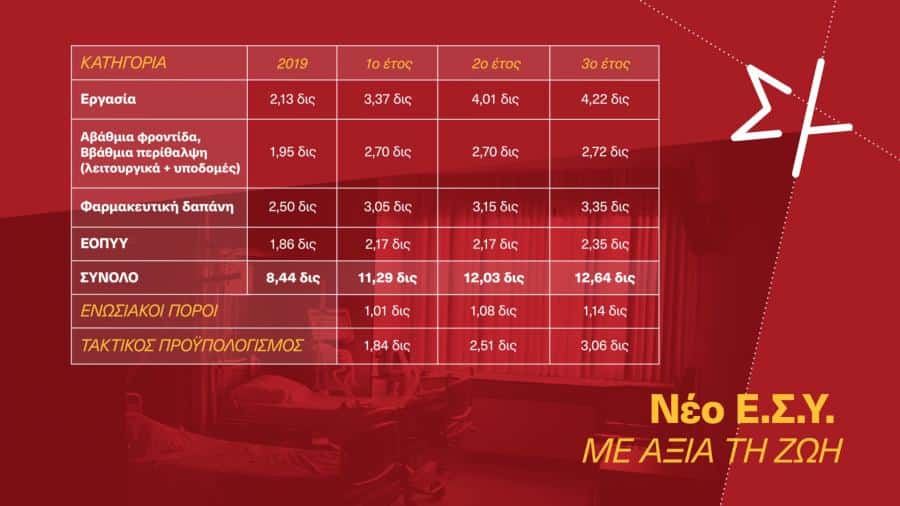
A substantial increase in the system’s financial resources, so that over a four-year period they will align with the European average, which stands at 7% of GDP. However, prior to that, during the first year of the NEW National Health System, a financial injection of approximately 2 billion € is planned from the national budget, plus an additional 1 billion from the Recovery Fund, in order to create the necessary fiscal «space» for this major reform.
Third pillar:
The redistribution of financial resources within the System. Increasing spending is not, in and of itself, a sufficient condition. If we want to invest resources rather than waste them, we must design a different model for utilizing them. This is why the internal reallocation of resources, based on international economic studies and practices, is essential. Resources that will be used to provide more and better services to citizens.

The Five Key Points
Alexis Tsipras emphasized that the new National Health System is a a well-structured, costed program, with provisions for each specific issue, and briefly touched on the five key points of the program.
Point One: Human Resources.
I mentioned this before. The NEW National Health System is centered on people. On the one hand, the patient. But also, on the other hand, the healthcare worker.
Because for the National Health System to have a present and a future, we must offer prospects not only to its current staff but also to those we want to recruit.
Our Plan, therefore, provides for the following:
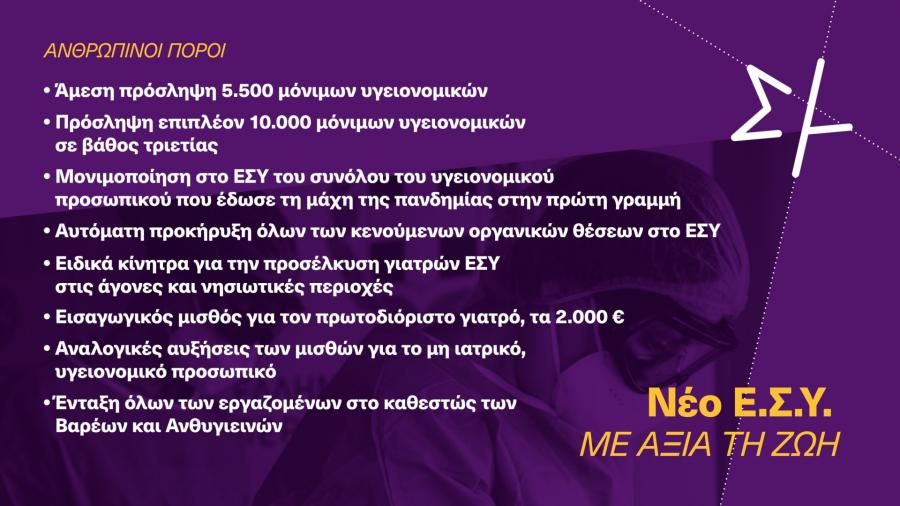
– Immediate hiring of 5,500 permanent healthcare workers who left the system over the past year (in the midst of a pandemic!) without being replaced.
– Hiring an additional 10,000 permanent healthcare workers over a three-year period.
– Permanent employment in the National Health System for all healthcare workers who fought on the front lines during the pandemic.
– Automatic posting of all vacant permanent positions in the National Health System (ESY)
– Special incentives to attract National Health System (ESY) doctors to remote and island areas
– Restructuring the salary scale for medical staff so that the starting salary for a newly appointed doctor is €2,000.
– Proportional pay raises for non-medical and healthcare staff.
– Inclusion of all employees in the Heavy and Unhealthy Work Conditions Program.
Point Two: Primary and Secondary Health Care.
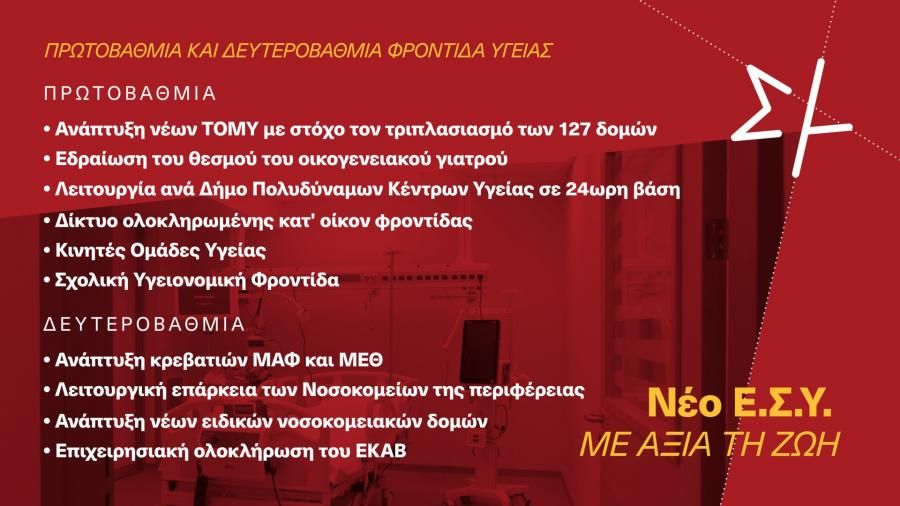
The second aspect of this planned revolution in the healthcare sector involves a significant strengthening of both primary and secondary healthcare.
With regard to primary care, I would like to point out the following:
-A threefold increase in TOMY facilities. From the 127 currently in operation, we are moving toward 380 nationwide.
-The establishment of the family doctor system throughout the country and for all citizens.
-The operation of Multifunctional Health Centers in each municipality.
-The Integrated Home Care Network.
The Mobile Health Teams, which primarily serve residents of remote areas, and School Health Care—through the establishment of School Health Care Teams (S.O.F.Y.) staffed by specialized child psychologists and nurses in schools across the country, round out Primary Care.
Secondary Health Care includes:
-The expansion of ACU (Advanced Care Unit) and ICU (Intensive Care Unit) beds in line with the European average.
-Ensuring that hospitals in the region are operationally capable so as to avoid the large-scale transfer of patients to central hospitals.
-The development of new specialized hospital facilities (oncology, cardiac surgery, pediatrics) based on morbidity rates and the absence of similar units in large geographic regions.
-The operational integration of EKAB, with a nationwide patient transport network utilizing land, air, and now also water-based means of transport.

Point 3: Pharmaceutical Policy and EOPYY
The third key aspect of the reform is pharmaceutical policy:
-With guaranteed access for ALL patients to modern pharmaceutical treatments.
-By supporting domestic research.
-With a significant reduction in the copayment for patients with chronic conditions.

Point Four: EOPYY
-By expanding the services provided to the ENTIRE population.
-With full coverage of medical supplies for uninsured citizens with chronic illnesses, because just as illness does not discriminate, neither should the State discriminate against patients.
-Including coverage for new services, such as dental care for children and adults.

Point 5: National Horizontal Strategies
And now I come to the fifth key point of the NEW National Health System, which is the National Horizontal Strategies for a new Health Services Charter:
And first and foremost, by drawing on the lessons learned from the pandemic,
The reorganization of the country's public health services, with an emphasis on prevention and health promotion.
By establishing a modern epidemiological surveillance system.
Through the decentralization of EODY services and the development of Regional Public Health Laboratories.
By strengthening occupational medicine, occupational health, and environmental health.
Providing health care for vulnerable populations



Wide-ranging discussion
Following the presentation of the plan for the new National Health System, a discussion will take place with the former Minister of Health and head of the SYRIZA-PS sector, Andreas Xanthos, the deputy head of the Health Sector, Dora Avgeri, the professor of epidemiology at the National and Kapodistrian University of Athens, Athina Linou, Professor of Hematology at the Sorbonne, Grigoris Gerotziafas, Professor of Health Policy at the LSE, Ilias Mosialos, Professor of Medicine at Harvard, Othon Iliopoulos; Dimitris Anagnostopoulos, Professor Emeritus of Child Psychiatry; Athanasia Pappa, President of the «ELENA» Association of People with Rheumatic Diseases; Athanasia Pappa; the President of the Evros Cancer Patients Association and Deputy Secretary of the Hellenic Patients’ Union, Evi Orfanou; and the Registered Nurse at the University Hospital of Thessaloniki, Katerina Kerama.
The discussion will be moderated by journalist Michalis Kefalogiannis.







Below is the full text of Alexis Tsipras’s opening remarks