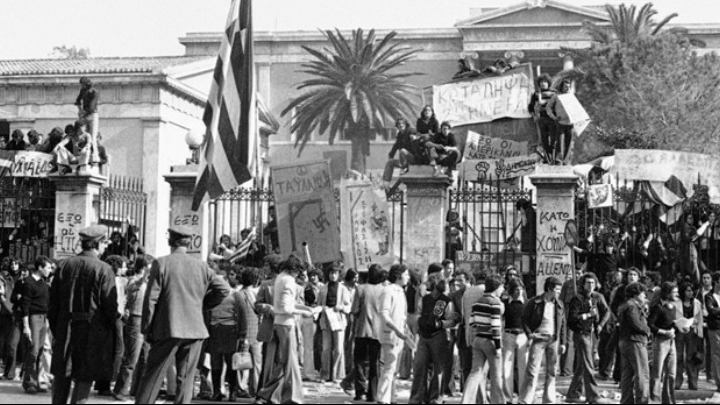
Fifty-two years have passed today since the students' uprising at the Polytechnic, and specifically since the dawn of 17 November 1973, when one of the army tanks that was lined up on Patission Street moved towards the iron door of the Polytechnic, demolishing the entrance of the institution and falling on the students standing behind the door.
The occupation of the Polytechnic in November 1973 and its bloody end was a symbol of the struggle for freedom and resistance to the dictatorship, which eight months later, in July 1974, led to its downfall.
The first anniversary of the Polytechnic uprising coincided with the first post-independence elections, which took place on 17 November, and so the official commemorations took place a week later, with a massive march to the US embassy.
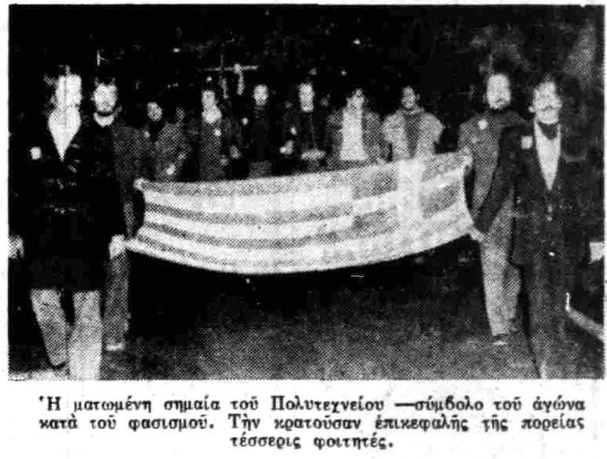
The second anniversary, however, was the first time that the bloodstained flag of the uprising was at the head of the march, held by the members of the Central Council of the National Student Union of Greece (NFEE).
APE-MPE spoke with Vangelis Ziogas, a PhD candidate in Modern and Contemporary Greek History at the National and Kapodistrian University of Athens, about the contribution of the EFEE to the conduct of that course, but also in general to the post-communist course of the country.
Post-independence, the anniversary of the Polytechnic and the student movement: The contribution of the EFEE to the 17 November 1975 march
«The anniversary of the Polytechnic in 1975 is a prime example of the contribution of students and especially of the EFEE to the consolidation of the Third Hellenic Republic,’ Mr.
«Its massiveness proved that the cosmic flood at the November ’74 anniversary celebrations was not a passing moment. On the contrary, it was becoming clear that the anti-dictatorial struggle was being established as one of the fundamental axes of “a mythology of post-independence” in which youth occupied a dominant position. In this context, especially in the first years after 1974, the participation of young people in political and social struggles was not simply perceived as an enthusiastic expression of age momentum, but as a credible and structured contribution distinguished by a high level of organisational competence and theoretical elaboration. The conduct of a peaceful yet massive march such as that of 1975 came to confirm this feeling,» he added.
As Mr. Ziogas explained, the student organisations, emerging from the violent period of the dictatorship, «assumed a primary role not only in the trade union reconstruction of the youth, but also in the broader social mobilisation that characterised the first years of the post-independence period».
«The participation of the students in the Polytechnic uprising had given a special prestige to the student movement, whose legal action after July 1974 confirmed the continuation of its largely pioneering function. Its interventions included issues that went beyond the purely academic boundaries, covering central public debates of the time, such as the dehumanization of state mechanisms, developments in the Cyprus issue, Greek-Turkish relations, Greece's position in NATO and its possible accession to the EEC», he noted.
Mr.Ziogas described the convening of the first National Student Council, in May 1975, and the subsequent election of the first Central Council of the EFEE, the highest student union body, as a «decisive milestone» in this process. George Stamatakis of the KNE, a person with a strong activity both during the dictatorship and in the early post-coup years, was elected President of the Council.
«This development marked the institutional restoration of the EFEE, which during the seven-year period was under the full control of the regime, with officials appointed directly by the junta, without elections. After its formation, the new Council took over the coordination of the most important student activities and initiatives.
In this context, perhaps the first major test that the EFEE had to face was the organisation of the march for the anniversary of the Polytechnic on 17 November 1975. «The mobilisation took on special significance as it was the first time that the march would be held on the day of the anniversary given that the previous year, the celebrations had been postponed to 22-24 November due to the holding of the parliamentary elections a week earlier,» explained Mr Ziogas.
As in 1974, so in 1975 the march as a memorial practice was widely accepted. «It is no coincidence that the long hours of the march were covered by the entire daily press with extensive front-page reports, with all publications from all political parties - except the far right - paying tribute to those who fought for the fall of the junta», Mr: «As for the volume of the demonstration, estimates varied. Some newspapers spoke of up to a million demonstrators, while other sources suggested lower figures, though always in the order of several hundred thousand. The US embassy, which estimated around 350,000 participants, is typical. Despite the variations in estimates, there is no doubt that this was one of the largest public demonstrations of the post-war period. At the same time that thousands of citizens were on the pavement, a special session was being held in the Parliament where representatives of the government and the opposition were speaking about the importance of the anniversary of the Polytechnic as a major act of resistance against the dictatorship.
The demonstration was led by student youths: KNE, PASOK Youth, «Rigas Feraios» and students of the extra-parliamentary Left had the most massive and most vocal presence, actively contributing to the character of the march.
«The homogeneity of the formations, the flags, placards and banners, as well as the intense rhythm of the slogans, made the youth formations the centre of gravity of the mobilisation, especially when the blocks arrived outside the building of the American Embassy», Mr.
Apart from this, however, a distinctive feature of the 1975 march was the appearance, for the first time, at the head of the march of the «bloody flag of the Polytechnic». «It was an act that was not just a symbolic reference to the events of 1973, but laid the foundations for the formation of a historical genealogy of the student movement,» Ziogas pointed out. «The fact that the flag was carried by prominent members of the student movement underlined the connection between the memory of the uprising and the protagonists of the present student action and the role of youth in the new democratic reality,» he continued.
The EFEE had ensured that extensive security networks were deployed to ensure the unhindered movement of all demonstrators and to avoid unnecessary tensions, and thus the 1975 march was completed smoothly, without any incidents to disrupt the march. Given today, it contributed not only to the establishment of an institution, but also to making youth an important and credible agent of dialogue in the socio-political life of the country.
Athena Kastrinaki
*Photos from the newspaper «Eleftherotypia» of that time