
The global lead achieved by our country in terms of business complexity, as reported in the TMF Group's annual report, should now be cause for alarm, becoming the focus of reflection and concern for Greece's political personnel. Instead, politicians continue to ignore the serious problems that, as long as they remain unresolved, will lead to a dead end, focusing instead on petty squabbles that bring temporary party benefits.
The full title of the report is: «Global Business Complexity Index 2025: Sink or Swim.» Perfect. He couldn't have put it more clearly.
The Global Business Complexity Index (GBCI) provides a detailed analysis of the complexity of procedures related to establishing, operating, and growing a business in 79 different countries around the world. By identifying the factors that lead to success or failure, this comprehensive overview focuses on both the current situation and key global trends, as well as local peculiarities that affect the economies under consideration.
GBCI 2025 is based on 292 indicators of business complexity, with this data being used to create a global ranking based on the complexity of the business environment in the 79 countries examined. Covering legislation, regulatory compliance, accounting procedures, tax regimes, human resource management rules, and payroll procedures, the latest edition of the GBCI aims to serve as a reference point for companies planning to expand into new markets in the coming years. And the picture for our country is disheartening, to say the least.
As we can see in the following table, Greece rose from 6th place in 2022 to 2nd place in 2023, then climbed to the top in 2024 and remains in first place in 2025.
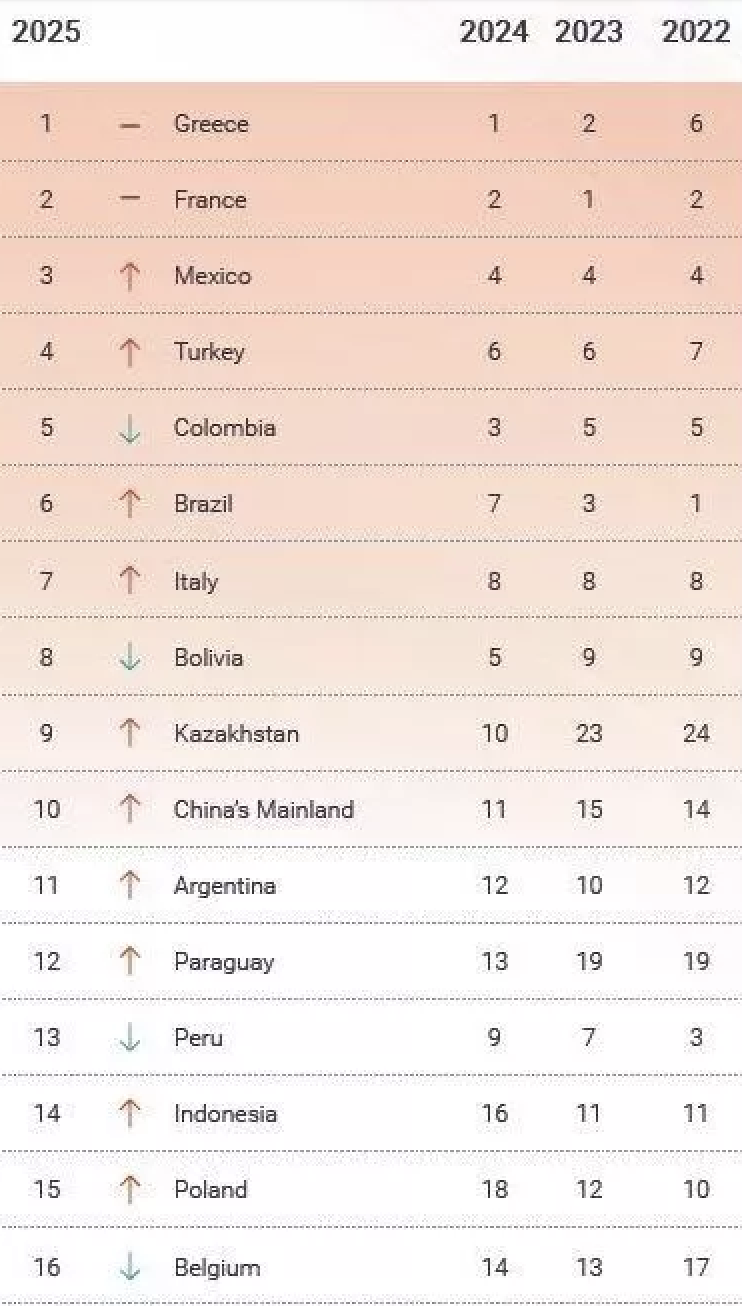
Greece maintains its position as the most complex jurisdiction for entrepreneurship in the world. The country remains unwelcoming to multinational companies. Not only because of its size, as it is a small market. But also because it faces difficulties, even in becoming a hub for the regional expansion of multinational companies. This is something it could achieve due to its location in the Balkans and Southeast Europe, as well as its geographical proximity to the Middle East and Africa, with the comparative advantage of being a European Union country.
According to the report, what is the reason for this sad reality? To constant and ongoing legislative changes, particularly in the areas of accounting and tax (A&T) and human resources and payroll (HRP), which are becoming increasingly complex and complicated. Instead of becoming simpler, these changes are becoming more complex and intricate, requiring significant financial expenditure and investment in technological support and regulatory compliance. In the report, the MyData electronic bookkeeping system, introduced in 2024, is cited as the most characteristic example of these requirements, with compliance costs being particularly high, placing a significant burden on smaller businesses.
This transition to electronic bureaucracy, although intended to simplify operations, has added complexity — at least in the short term — along with the other 292 indicators of business complexity that already weigh heavily on our country. Therefore, things are becoming more difficult rather than simpler.
For businesses, these complexities inevitably lead to higher costs and the allocation of additional human resources to comply with the new requirements. Smaller businesses may find it difficult not only to compete but even to survive, discouraging new investment or expansion. In the long term, while there is optimism that the difficulties will eventually be resolved, the current environment may deter potential investors due to the high initial compliance costs involved.
The GBCI 2025 report also focuses on the creation of resilient routes and trade routes at the international level. Because in an ever-changing geopolitical landscape, the development of resilient routes and trade lanes facilitates the continuous flow of goods, offering comparative advantages to the economies that have them.
With regard to Greece, the report states that sea routes dominate, with recent investments in major ports signaling improvements in the services offered to global businesses. However, it notes that improvements to road and rail networks are progressing very slowly, acting as a deterrent to businesses that would choose our country for their operations.
GBCI 2025 refers to «electronic bureaucracy.» It argues that what we are experiencing is a transition from traditional bureaucracy to electronic bureaucracy. This includes the existence of multiple online platforms for different submissions to tax and supervisory authorities, each of which requires a different way of entering and managing data. So instead of visiting each department of the tax or supervisory authorities in person, as was the case in the past, we navigate different digital environments that are not particularly user-friendly.
In other words, instead of reducing bureaucracy, we are replacing it with digital procedures that are just as complex. The report states that this new digital transition is likely to improve over time. However, it is currently in its early stages, causing difficulties for businesses and increasing the resources required for them to comply with government requirements.
While Greece remains the most unwelcoming country for international business, competing countries that are just as eager as we are for investment, mainly from foreign companies, are presenting a better and more attractive profile. Spain is in 17th place, Croatia in 19th, Romania in 24th, Slovakia in 31st, Hungary in 32nd, Slovenia in 33rd, Serbia in 35th, Bulgaria is in 40th place, Cyprus is in 63rd place, etc.
Reading the names of the countries and their positions in the GBCI 2025 list brings us back to the question posed in the title of this report. «Sink or swim.» Are we sinking or swimming?;