The current geopolitical developments in the international system following her assumption of the position governance of the U.S. by Donald Trump, are turning the global community upside down.
According to the 2025 Munich Security Report: «In today’s multipolar international system, there is an ongoing shift in power toward a larger number of states, where, in addition to the two superpowers, play a significant role in the international order and compete to gain greater power and influence.».
Also, in addition to the existing threats (regional conflicts, terrorism, migration, proliferation of weapons of mass destruction, disruptive technologies, climate change, the geopoliticalization of strategic resources, etc.), In addition to the challenges the world faces today, there is also ideological polarization. According to this report, political and economic liberalism—which shaped the unipolar era following the Cold War—is increasingly being challenged from within., as evidenced by the rise of authoritarianism, nationalist populism, isolationism, economic competition, and the adoption of unilateral initiatives to increase the political power of international state and non-state actors.
Η most significant impact resulting from the above changes in the international system However, the fact is that the multilateral system of global governance, which has dominated international relations for nearly eight decades, is being called into question, and the rules-based international order that has prevailed until now is being discredited, with the result that international law is being violated in favor of the law of the strong.
Therefore, considering that The actions taken so far by the major players in the international system are undermining the existing international order It is clear that the global community is heading into uncharted waters.
Η survival In this new global reality, what is required above all is, a deep understanding and analysis of changes that are taking place.
In this light, it should be noted that strategic alliances such as The U.S.-Europe alliance is undergoing a major identity crisis.
The U.S. strategic decision to scale back its involvement in the defense alliance, which has safeguarded peace in Europe for nearly eight decades, may signal the the end of an era for the U.S.-Europe partnership, which was based on shared values and principles.
The principles that the U.S. has espoused thus far on opposition to territorial expansionism, the protection of the inviolability of borders, the rejection of the use of force, the reduction of trade tariffs, and support for international cooperation to achieve economic and social prosperity, appear to be being nullified, dealing a serious blow to the international order.
It seems that, The new U.S. president does not view global events in geopolitical terms, but rather in market terms, where everything is a constant negotiation aimed at securing profit.
Mr. Trump, always thinking in market terms, realizes that when his country has a debt of $34 trillion, it is U.S. involvement in the Russia-Ukraine war is economically unwise And for that reason, he announced his country’s immediate withdrawal, calling for an immediate ceasefire at any cost.
He believes that the war has been decided on the battlefield and that there is no way Russia will lose the Ukrainian territories it has captured so far.
As a hard-nosed realist and, at the same time, a rationalist, Mr. Trump knows that in order to reverse the current situation in Ukraine, there must be military involvement of the U.S. and NATO member states, which would mark the start of World War III and it would be disastrous for both the U.S. and the rest of the world.
Mr. Trump believes that the main threat to the U.S. today is not Russia, but China.
China is a global competitor to the U.S., where it is constantly growing economically, is becoming a military powerhouse, and is poised to become the voice not only of the countries of the so-called Global South but also of the United States’ other rivals.
Furthermore, as Professor Athanasios Platias points out (see his article in *VIMA* titled “Washington’s Disengagement”), «Beijing's strategic axis –Moscow axis gave China the competitive advantage of cheap energy, while securing its land borders from threats and providing it with strategic depth. Thus, China turned its attention to the seas, threatening U.S. maritime supremacy.».
In this light, Mr. Trump chose to usher in a new era in U.S.-Russia relations, seeking multiple benefits on both the geopolitical and economic fronts. Finally, he considers it of the utmost importance for himself and his country to to free Russia from China's sphere of influence.
Given the new circumstances, despite efforts to date to forge political unity and strengthen the Common Foreign and Security Policy (CFSP) at the European Union level, Europe has certain distinctive characteristics that influence its leadership role in the international system.
- While efforts are being made to achieve the European Union’s (EU) strategic autonomy, the United States serves as the guarantor of European security through NATO.
- The EU lacks the capacity to develop a Common Security and Defense Policy (CSDP) that would enable it to become a reliable provider of security.
- Europe's nuclear arsenal is too small to serve as a deterrent, especially against Russia.
- Europe's energy dependence on Russian fossil fuels is a significant strategic and political weakness.
- The member states of Europe do not share a common understanding of the challenges and threats facing Europe. For example, for Greece, the main threat is Turkey, while for the United Kingdom and the Baltic states, it is Russia.
Despite the above-mentioned imbalances in European security, current developments in the new geopolitical environment represent Europe's last chance to invest in its defense and security in order to achieve strategic autonomy and strengthen its geopolitical footprint in the international system.
In this context, The EU is required to accelerate the implementation of its Compass Strategy (Strategic Compass) to strengthen the EU’s defense and security policy by 2030, to create a reliable European defense industry and the EU’s rapid deployment capability, as a precursor to a European army.
Only if the EU's strategic autonomy is ensured, its member states will gain the ability to cooperate with partners to protect their values and interests and to play a more significant role in maintaining international peace and security.
In addition to a deep understanding and analysis of the changes taking place in the world, in order to survive In this new global reality, a strategic readjustment is also required.
In this context, Greece in addition to an awareness of the international environment it needs to make the necessary strategic adjustments to its foreign policy, in order to ensure its sustainability and growth.
In this new, rapidly changing world, I believe that Greece must move forward in two parallel directions.
Given that the international community has proven incapable of addressing the current challenges and threats to the international system, Greece must take the lead in international initiatives aimed at renewing states’ commitment to international law and reforming the multilateral system of global governance.
Greece must make the most of its position as a non-permanent member of the UN Security Council and to help strengthen the international community’s ability to resist destabilizing forces that seek to replace international law with the law of the strongest and to change the rules and values of the current system of governance.
In light of this, Greece must strongly support United Nations General Assembly (UNGA) Resolution A/RES/79/1, titled «The Pact for the Future», which demonstrates the international community’s commitment to reforming the rules-based international order in order to address the serious challenges facing the world today.
The second direction Greece should take is based on the traditional realist approach to international relations and relates to the country’s alliances.
Given the intense competition among the actors in today’s multipolar international system and their quest to replace international law with the law of the strongest, In order to survive, Greece must invest even more in its strong alliances (the U.S., Israel, France) and strengthen its strategic relationship with them.
A key prerequisite, however, for achieving the national targets based on these two guidelines is Greece must immediately address its vulnerabilities, which act as a hindrance and undermine Greek foreign policy and national interests.
For a long time now, Greece has been the target of hybrid operations carried out by powerful centers of power both within and outside Greece, which seek to undermine and directly destabilize the country.
Η A key long-standing vulnerability of the country is the information and psychological operations that have been underway for some time now by these centers of power, with the aim of scrutinizing political narratives designed to manipulate and misinform the Greek people, so as to cause them to withdraw their trust and support from Greece’s political leadership.
To illustrate this point, I will cite some examples of narratives that have recently been put forward by the domestic bodies of these centers of power.
Following the European elections, both the Prime Minister and the Minister of Foreign Affairs faced intense criticism for their policy of engagement with Turkey, with critics labeling them as national sellouts and traitors.. None of them, however, mentioned the fact that, when it was necessary in 2020, the same political leadership effectively defended national rights and national sovereignty, while at the same time sending a strong message of deterrence to Turkey.
The question that needs to be asked in order to dispel misinformation is, How is it possible that some traitors are so staunchly defending our country's national security?.
The second piece of misinformation concerns the country’s decision to support Ukraine’s just struggle to defend its national independence against an aggressor who, in violation of the rules of international law,to impose the law of the strong. The misinformation regarding Greece’s shipment of weapons to Ukraine also falls within this same narrative, thereby undermining the security of the Greek islands.
As I pointed out in a previous article, although we were asked to do so, Greece did not provide tanks, F-16 fighter jets, or even anti-aircraft systems. The minimal amount of military equipment it did provide was unnecessary; its withdrawal and destruction by the armed forces would have cost many millions of euros, and the security of the Greek islands was not compromised.
The very same people who accused Greece’s political leadership of making the above choices are now accusing Prime Minister Kyriakos Mitsotakis of allegedly weakening Greece’s international standing and why Greece was not invited to the “Summit of the Willing” convened by British Prime Minister Mr. Starmer in London on March 2, 2025.
The fact that the Greek prime minister's absence was the result of a strategic national decision, no one mentions it because it doesn't fit the narrative of misinformation.
But even if it wasn't a strategic choice, I pose this question to all those spreading misinformation. Is Greece willing? Is it prepared to send troops to Ukraine?;
Last Thursday, March 5, 25, Russian Foreign Minister Sergey Lavrov, according to the Russian news agency TASS, told Mr. Macron that The presence of European forces in Ukraine would mean an immediate war by European countries against Russia.
Let those who are spreading this propaganda rhetoric answer us. Do they want Greece to go to war with Russia over Ukraine? If they do, let them come out and tell us.
Let every well-meaning reader consider, then, what an uproar would be caused by those same propagandists and the paid mouthpieces of foreign power centers in Greece, if the Prime Minister had participated in this “Summit of the Willing” on the topic of sending Greek troops to Ukraine.
In addition, Great Britain is outside the EU. and has launched a unilateral initiative primarily to explore the willingness of countries to participate in a potential peacekeeping mission in Ukraine, which is a cause of war for Russiaand, secondarily, to strengthen its geopolitical footprint in Europe following the U.S.’s strategic decision to withdraw.
Would the Greek Prime Minister’s participation in this summit be in Greece’s interest, given that what Europe needs is for decisions to be made within the European framework?;
Finally, there is a great deal of misinformation circulating regarding the participation of Turkish Foreign Minister Hakan Fidan in this summit and the possibility of Turkey’s participation in European defense.
The possibility that the Greek Prime Minister did not go to London, because he considered the invitation to Turkey—which has committed exactly the same acts as Russia in Ukraine—to be hypocritical and offensive, and because no one mentions Turkey’s invasion and occupation of northern Cyprus, and also because it does not serve the propaganda narrative.
With regard to Turkey’s participation in European defense, the public should be made aware that this aspiration on Turkey’s part is not new. For more than four years, Turkey has been unsuccessfully pursuing this goal due to the firm stance of Greece and its allies.
To prove the point, the author of this article, on October 18, 2022, participated as Director General of the General Directorate of National Defense Policy & International Relations (GDNPIR) of the Ministry of National Defense, at the EU Defense Policy Directors’ Meeting held in Brussels, I emphasized to my counterparts that Greece would under no circumstances advocate supporting the Turkish defense industry or the procurement of Turkish military equipment through the European Peace Facility (EPF), given the collective nature of this mechanism, with contributions drawn from the national budgets of the member states.
The same is true today. In addition to Greek Prime Minister Mitsotakis, French President Macron is also opposed to such a prospect and has openly disagreed with his German counterpart.
The same propaganda and disinformation campaign is currently being waged regarding the Greek Prime Minister’s relationship with U.S. President Mr. Trump, despite the fact that the Greek Foreign Minister, Mr. Gerapetritis recently had a highly successful meeting with his counterpart in Washington, and an official visit by Mr. Mitsotakis to the White House is being prepared.
Given the length of this article, I am unable to discuss in detail the narratives of this disinformation campaign in order to deconstruct them through reasoned arguments. Perhaps I will return to this topic in another article of mine.
To summarize my remarks on the aforementioned hybrid campaign—which seeks to destabilize the country through information and psychological operations—I would like to emphasize once again the the need to strengthen national resilience.
In conclusion, in this new, rapidly changing world, Greece has nothing to fear, because its strategic choices to date have proven to be the right ones.
A crisis, aside from the hardships it causes, also creates opportunities.
What What Greece needs to do is play a significant role in reforming the multilateral system of global governance and strengthen its relationship with its strategic allies and to capitalize on the strategic opportunities that arise, so that, through the pursuit of a more active and multifaceted diplomacy, it can expand its geopolitical footprint.
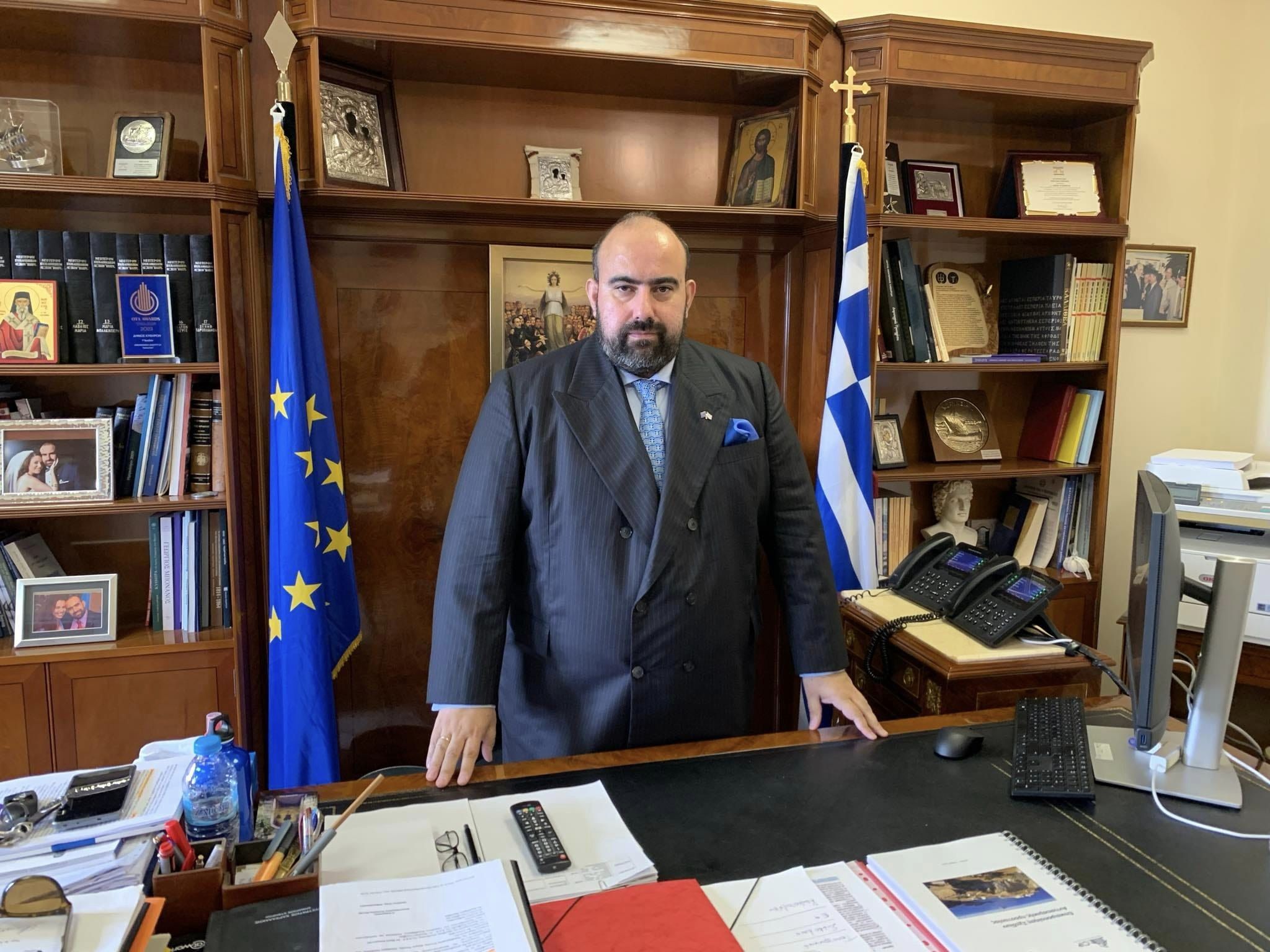
Dr. Konstantinos P. Balomenos
Political Scientist – International Relations Specialist
Former Director General – Directorate General for National Defense Policy and International Relations (DGNPIR) of the Ministry of National Defense (MND)