By Natalia Petriti
At one time, the Nikos Koundouros in an interview regarding his artistic work said: «One time Finos said a great word to me: «If it weren't for me, that is, my films, you, Nico, you wouldn't have workshops to develop your material, you wouldn't have studios to do your recording, to develop your films.» He was absolutely right, because Finos maintained for us, the machines, the whole infrastructure. And when I say «us» I mean a limited world that was making a different kind of film.»
In fact, the Philippine Finos was not only one of the people of the «other cinema», but rather the same the incarnation of the 7th art in the Greek space.
Philippine Finos was born on January 26, 1908 in Tithorea Locris. Born into a middle-class family, he settled in Athens when he was still in infancy. His father, although a doctor, was one of the best-known film businessmen of the time, owning cinemas in Athens and the provinces, most famously the Alcazar, the largest and most important summer cinema in Athens. The Philopoimin, would receive at the Alcazar the first impulses of the art of cinema.
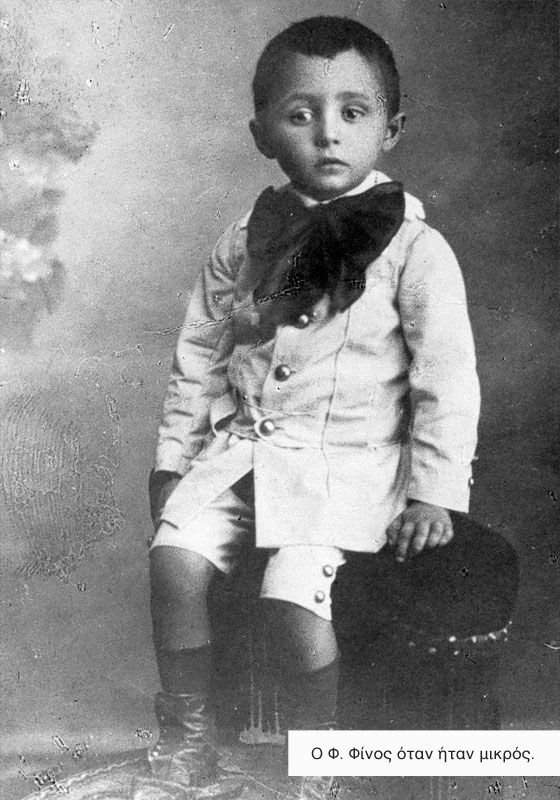
He studied in Ionian School as an inmate, but he graduated from the public «Athenian Lyceum of Megareos». From childhood, he loved the art of acting and even organized with teenagers of the same age an amateur and recreational club, the «Youth», with which they gave a few theatrical performances in Kotopouli Theatre. At the same time, he was very fond of literature and from his school days he was still involved in journalism. He pursued theoretical studies, studying law in Athens and continued with a master's degree in political science at the University of Athens. Germany, but degrees that he would never need in his professional future.
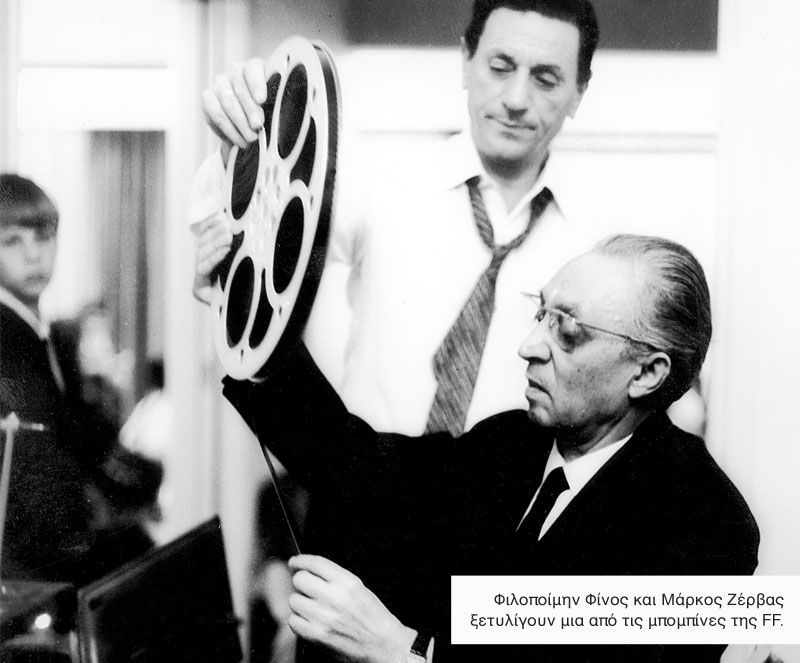
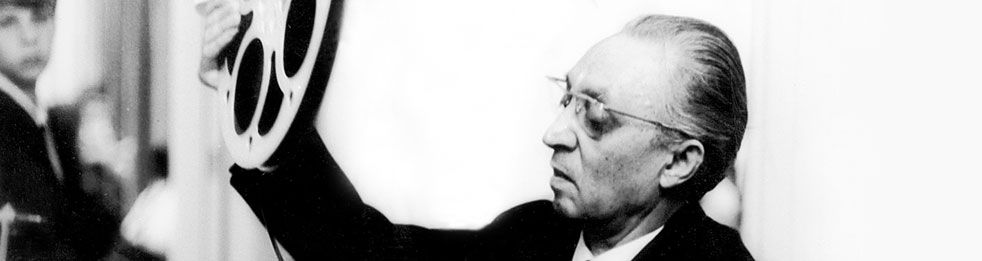
This is because, during his studies, he worked as a projectionist at the Alcazar cinema. It was in the projection booth of the Alcazar that his passionate relationship with cinema and its technique was forged, which led him to persistently study physics, optics and mechanics in order to expand his knowledge and apply it by dismantling and reassembling every piece of equipment he could get his hands on. In the future, Finus' nickname would be «cockroach», because of his obsession with repairing his company's film equipment.
In 1930, he managed to create and install a sound machine in the Alcazar. Finos' next challenge was to build a sound machine that would enable the creation of primary talking films without duplicated sound. This would become a reality in 1935, despite his meagre resources, and the filming of the film would begin at the same time «Watered Down Wine», which was never completed.
In 1938, Finos would establish the «Greek Film Studios» in Kalamaki, with his chosen collaborators Skouras, Provelengio, Chloidis, and the Drimaropoulos brothers. Together, they would achieve their coveted goal, releasing the first talking Greek film production. In April 1940, the film was released in cinemas. «The Song of Separation» in a scenario Dimitris Bogris. Finos, in addition to being responsible for technical matters, would become a director, for the first and last time.
In the autumn of 1940 he rents an old three-storey building in the centre of Athens, on Stournaras Street. On the third floor he sets up, with his wife Jella, their home. The rest of the building was converted into a film studio to house the film business he intended to establish. But before he could put his new plans into operation, the Greek-Italian war would catch up with him.
Finos together with old colleagues are presented in the Army Geographical Service, setting up a downloading crew of the Epikara in Albanian Front. The films they make for Epikaira, capturing the exploits of the Greek army, fascinate and inspire the world.
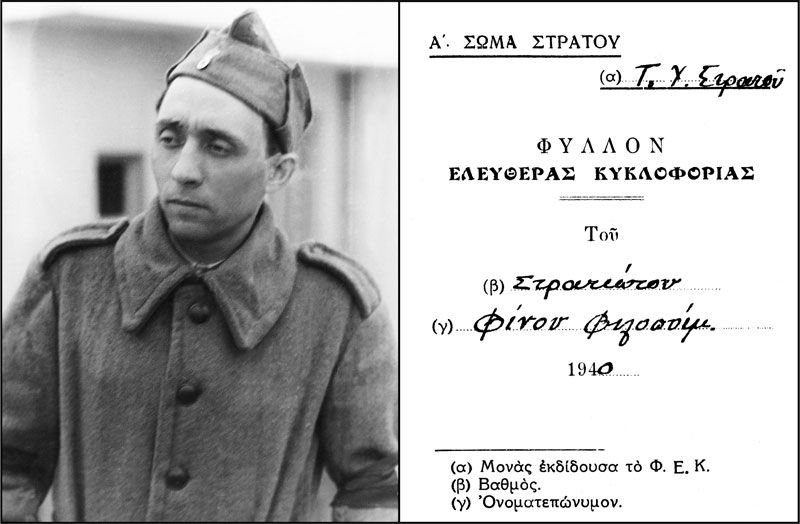
But in April 1941, the German occupation would stop the valuable work of the team. The Germans destroyed the film equipment of Finos, but also the negatives of the scenes of the Albanian front. The studios in Kalamaki would then be completely destroyed. However, Finos would manage to salvage some negatives from the archive, which to this day constitute unique historical documents.
In the winter of the same year and in his attempt to regroup amidst the difficulties of the occupation, Finos filmed, together with his friend Dimitris Ioannopoulos, the census of the population for the needs of a short film inspired by himself, which would show the procedures of the modern census. The film showed significant improvements for Greek standards, both in image and sound.
After the promising short film and together with Ioannopoulos, they were going to make a feature film, based on a script that Ioannopoulos himself had written. Their aim was to put all of Finos' passion, passion and technical knowledge to work, while avoiding all the mistakes of their first experience. Ο George Kavoukidis, a friend of Finos, would trust them, financing their work by 50% (the rest would be available to Finos after the sale of some of his father's fields).
The shooting of the film «The Voice of the Heart» lasted about a year of hard perseverance, as Finos, among other things, took care of feeding everyone involved in the filming. The film starred the stage actor, Amilios Veakis, who had then only played in one silent film, «Astero», but also actors such as Alekos Livaditis and Lambros Constantaras.
This was Finos Film's first official film and its success was magnificent. As Finos himself had pointed out: «The film was a national triumph.» And the facts bear out this claim. The premiere on March 29, 1943, seemed like a resistance event, with the theatre hall REX on the street University filling up to capacity. After the end of the performance, the enthusiastic spectators carried a torchlight procession from the cinema to the columns of the Olympic Zeus.
With 102.237 tickets sold in the two cinemas where it was screened and with rave reviews, «The Voice of the Heart» is the starting point of modern Greek Cinema. Its enormous success prompted Finos to continue and start his exciting journey, with the FF brand entering the collective consciousness as the ultimate symbol of the «Golden Age of Greek Cinema».
In early 1944, the Germans arrested Finos and his father, who was supplying resistance units with wheat and barley from his farms in Kopaida. The court martial sentenced both of them to death. But thanks to his father's persistence in convincing the Germans that his son had nothing to do with it, Philopoimin was released from the Averoff prison, under the term «voluntary donation of his assets to the occupying forces». Shortly afterwards, in July 1944, Finos' father was executed by the Germans.
During his 33 years at Finos Films, Finos has been fully committed to his work. He had no social life and was not interested in social appearances and public relations. He never sought help from the state, and whatever money he earned from his films was invested in subsequent ones. His only property was an apartment in his partner's name, Jellas Vanakou. They were married in 1947 at his mother's house, having been a couple since just before the war, and their best man was Finos' friend and favourite collaborator, Alekos Sakelarios. Jella Vanakou herself had said «He had given his whole life and dedicated it to cinema alone. The house, the fun, the entertainment was second to us».
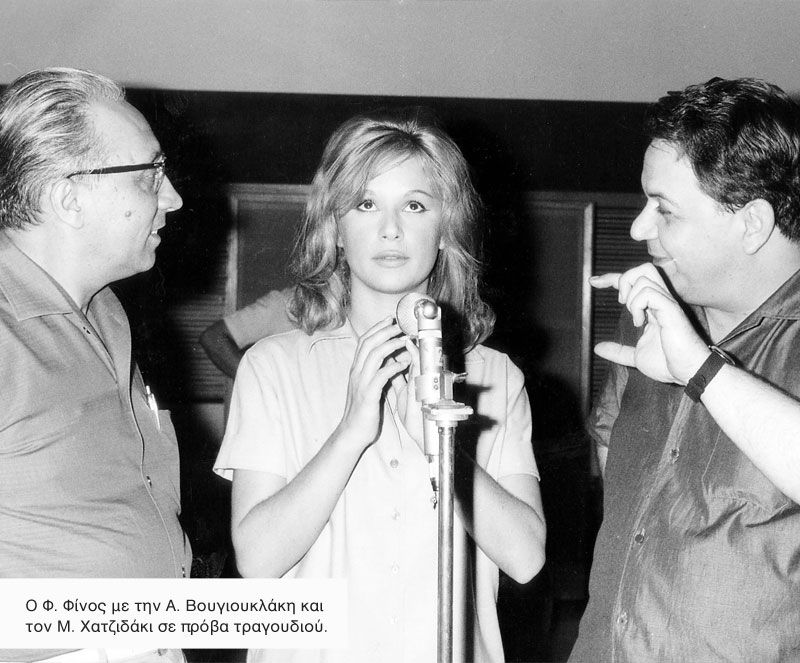
Finos had stated in an interview that his aim was to create good, commercial cinema - something he had achieved completely. Moreover, he had lost a lot of money the times he had invested in more «artistic» productions that he had believed in. However, he always helped and supported filmmakers who had deeper artistic aspirations.
Philopoimin Finos was one of the most important figures in the modern cultural history of our country. His work is a universal model of «mass culture», without this implying a low artistic level. He himself had even stated that «In the end, the canvas speaks».
The distinctions of Finos
–In 1930 he built a sound machine and installed it in the Alcazar summer cinema, resulting in the first screening of a talking film in a summer cinema in Greece.
-In 1935 he built a Greek sound machine with the valuable help of his friend, an electronic engineer by profession, John Salliveros, thanks to which it became the first talking film in Greek Cinema, «The Song of Separation». The production was made by «Dark Film».
-The filming of the «Epikaira» on behalf of the Army Geographical Service», which were printed and displayed on Finos' own machines. Whatever documentary material exists today from that time is due to him and his team.
-He filmed the unique document of a German soldier planting the Nazi flag on the Acropolis before the conquerors left Greece.
From 1943 to 1977, Philippine Finos made a total of 186 productions. He was for many years a member of the committee of the Thessaloniki Festival and served as president of the Greek producers. In September 1962, Filopoimin Finos refused the position of Technical Director at the leading film company Metro Goldwyn Mayer, stating with humour «In Hollywood they wouldn't let me poke the cameras with my screwdriver» and «They make movies with their minds over there, here we make them with our hearts».
Among Finos' distinctions are the following:
1. The duplicate-doubling method used for the first time in Greece in the film «The Purity of the Harbour» in 1952.
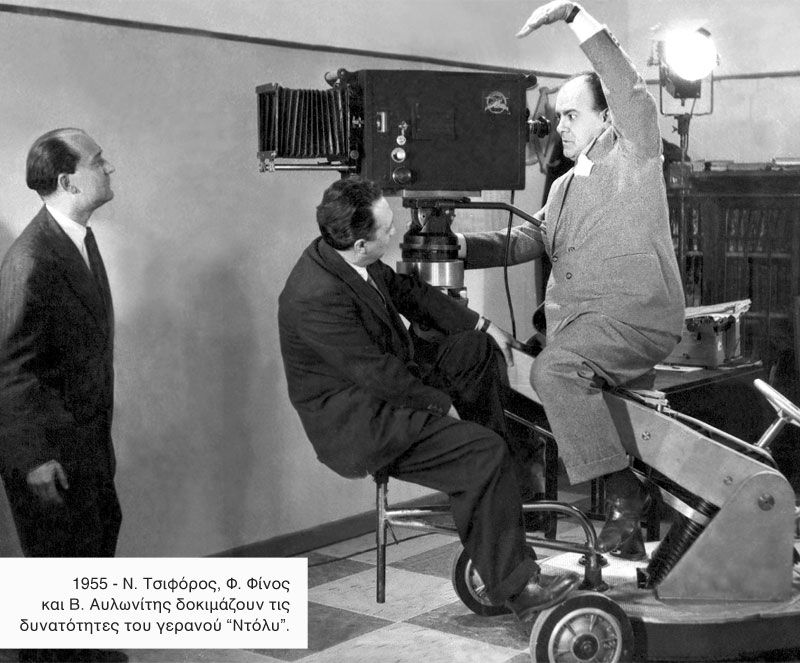
2. The use of the crane «Dolly» for moving camera, which he brought to Greece in 1954.
3. His award from the Swiss film company Gevaert in 1961, for his technical contribution.
4. The musical genre, which Finos was the first to support in Greek cinema with the film «Some prefer it cold» (1963).
5. Zoom lenses, first used in the film «No Identity» (1963).
6. The Cinemascope technique, used by Fino for the first time in colour film «Something to Burn» (1964).
7. His award from the Ministry of Industry in 1970, for his thirty-year contribution to Greek Cinema.
8. The ultra-modern - for that time - studios in the Spata, with its huge screens, opened in 1970 and was considered one of the best in Europe.
For Fino they said:
«Finos was a very sweet man, a cinephile. He was a missionary, where cinema was his religion.» Nikos Mamagakis (Musician)
«Many times Fino and I would watch moving films together and I would watch him crying. With the children he was a child. He was never a boss. He advised children, people. He worked day and night. He had a love affair with cinema.» George Kavoukidis (Photographer)
«Finos was what we call a good payer. Once I needed it and he lent me a grand and he never agreed to let me pay him back. Unforgettable!» Nikos Xepapadakos (Makeup artist)
«After Finos» death, cinema was over for me." Zoe Laskari (Actor)
«We can only remember him...» Alekos Sakellarios (Director)
«Finos» life was the cinema, the actors we worked with, his technicians, his staff."
Aliki Vougiouklaki (Actor)
«All the way through my time at Finos Film, my relationship with Finos was almost paternal. » Pantelis Voulgaris (Director)
«He did his duty as a man, as a creator and as a Greek. The nation owes him much and art owes him much more.» Manos Katrakis (Actor)
«Finos» adoration of cinema was unprecedented and this is something I had never seen in my life and will never see again." Nikos Kourkoulos (Actor)
«Finos had passion. If there was a film chair at the Academy, he was the only one who deserved it.»
Dinos Dimopoulos (Director)
«I don't think there was an actor who acted in a Finos film and didn't love him. We respected him and loved him for his passion and for the passion he had for his work.» Alekos Alexandrakis (Actor)
«He always moved me because he had a passion for his work. I never saw him sitting behind a desk, but always tinkering with his assistants. Many times when I wanted to see him and was told he was screwing or unscrewing a machine, I would walk away because I knew it was a sacred moment for him.» Manos Hadjidakis (Composer)